The killing thing about desert heat is not only how high the number climbs but how long it holds and how dry it is. This is Mojave country, which includes the hottest ground on Earth; the world's record air temperature, 134 degrees Fahrenheit, was set at Death Valley in 1913, not far from here as deserts measure distance. Sitting up above 3,000 feet takes the worst edge off, but the summer still runs extreme, and it runs that way for a specific reason.
The air is the reason. With almost no water vapor in it, the same dryness the rain shadow leaves behind, there are few clouds and little moisture to absorb or soften the sunlight, so by day the ground takes the full solar load with nothing between it and the sun. That clear dry air is also why the nights fall so far and so fast, because the same emptiness that lets the heat in by day lets it radiate straight back to space after dark.
For a body, the heat and the dryness are one problem, not two. The only way to shed that much heat is to evaporate water, and water is exactly what this country will not spare. That is why so much of the desert's life answers the heat by hiding from it, going to shade, to burrows, to the night, rather than sweating through the day. Cooling costs water, and water is the whole budget.
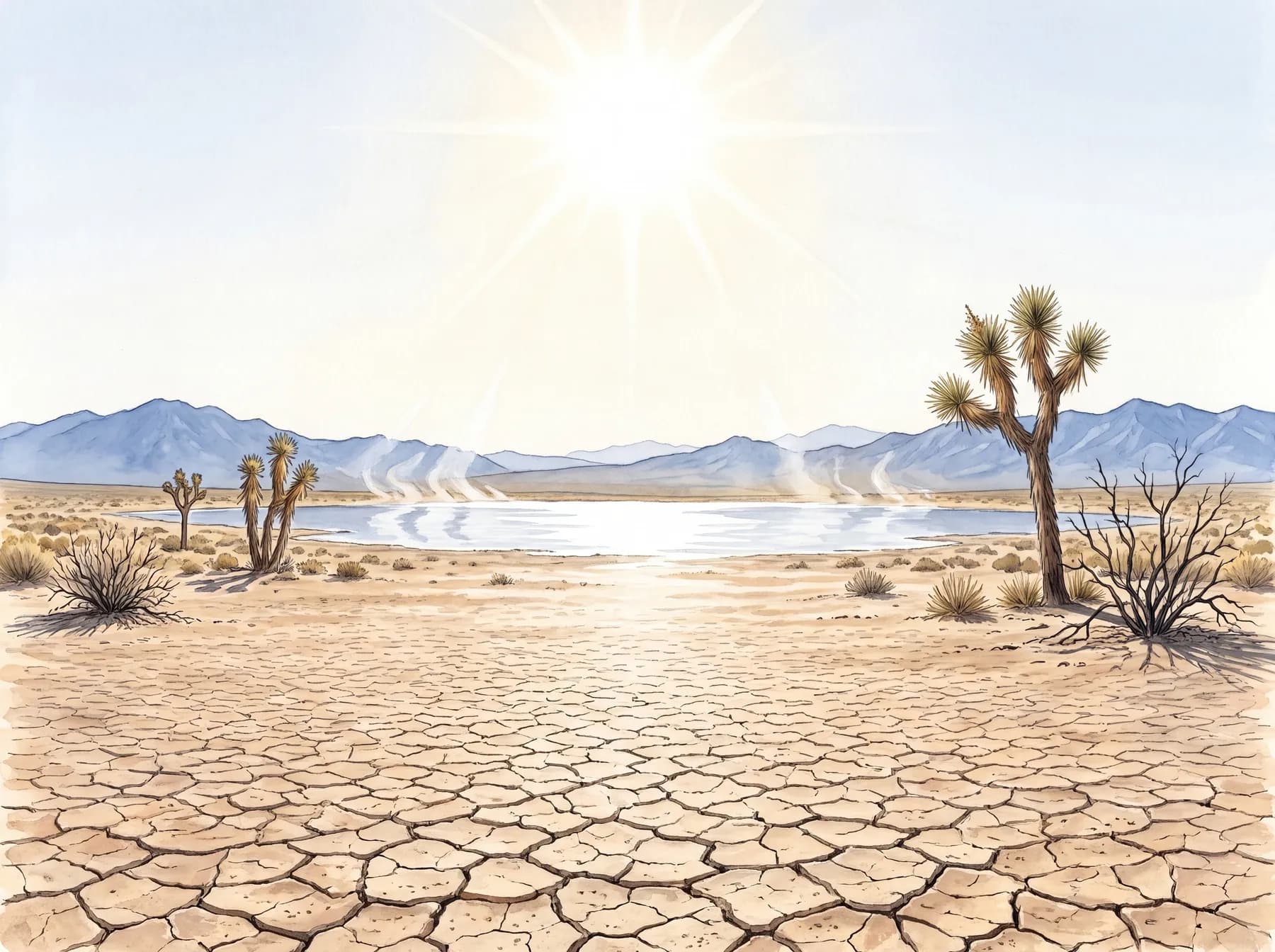
The heat even bends light. On the worst afternoons a shimmering silver lake seems to float on the flat in the middle distance, and it is not water and never was; it is a mirage, the superheated air near the ground refracting the sky so that the horizon looks flooded. That trembling false lake is the surest sign of the day's most dangerous hours.
So the desert asks for the same discipline the wildlife already keeps: shade, water, and timing. Work at the cool edges of the day, and hide from the middle of it, because sustained heat over single-digit humidity dehydrates faster than it feels like it should.
Watch for the shimmer. When the flat floods with light that is not water, you want to be out of the sun.