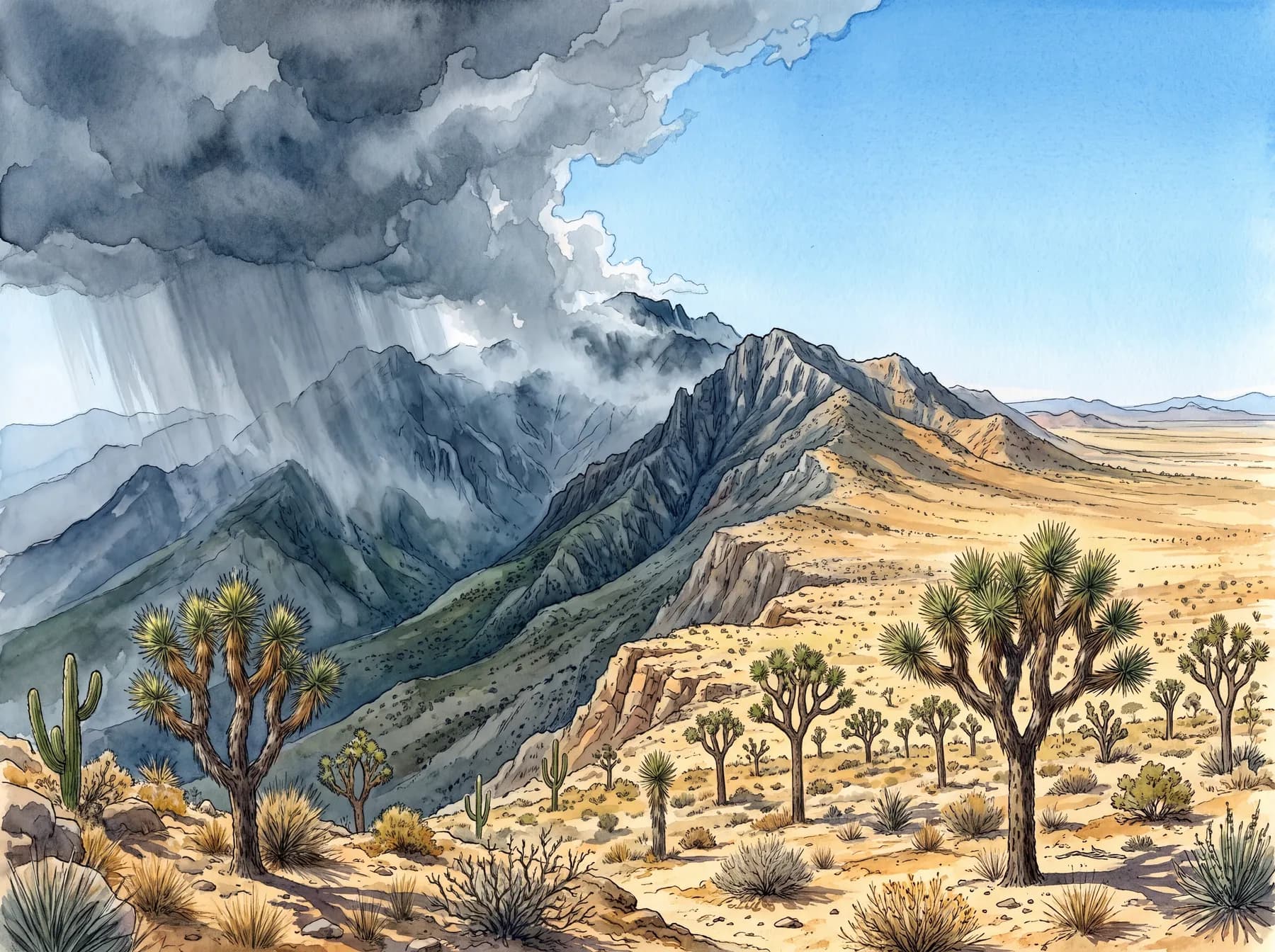
The first honest question about this place is the one nobody thinks to ask: why is it dry here at all? The answer is a single wall of rock to the west, and once you have it, most of the rest of the desert stops being a list of unrelated hardships and becomes one fact seen from different sides.
Storms come off the Pacific heavy with water and run into the mountain ranges to the west — the Sierra Nevada, the ranges of southern California. The air is forced up; rising air cools; cool air cannot hold as much moisture, so it drops it as rain and snow on the western slopes. Then that same air crests the range and sinks down the far side, and sinking air warms, and warming air can hold more water again, so instead of releasing moisture it starts taking it back. By the time it reaches this side it is not merely dry. It has been wrung out and then reheated, and it now pulls water out of whatever it touches: soil, plants, an open stock tank, you.
That one mechanism runs most of the rest. The thin humidity, the hard clean sky, the weight of a sun coming through air with almost no water vapor to soften it, the wide swing between afternoon heat and night cold because vapor is what holds warmth in and there is so little of it. Those are not separate facts about a harsh place. They are the same fact, viewed from different angles.
The strangest part is what the wall does not stop. The mountains stand to the west, so they take the Pacific storms, but the summer monsoon does not come from the west. It comes up from the south, off the Gulf of California and beyond, around the end of the shadow, through a door the mountains do not guard. That is why this eastern edge of the Mojave gets two wet seasons where the western edge gets one. There is even a rough dividing line for it, running near Barstow around 117 degrees west: winter-dominated country to the west, two-season country to the east. This ground sits well east of it.
The two rains have completely different tempers. The winter rain, roughly November to April, is the steady soaking kind — the little that the shadow lets through. The summer monsoon is the violent kind: local, sudden, a storm you can watch miss the house entirely and still fill the wash a mile off. It is only something like a tenth to a fifth of the year's water, but it is the part that moves rock and cuts the arroyos.
So look west to understand why it is dry, and look south in July to understand why the wash runs. One wall, two answers.