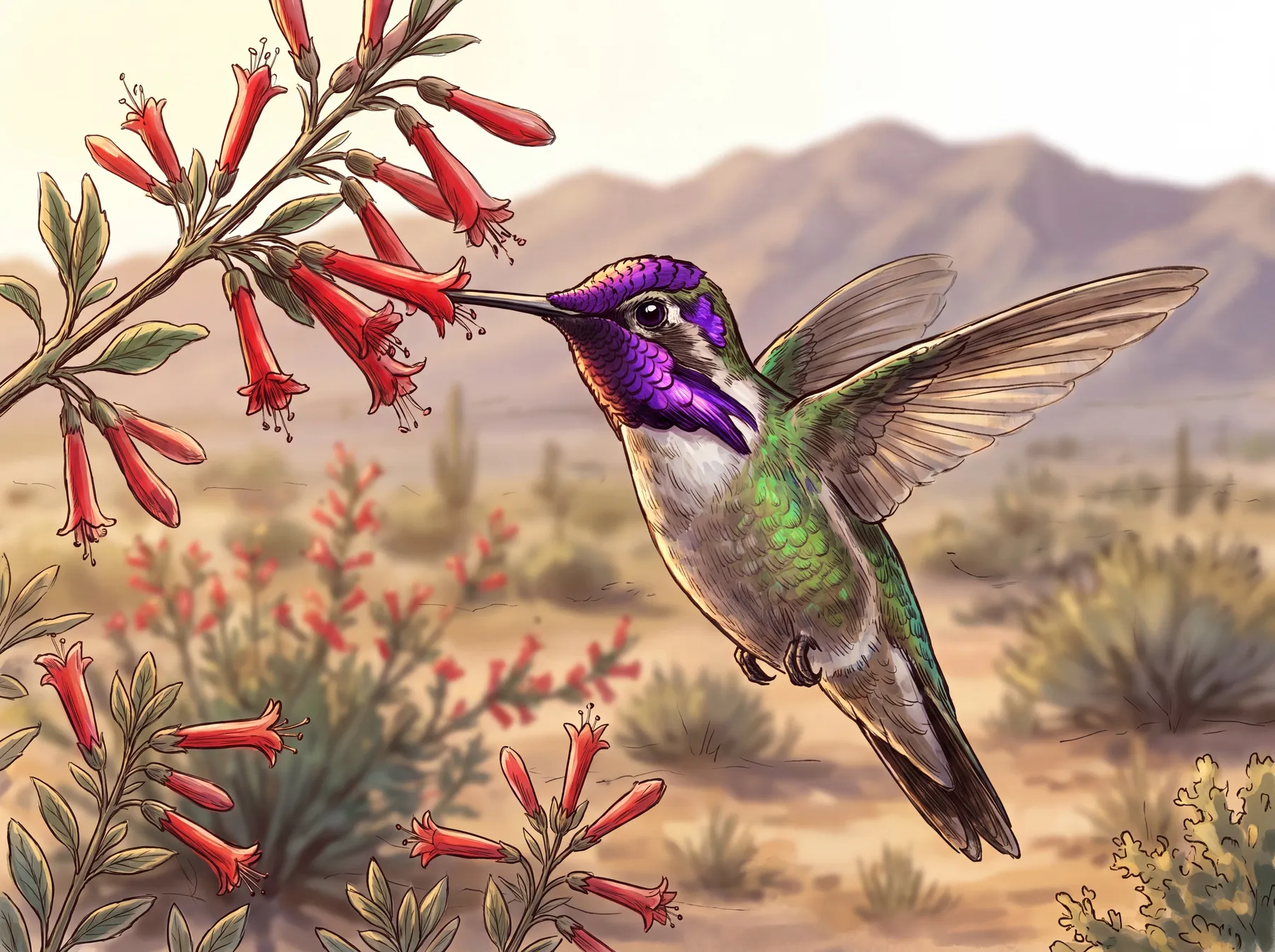
The thin high whistle at the bottom of a Costa's dive is not really a whistle, and it does not come from the bird's throat. It comes from his tail. When a male climbs, sometimes to about 100 feet, and drops toward a female, the outer feathers of his tail flutter in the rushing air and sing, the way a blade of grass sings pinched between your thumbs. Researchers who took the courtship dive apart found the sound is made by the feathers, not the voice.
The surprising part is how much he steers it. During the dive he twists half of his tail vertically, by as much as 90 degrees, and because the feather sound carries in one direction rather than all around, that twist aims the beam of it sideways. He is not broadcasting to the desert. He is pointing a sound he makes with his own tail at the single female he is diving for. Nobody is quite sure why he twists only half of it rather than all of it.
Then the story turns. He does not drop straight at her; he passes to her side, and the angle is the point. A dive aimed off to one side flattens the Doppler curve in the sound, the rising-then-falling shift in pitch you hear as a car goes past. By swinging wide he erases the one cue that would tell her how fast he is going. The concealment itself is measured, not guessed; only the reason behind it stays open. What no one can settle is why a courting male would want to hide his speed, when you might expect a fast, athletic dive to be exactly what he would want her to hear.
He is a small thing to carry all that machinery. A Costa's weighs about 3 grams and runs roughly 3 inches long, the second smallest hummingbird in North America, and the male spends his one extravagance on his face: a metallic violet-purple crown and throat, the throat feathers flaring back into two long points like a dropped moustache. This is the desert's own hummingbird, a Mojave and Sonoran specialist rather than a wanderer passing through, living on nectar and small insects. Its Mojave range runs from near sea level to about 4,000 feet, so this ground, just over 3,000, sits comfortably inside it.
Timing is the catch, and it is why you should not look for this bird in the worst of the heat. In the Mojave, Costa's breed from February to June, with most of the diving and nesting crowded into March and April. By late June, as this country turns punishing, most have already gone, drifting toward the cooler coast of California and Baja. It is a spring bird here and largely a memory by high summer. No sighting of our own here so far.
Watch in March, low over the blackbrush: a purple-faced male climbing, then falling past a perched female, aiming a whistle at her with his tail.