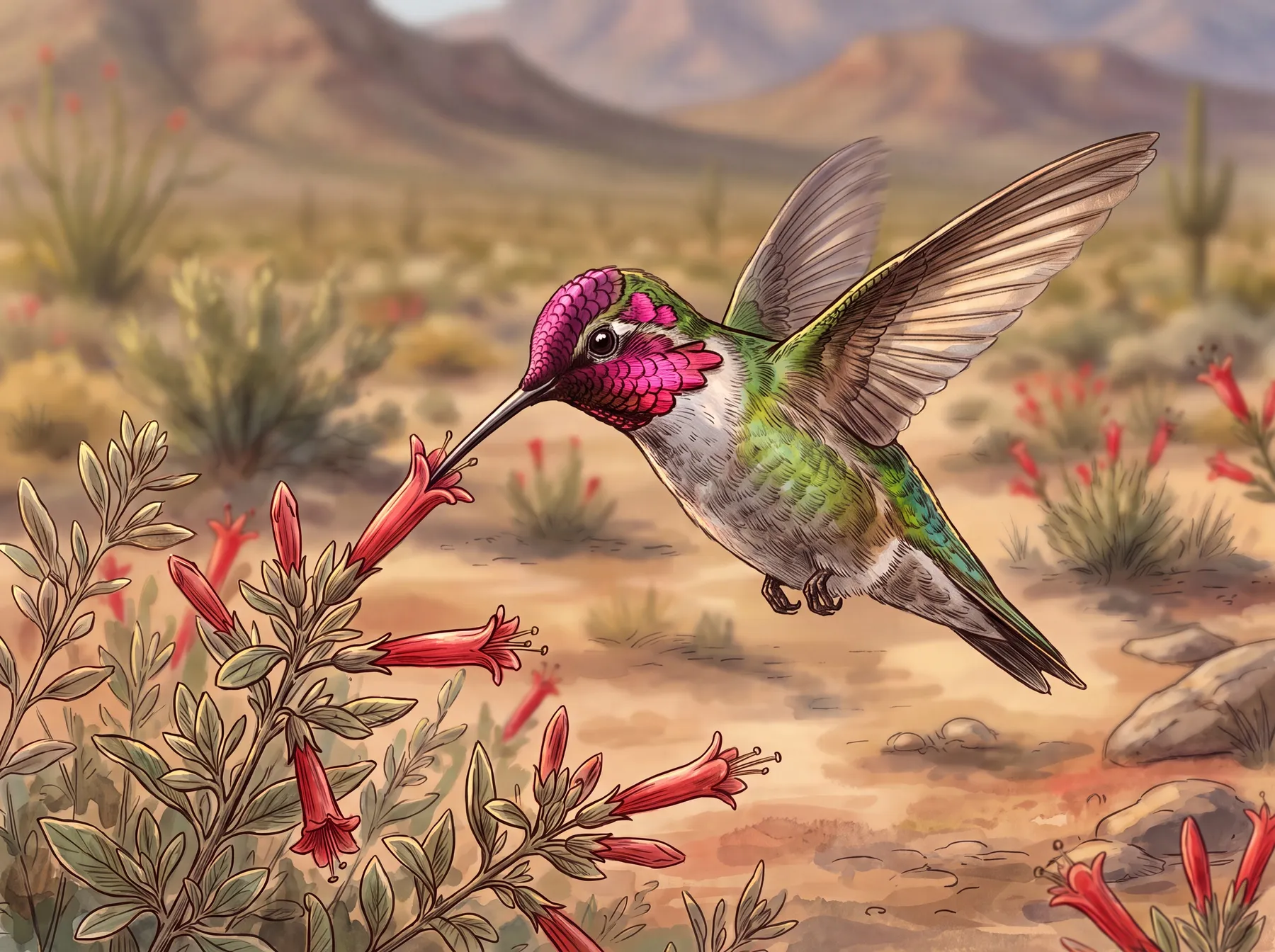
The rose-headed hummingbird that might turn up at a feeder on this bajada has not been a desert bird for very long. Anna's hummingbird spent most of its history in a narrow band of Baja California and the California coast. Over the last century it pushed north and east across the West, reaching British Columbia in the north and Arizona in the east, and researchers tie that spread less to some new toughness than to people: to garden flowers, ornamental plantings, and the sugar-water feeders hung out through winter. It looks like a desert native, and it mostly isn't.
That arrival is real but unsettled. Across the Southwest many of these birds are only partial migrants; Arizona nesters commonly drift west to California in mid-spring and return in late summer, while some stay put all year. So on high ground like this, up in the Joshua-tree and blackbrush country, its foothold leans on human water and nectar and runs more seasonal than steady. We expect it here. None verified so far, and away from a fed yard it thins out.
What earns it more than a feeder note is what the males do in the air. A courting male climbs more than thirty metres and drops. At the bottom he reaches about 385 body lengths every second, near sixty-one miles an hour, which researchers have measured as the highest length-specific velocity known in any vertebrate — roughly twice the two hundred body lengths a second of a peregrine falcon in a full stoop. In flat miles per hour the falcon is far faster; measured against the length of the animal, the four-gram hummingbird wins. Pulling out of the dive he takes nearly nine times the force of gravity, a load that would gray out a fighter pilot, borne only because it lasts a fraction of a second.
At the very bottom of that dive comes a sharp chirp, and for something like a century and a half people assumed he sang it. He does not. The sound is made by a single tail feather, the outermost one on each side, whose trailing edge flutters in the rushing air about four thousand times a second, and in the dive it runs eighteen decibels louder than anything the bird produces with its throat. Pluck that feather and the chirp disappears; trim only its trailing vane and the sound goes again; hold the feather by itself in a wind tunnel and it sings on its own. The voice at the bottom of the dive was never a voice.
Cold nights it meets a different way. A hummingbird holds its body near 107 degrees and its heart around twelve hundred beats a minute in flight, and on a cold night it can let both fall off, one bird documented down near the high forties with its heart slowed toward fifty, spending almost nothing until light. This is a dial, not a reflex. Researchers have found the bird sinks into that deep torpor mainly when its stored fat runs low; a well-fed bird on a mild night simply sleeps.
If one does show, look at the male. Most hummingbirds flash a bright throat; this one carries rose-red over the whole crown as well, and because the color comes from feather structure rather than pigment it reads flat black or dull gold until he turns toward the sun. A hung feeder can draw him, but spoiled syrup and a dirty feeder grow molds that kill hummingbirds, so it has to be kept clean or taken down.
Watch a male turn his head as he faces you: dull as soot one moment, then the whole head lit magenta.