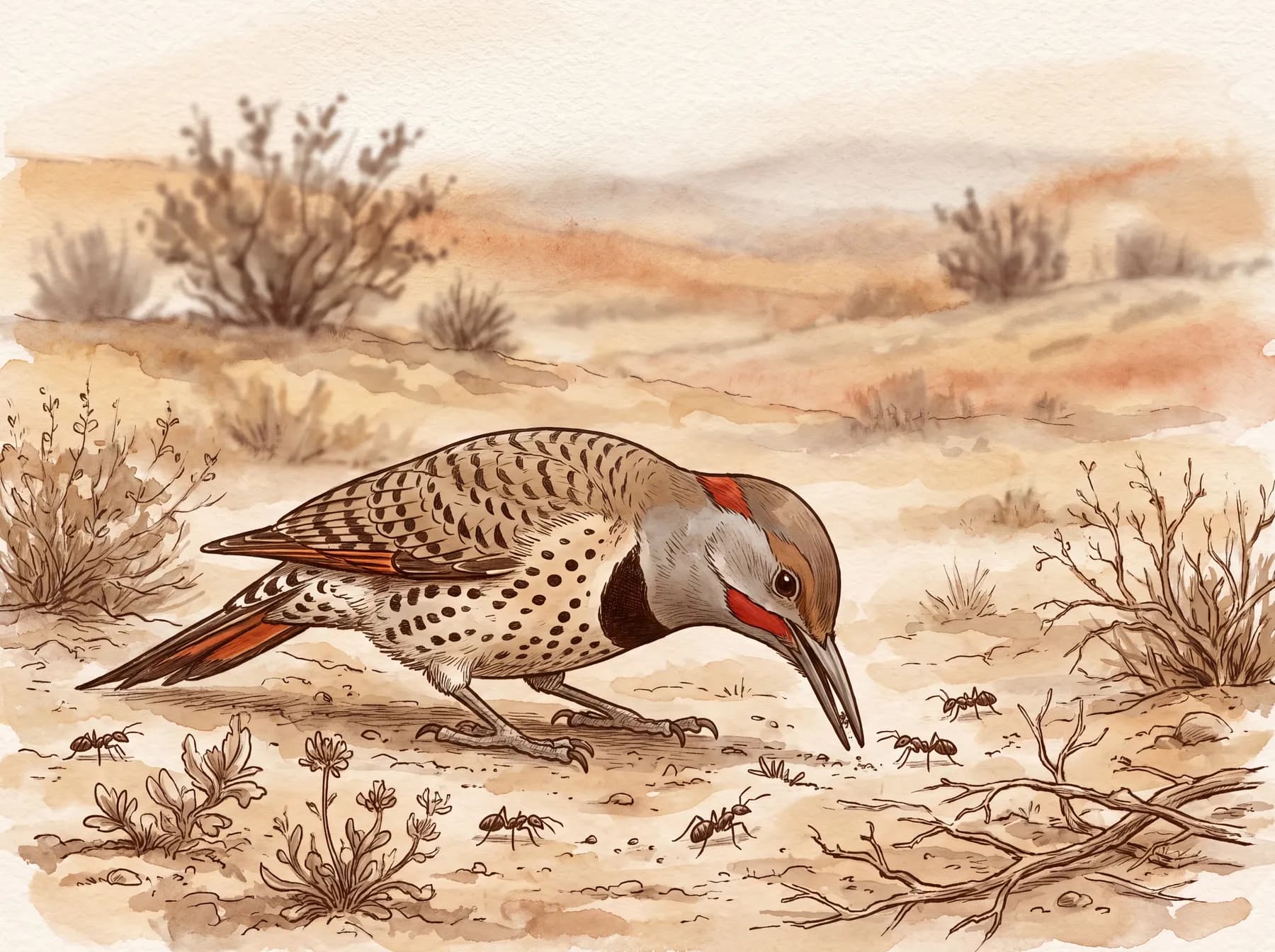
A woodpecker on the ground looks like a mistake. You expect the family up on a trunk, braced on its stiff tail, hammering into bark for grubs. The northern flicker feeds mostly the other way, hopping across open dirt and probing into anthills. It is a woodpecker that has moved its feeding down to the ground.
The reason is ants. Of all the birds on this continent, the flicker probably eats them more than any other. The qualifier is the authority's own, and worth keeping, because nobody has weighed every bird's diet against every other's. The strongest evidence is also old. In an early USDA stomach survey, F.E.L. Beal opened 684 flicker stomachs and found ants in 524 of them; 98 held nothing else, and one held over 5,000. The extreme count is a single bird at the far end of a survey published in 1911. The everyday finding is the one that matters: most of the flickers Beal opened had been eating ants.
The tool for it is a tongue you would never guess from the bill. A flicker's tongue reaches about two inches past the tip of its bill, barbed and coated in sticky saliva, and it is stowed when idle by wrapping up and over the back of the skull. It is the longest tongue of any North American woodpecker. The whole apparatus is arranged for reaching down into ant galleries rather than chiseling through wood.
Whether you can expect it on this ground depends on the season, and here the neat version needs correcting. The red-shafted flicker of the West breeds in higher country, in the pine-oak and pinyon-juniper woodlands of the mountains, and drops into the desert lowlands for the cool months, when the resident birds are joined by migrants pushing down from the north. In this blackbrush and Joshua tree, it is most honestly a winter visitor here, rather than a bird that nests on the flats. It would be easy to hand it the desert's woodpecker habits, including the Joshua trees, but the flicker that carves nest holes in Joshua trees across the Mojave is a separate species, the gilded flicker. Giving those holes to this bird borrows a reputation it has not earned here.
None confirmed here yet, so for now the page is teaching what to watch for. In flight it announces itself twice. A white rump patch flashes the moment it lifts off, and its flap-and-fold undulating flight rises and dips as the wings fold shut between bursts. Up close the western form shows a plain brown crown, a grey face, and a black crescent bib across the chest; on the male, a red moustache stripe runs back from the bill, and when the wings open you may catch the salmon-red lining the shafts of the flight and tail feathers.
Look low, then up. A brown woodpecker feeding on the ground that bounces off in undulating flight, flashing a white rump, is almost certainly it.