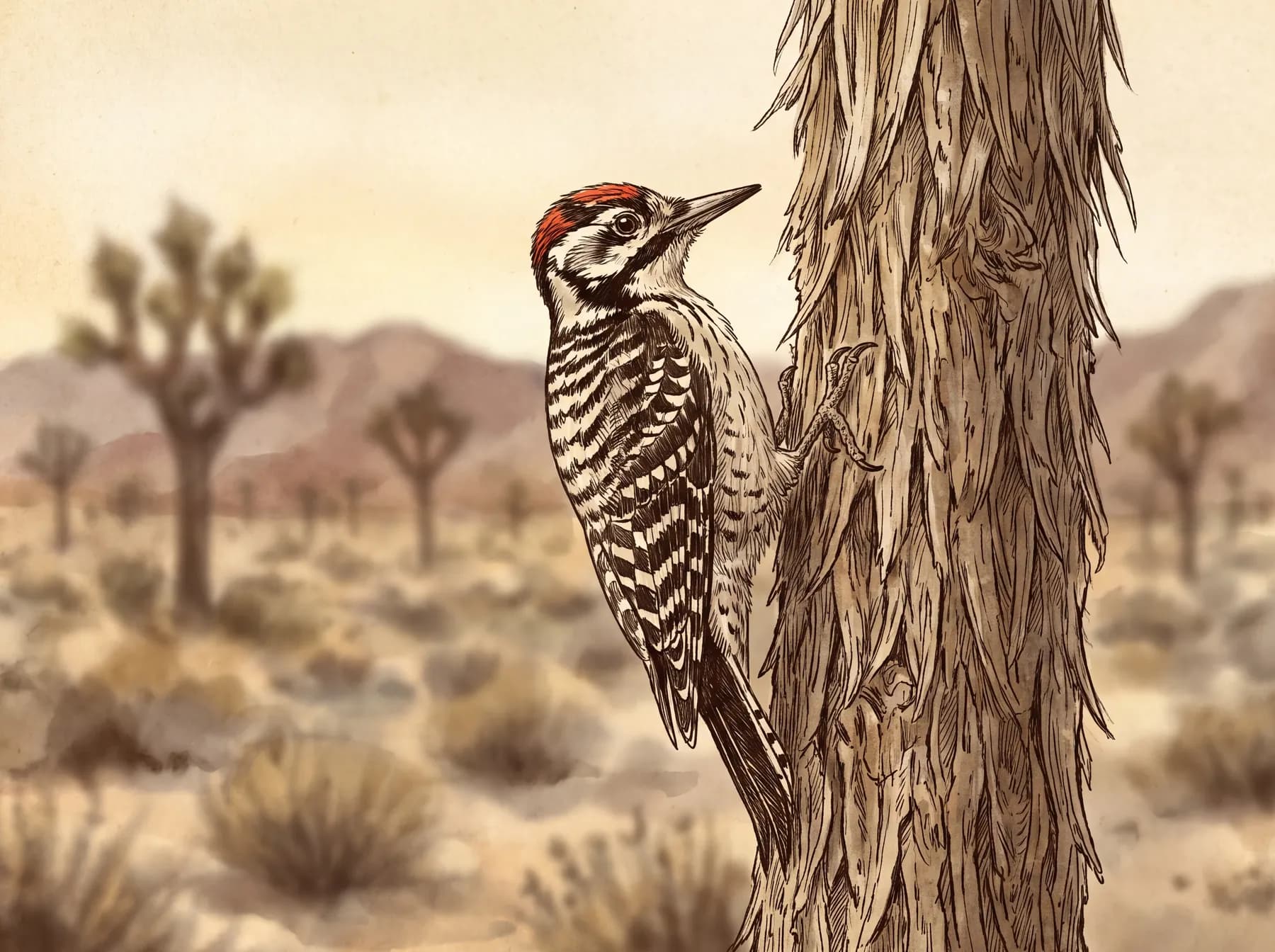
A woodpecker needs a hole to raise a brood in, and it has to chisel that hole itself. That is an awkward trade to bring into the Mojave, where most of what grows is either too thin to hold a cavity or too hard to open. Set that problem down on this bajada and you have most of the life of the ladder-backed woodpecker, the small barred bird that is, by the published accounts, the most common woodpecker in this desert.
What solves the problem is the Joshua tree. It looks like a tree and branches like one, but it is a giant yucca, a monocot with no true wood, filed in the lily family under the old classification and moved out of it since. That botanical oddity is the point. A Joshua tree is far easier to hollow out than a hard-wooded juniper or piñon, and in the Mojave, researchers note, Joshua trees are among the only plants a ladder-back can use at all. Most of the rest is either too short, which leaves a cavity a predator can reach, or too narrow to hold one.
The cavity itself is small and deep. The entrance runs a shade over an inch across, wide enough for the bird and little else, and the chamber drops as much as fourteen inches or so, most often nearer ten, set anywhere from two to twenty feet up. The Joshua tree is not the only oddity it will take. It nests in mesquite, hackberry, willow, and oak where those stand, in a giant cactus, on a fence post or utility pole, and sometimes down the dead flower stalk of a yucca or an agave, raising a brood inside a spent bloom.
Its size does a second job. Small enough to work in among the thorns, it forages where larger birds will not go, chiselling and probing the woody, spined desert plants, mesquite and cholla among them, after wood-boring beetles and their larvae, caterpillars, true bugs, and ants, with some cactus fruit in season. The plants that make this desert hard to move through are its pantry.
It does not leave. Where many desert birds come and go with the season, the ladder-back is a permanent resident, on this ground in January as in July, keeping below the roughly five-thousand-foot band it holds to; this parcel, well up on the bench, sits well inside it. Elsewhere in the Southwest the desert's woodpecker work is divided, and the Gila woodpecker takes the saguaro of the Sonoran country. But no saguaro grows up here in the Joshua-tree belt, and no resident Gila comes with it. This is the small woodpecker that actually fits this habitat, its range and the Joshua tree's drawn very nearly on top of one another across the Mojave.
Still waiting to record our first here. When you look, read the back first: black and white, barred like a ladder from the neck down, with wider white bars and more white on the face than the near-identical Nuttall's, a chaparral-and-oak bird that does not belong in this scrub. A red crown running from the eye to the back of the head means a male; the female wears none.
The likelier first sign is sound: a bill working a Joshua-tree limb, chipping a hole no wider than a thumb.