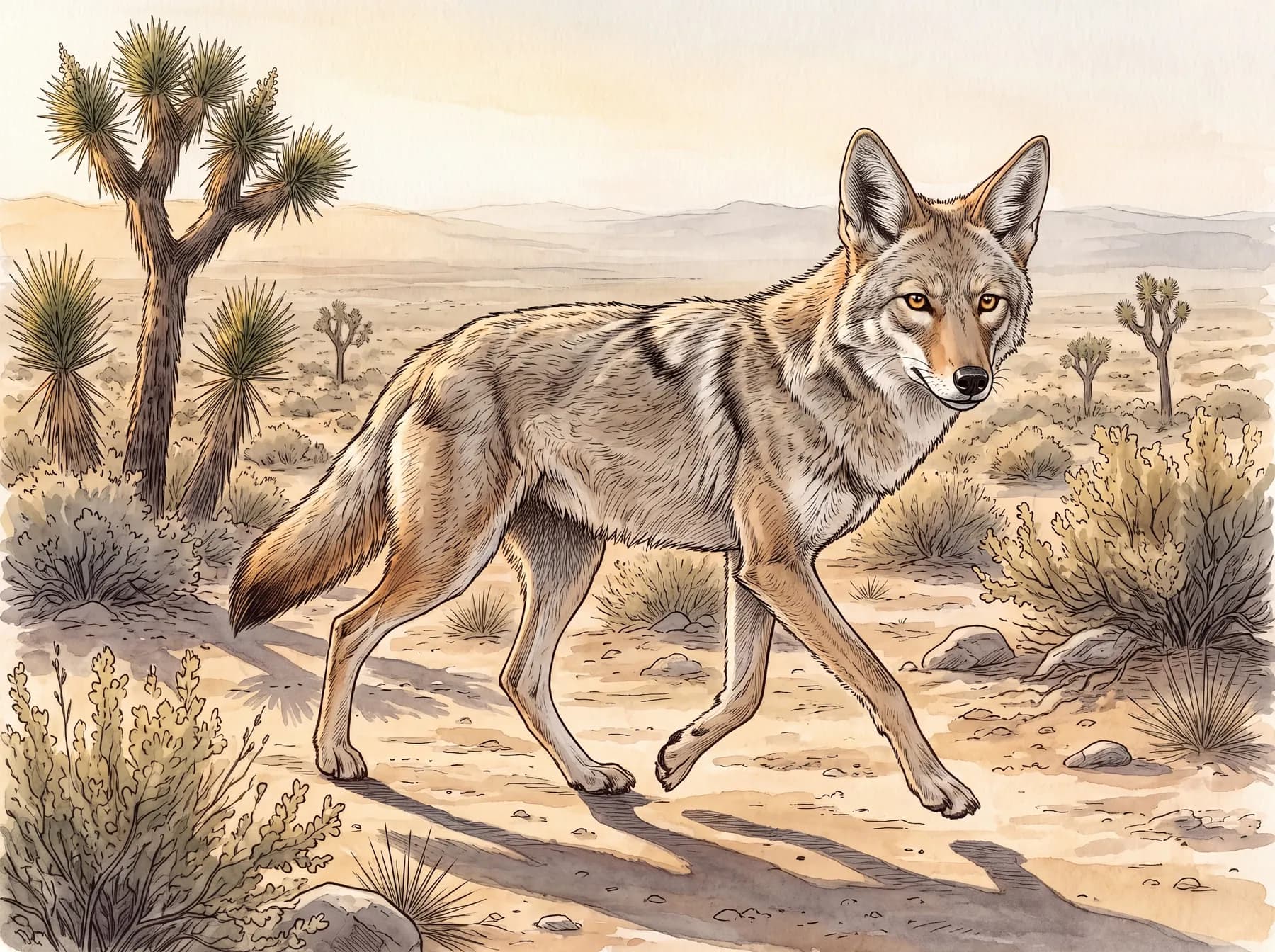
Count the coyotes you hear at night and you will almost certainly count too many. When researchers played recordings of one to four animals to 427 listeners and asked how many were calling, the guesses came back close to double. A pair does not sound like a pair. Each animal slides its pitch and seems to throw several voices at once, and the open dark does the rest, until two coyotes fill a wash like a mob.
Whether that is a deliberate bluff, nobody has actually shown. The overcount is measured; the intention behind it is a guess, and worth holding loosely. What the sound is not is a crowd. Coyotes here live alone or in a family group, not the pack the chorus advertises.
It is tempting to hear that chorus as an arrival — a sharp animal moving in to take the ground the wolf left behind. In the West that story runs backward. Coyotes have lived in this arid country throughout the Holocene, and the fossil bones say so; they did not fill a gap here, they were already in it. The famous expansion happened somewhere else and recently: coyotes pushed east and south across the continent into 49 states, every one but Hawaii, and reached Panama by 2013. On the range map it looks like an invasion. On this ground it is closer to the oldest resident on the page.
What it does here is hold the middle of the food web down. In one desert removal study, taking the coyotes out let the rodent community fall from twelve species to one, a single kangaroo rat crowding out the rest, while black-tailed jackrabbits climbed somewhere between three- and eighteen-fold. Remove the predator and the place does not relax. It simplifies. The coyote earns its keep by being unfussy, too, turning fruit-eater in season on juniper berries and prickly pear, which are a normal part of an Arizona coyote's diet and not a last resort.
The animal itself is smaller than its reputation, a lean, pale, big-eared dog running published western weights of about 20 to 35 pounds, less than many family retrievers. If you do see one, read the tail: a coyote trots with it carried low, below the line of the back, not raised like a happy dog and not held straight out like a wolf. When distance flattens the color and size into "some kind of dog," the dropped tail is the thing that settles it.
Still off our list on this ground. The first proof will probably be the chorus, lying about its own number.