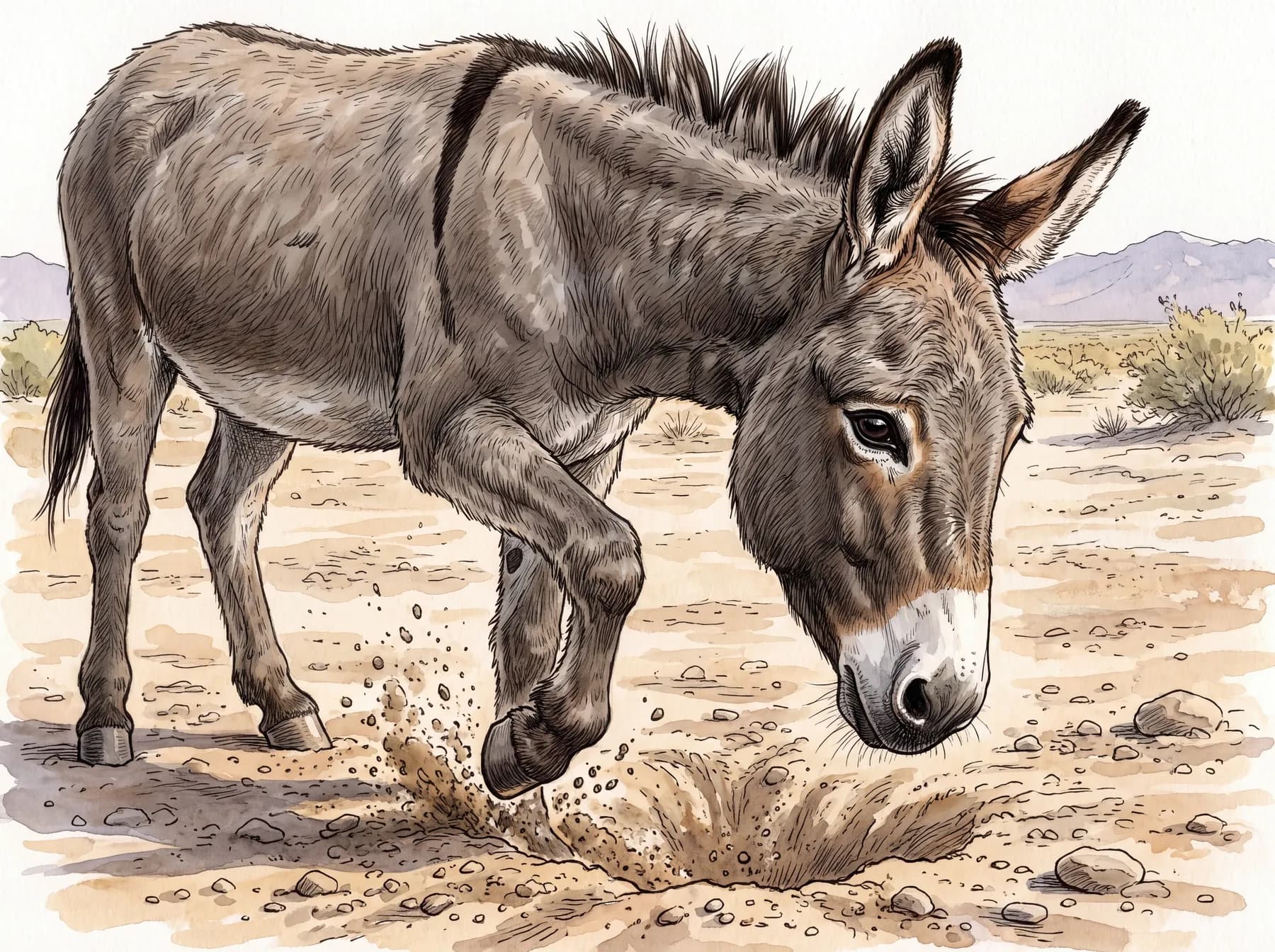
In a dry stretch a feral burro will dig, pounding down through a sandy wash bed with its hooves until it reaches groundwater within a couple of feet of the surface. It has not undertaken a public-works project. It is thirsty. But once the well is open, everyone else arrives: a Western study recorded 57 vertebrate species drinking at burro-dug wells, from songbirds to a mountain lion, and found roughly 64 percent more kinds of animal at the wells than on nearby dry ground. Where a stream had failed, the burro's holes were sometimes the only water for miles.
Some of those wells do more than water animals. In the damp dug soil, Fremont cottonwood seeds germinate and take hold, so a hoof-dug hole can become a small cottonwood nursery, standing in for the flood disturbance that used to plant them. For an animal most people file under feral nuisance, that is a genuinely generative thing to leave behind.
And yet. The same animal, in the same country, is far past what the land can carry. The herd in this county's management area is running around ten times its target — on the order of 4,870 animals where the goal is 478 — and it has not been near that goal since early this century. At those numbers the good the wells do cannot cancel the harm. Surveys in burro range have measured markedly less ground cover, killed nurse trees, and far fewer young of the slow desert plants coming up to replace the old ones.
It also sits in a legal category of its own. The burro is neither game animal nor livestock; a 1971 federal law protects it as a living symbol of the pioneer spirit of the West, which is part of why the overpopulation is so hard to manage. So the burro asks you to hold two true things at once. It is a desert well-digger that waters dozens of other species, and it is an overabundant animal grinding down slow desert plants that cannot grow back fast enough. Both, at the same time.
Watch a wash after the burros work it. The holes fill with tracks; everything in the desert comes to water it did not dig.