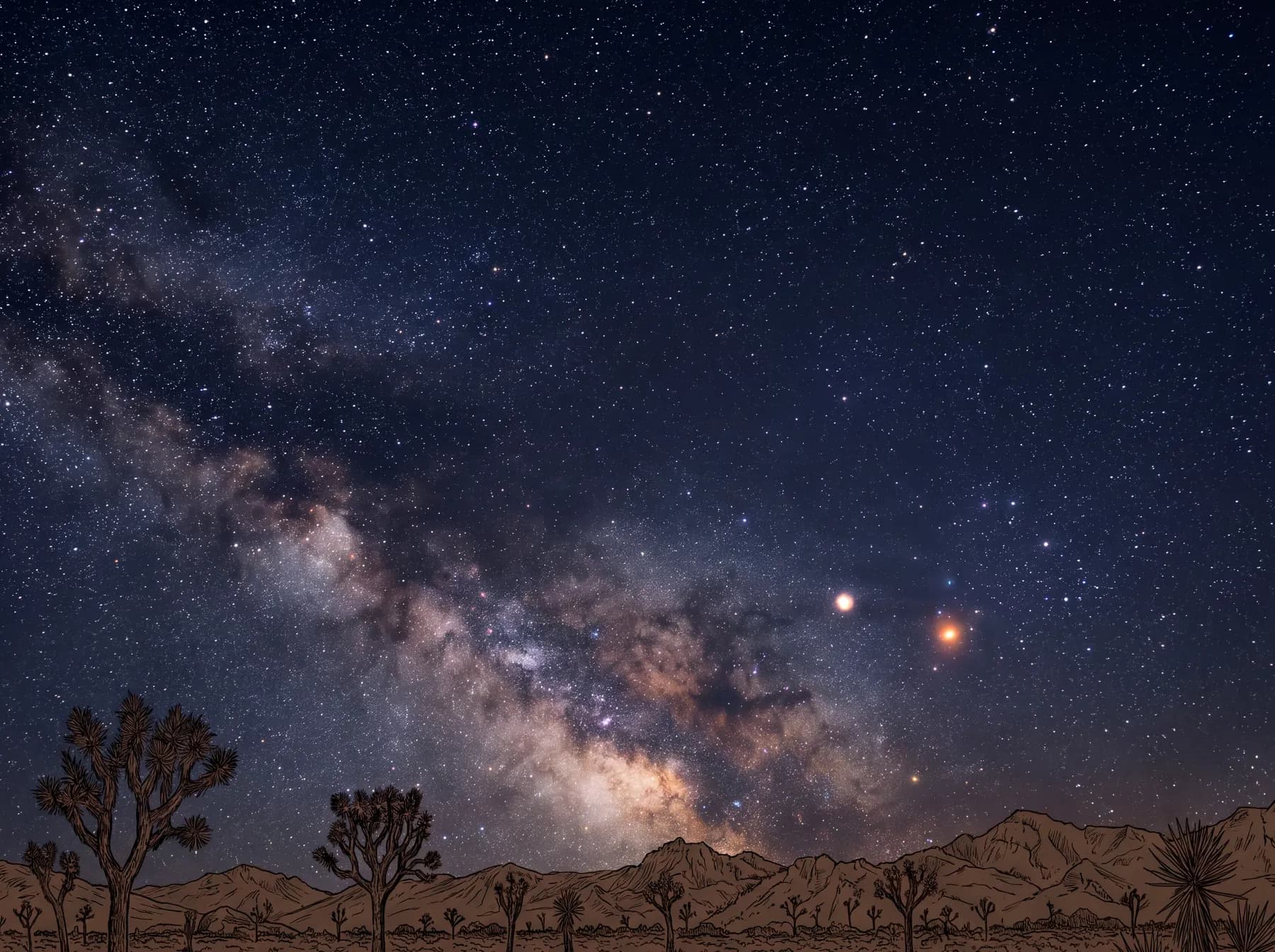
Look south and low on a summer night, lower than feels right for something worth finding, and one pattern actually delivers on its name. Most constellations ask you to take the figure on faith. Scorpius does not. A short row of stars stands out front for the claws, a long line of them hooks down and around for the tail and its stinger, and between them sits a single red-orange spark the eye keeps returning to. That spark is Antares, the heart of the scorpion, and the color is the whole point of the name.
Antares comes from the Greek Ant-Ares, rival of Ares, which is to say rival of Mars — the planet. Someone naming stars long ago looked at this steady red point and saw the same red as the wandering planet, and the confusion is real. Mars does pass through this part of the sky, and when it does the two reds sit near each other and trade places in your certainty about which is which. The tell is motion. Antares stays pinned in the scorpion, night after night, year after year. Mars drifts through and leaves.
Then the dot stops being a dot. Antares is a red supergiant, a star late in its life and bound eventually to go off as a supernova. Its radius runs to roughly 680 times the Sun's, about 3 astronomical units, which is another way of saying this: set Antares where the Sun sits and its surface would swell out past the orbits of Mercury, Venus, Earth, and Mars, reaching somewhere between Mars and Jupiter. The entire inner solar system would be inside the star. It is around 600 million miles across and 550 to 600 light-years away, which is why all that size arrives here as one faint red point you have to hunt for near the horizon.
That hunt is the local part. From this latitude, around 34 to 35 degrees north, Scorpius never climbs. Antares sits far down toward the south of the sky, so at its highest it stands only about 29 degrees above the southern horizon, and the tail hangs lower still, skimming the skyline. Low means you are looking through far more air than you would straight overhead, and that low southern band is exactly where a town's glow does the most damage. From a lit-up place the scorpion drowns in it. What this dry desert ground offers is a southern horizon that stays dark most of the way down, so the whole animal, stinger included, clears the murk.
There is a reason to find it beyond the star itself. Follow the curl of the tail east and northeast and it hands you off to the Teapot of Sagittarius, the next pattern over, whose spout points straight at the center of the galaxy. Scorpius is the doorway into the summer Milky Way core, and Antares is the porch light beside the door.
Find the red spark low in the south this summer, trace the tail's hook down, and let it point you to the galaxy's core.