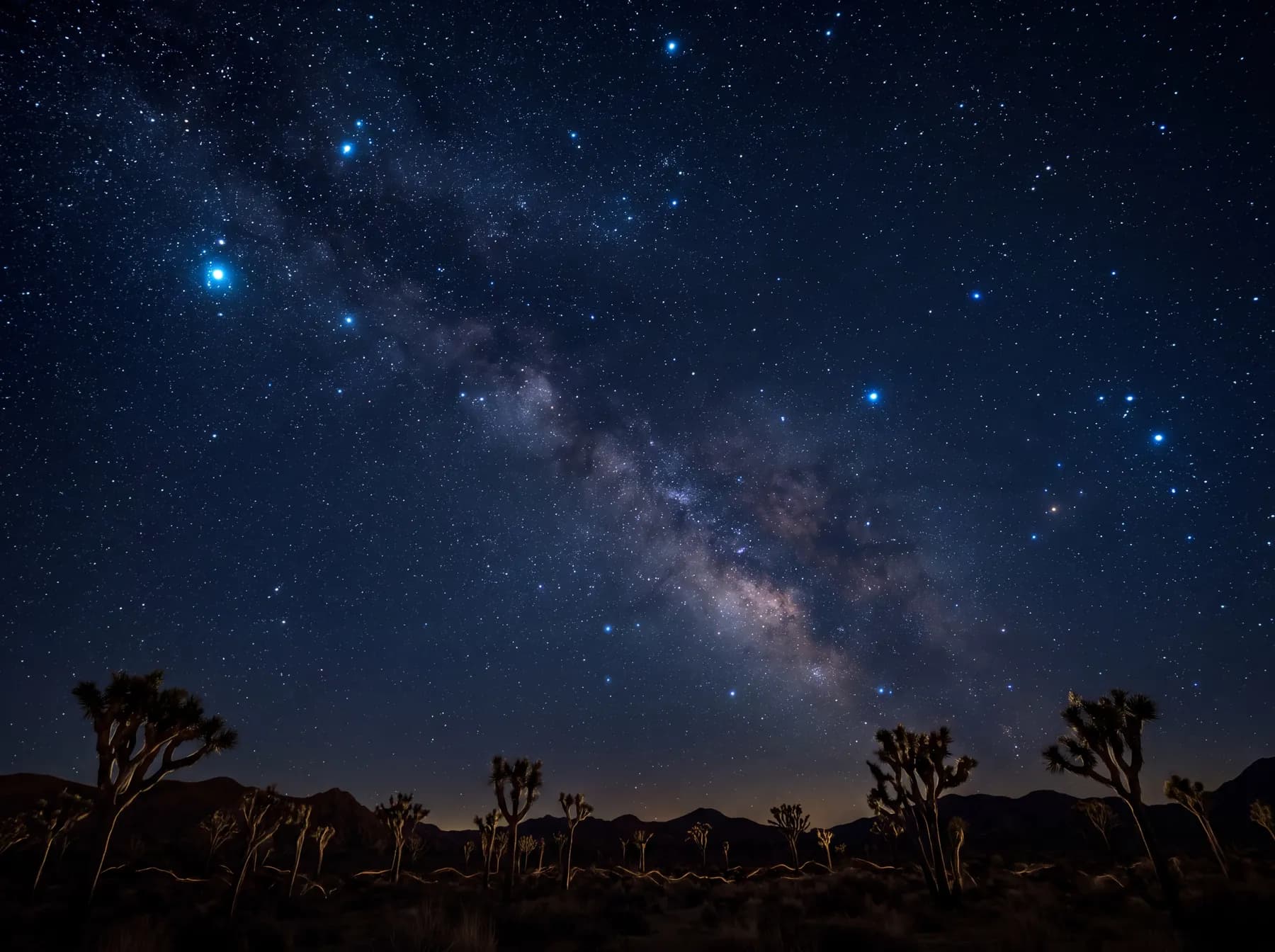
The clearest sky of the year comes on the coldest, stillest nights of January, the ones you least want to be standing under. Go out on such an evening, let your eyes settle, and the brightest stars of the whole year come up at once, six of them ringing the sky overhead in an enormous circle. There is a plain reason you can see them so sharply from this dry ground.
Cold air is the reason for the sharpness. Water vapor is what smears and scatters starlight, and cold air holds little of it, so the most transparent, steadiest nights of the year are also the coldest. A city loses this sky to its own glow. This bajada, dark and dry and high, keeps it. The best viewing comes on the nights least comfortable to stand out in, so you dress for the cold and go anyway.
The circle is six separate stars, each the brightest in its own constellation, sitting far apart and burning hard enough to hold the figure together for the eye. Sirius, Rigel, Aldebaran, Capella, Pollux, and Procyon — six stars from six constellations, all of them among the sky's brightest. Most of the sky is not laid out this generously, and you can pass whole seasons without this many bright stars up at once.
You do not hunt for the circle directly. Find Orion first, which is unmistakable, and notice that he stands inside the ring rather than beside it, with Betelgeuse glowing near its center. Once Orion anchors you, the hexagon assembles itself around him. The sky supplies only the six points; the connecting lines are ones your eye fills in. Follow his belt down and to the left and it points you at the low corner in the south.
That low corner is Sirius, the brightest star in the whole night sky at magnitude −1.46, and from this ground it never climbs high. Riding low in the south, its light shears through the thickest, most restless layer of the atmosphere, so it does not burn steadily the way it would overhead. It flickers and flashes through reds and greens and blues, hard enough that people take it for something with an engine. The color is not in the star at all; it is the air between you and it, sorting the light on the way down.
Look low in the south for the one bright star that will not hold still. Everything above it hangs steady; only Sirius flashes.