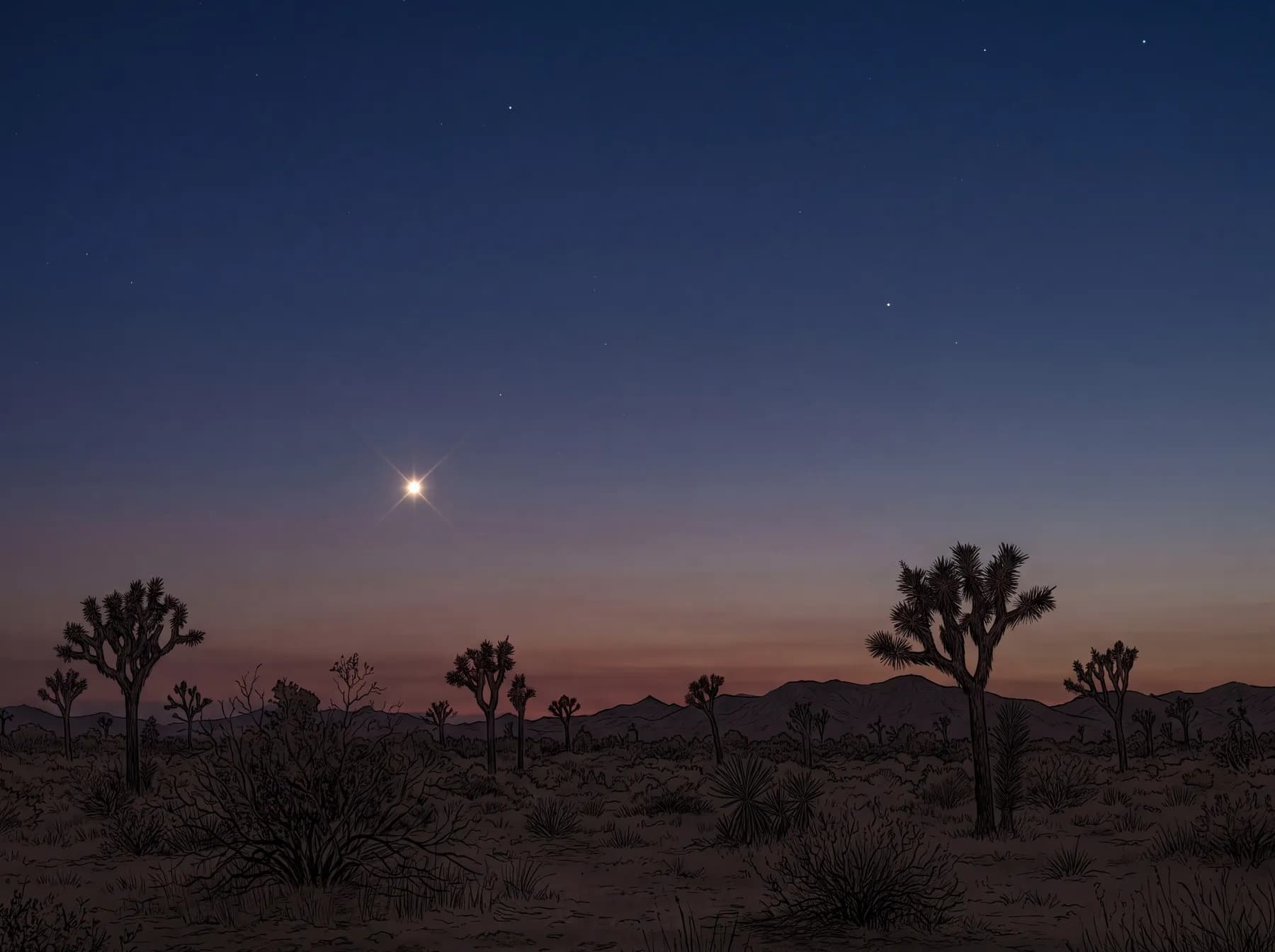
The brightest thing you will see after dusk is also the one that refuses to climb. Look for it low in the west once the sun is down: a single steady lamp, brighter than anything else in the sky but the Moon, sitting above the ridgeline. Come back an hour later and it has not risen the way a star would. It has followed the Sun down. That is Venus, and it is doing the only thing its orbit allows.
The reason is geometry, and it is strict. Venus circles the Sun inside Earth's own orbit, so from this ground the two never separate by much. Measure the angle between them at its widest and it comes to about 47 degrees, never more. That single number is why Venus is only ever a morning star or an evening star. It rides up out of the dawn or trails the dusk, and cannot cross to the middle of the night or stand overhead, because it is leashed to a Sun that is always close by. A planet you only ever meet near the horizon, in the hour the sky is still bruised with light.
Two tests tell you it is a planet and not a star. The first is that it does not twinkle. A star sits so far off it arrives as a single point, and the desert air, even the dry clear air a rain shadow gives this bajada, shoves that point around until it flickers. Venus arrives as a small disc instead, too near to collapse to a point, and a disc averages the turbulence out into a steady shine. The second test is brightness with no competition. Near its dimmest Venus still burns at about magnitude minus 3.9, and in its crescent phases it climbs past minus 4.5 toward roughly minus 4.8, which is why after the Moon nothing natural in the sky beats it.
That brightness does two things that sound like tall tales and are not. From a dark site like this one, measured at 21.97 magnitudes per square arcsecond, a Venus near its greatest brilliancy can throw a faint shadow. It is not obvious, but you can find it by standing between the planet and a pale surface and letting your eyes settle. It is also bright enough to be picked out in full daylight if you know exactly where to look, which is part of why it gets reported as a UFO several times a year by people who have never noticed a planet in a blue sky.
The oddest fact about it your eyes cannot reach, but binoculars begin to show: Venus has phases, a crescent and a half and a gibbous, the same cycle the Moon runs. Galileo turned his glass on it in 1610 and watched it move through the whole set. A world that shows a full sweep of phases cannot be circling the Earth the way the old model demanded. It has to be going around the Sun. The pretty light over the ridge helped break the sky open.
Catch it low in the west after sunset, steady where the stars flicker. Brace binoculars and the disc may already be a crescent.