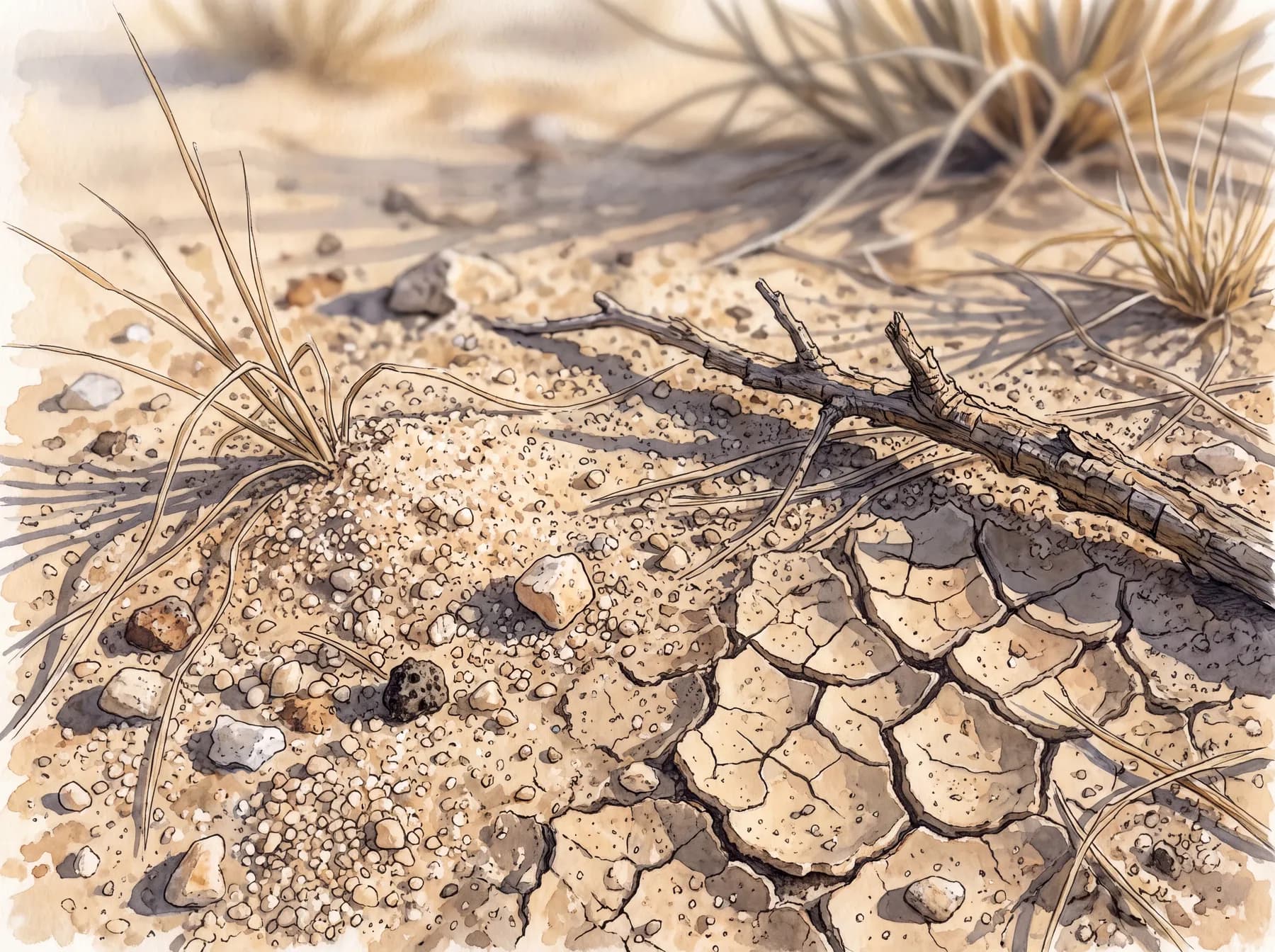
The easiest thing to say about desert ground is that it is sand, and it is the first thing to get wrong. Pick up a handful from this bajada and most of what runs through your fingers is coarse and pale, so the word fits the feeling. But dig in after a hard rain, or come back in June when the same spot has cracked into plates and set hard enough to bend a shovel, and sand alone cannot explain what you are holding.
Soil texture is only a recipe: how much sand, how much silt, how much clay. The three are sorted by size, and the sizes are exact. A sand grain runs from 0.05 to 2.0 millimeters, big enough to see and feel. Silt is finer, 0.002 to 0.05 millimeters, the smooth flour between your fingers. Clay is anything under 0.002 millimeters, small past seeing. That gap is not a technicality. It is the behavior of the ground.
Big sand grains stack like gravel and leave big gaps, so water falls straight through and keeps almost none; sandy soil drains fast and dries faster. Clay does the reverse. Its particles are tiny and countless, and their combined surface holds water against gravity, so the ground drinks slowly, stays wet, swells when it is soaked, then shrinks and cracks and sets brick-hard as it dries. Silt sits in the middle. The fraction everyone ignores, the little clay, is the part that splits the surface and stops the spade.
Where you stand on the slope decides the mix, because a flash flood is a sorting machine. Water tearing down the bajada drops the heavy sand and gravel first, high on the fan, and carries the fine silt and clay farther, letting it settle low toward the basin, where the flattest ground, a playa, is nearly all clay. Walk downhill and the grains grow finer under your boots. The upper fan drinks and drains; the lower ground holds water and cracks.
Underneath all of it, texture stops mattering. Somewhere below the loose topsoil sits caliche, a pale layer cemented hard with calcium carbonate, and it caps roots and drainage no matter how sandy the surface above it reads. A shovel that slides through the top foot can ring against it like stone.
To read the mix without a lab, shake a scoop of soil in a jar of water and set it down. Sand drops to the bottom in seconds, silt layers over it in minutes, and clay can hang cloudy for hours or days before it settles on top. The bands are the recipe, sorted by the same weight that sorts the whole bajada.
Come back to the jar the next morning: the clay still settling on top is the part that cracks the ground and holds the rain.