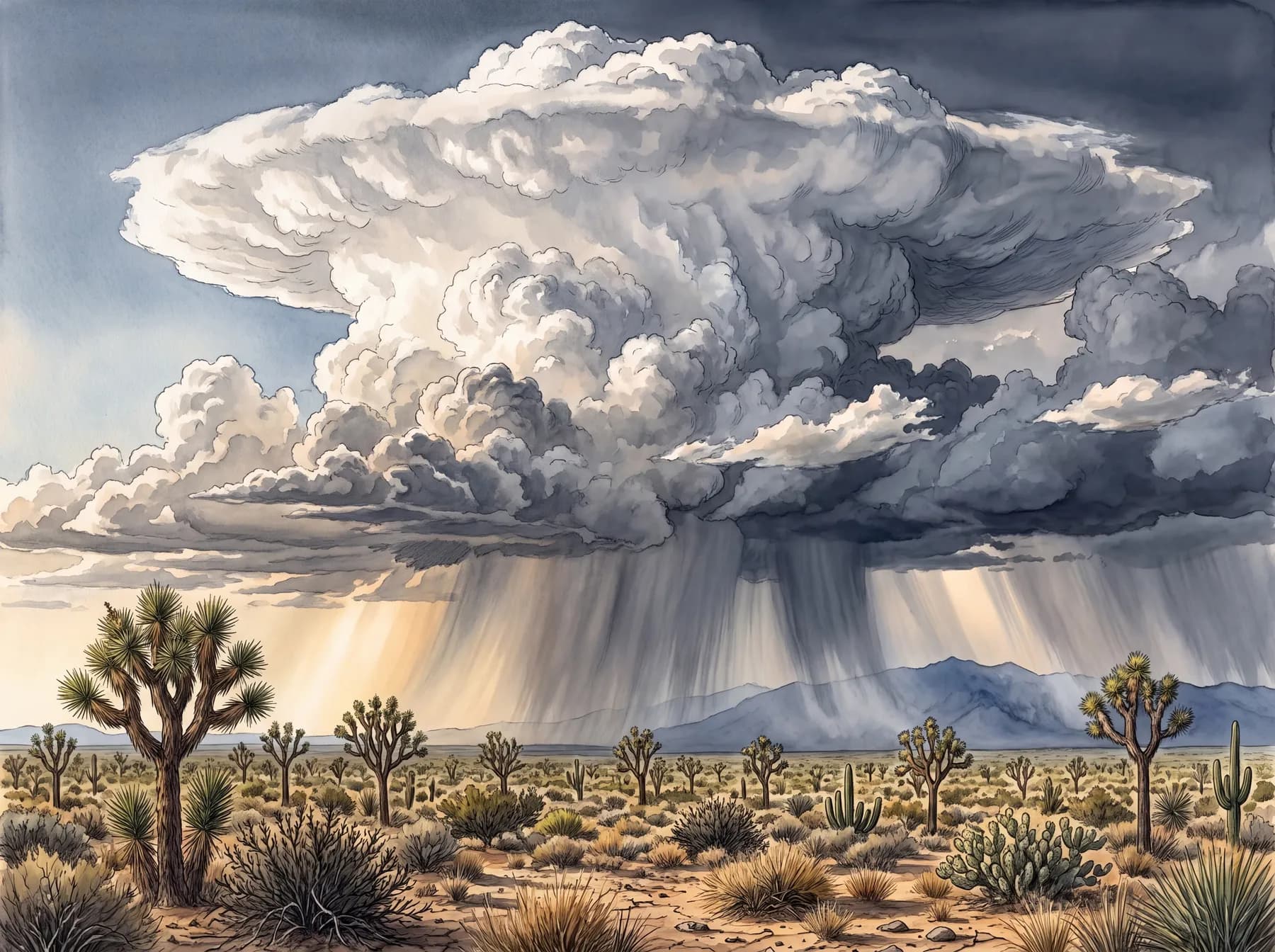
Most people expect a desert to have one dry season and one less-dry one. This eastern edge of the Mojave has two separate rainy seasons, and they arrive from opposite directions for different reasons. Understanding the second one, the summer monsoon, explains most of the year's violent weather at once.
The winter rain comes off the Pacific from the west, and the mountains there wring most of it out before it arrives, which is the rain shadow that makes this country dry in the first place. The monsoon does not come from the west. Each summer the wind pattern reverses and pulls moist air up from the south, off the Gulf of California and beyond, around the end of the mountain barrier, through a door the rain shadow does not guard. That is why the eastern Mojave gets a second wet season where the western Mojave gets only one. There is even a rough dividing line for it, running near 117 degrees west around Barstow: winter-dominated country to the west, two-season country to the east. This ground sits well east of it.
The summer storms are nothing like the winter ones. Where the winter rain is a steady, soaking, region-wide gray, the monsoon is convective and local: towering thunderheads that build in the afternoon heat, dump hard in one spot, and leave the next valley dry. A storm can miss the house entirely and still fill the wash a mile off. It runs roughly July into September.
For all its drama, it is not most of the water. In this eastern, two-season part of the desert the summer storms deliver only something like a tenth to a fifth of the year's total precipitation. But that small share does most of the work the eye can see. It is the monsoon that carves the washes, floods the arroyos, throws the walls of dust, and lights the sky, because all of that violence rides on convective storms, and the convective storms are the monsoon.
So the season has two tempers packed into it, the tender and the brutal. The same weeks that green the desert and fill the rock pools that wake the spadefoots are the weeks of flash flood, lightning, microburst, and haboob. The monsoon is the desert at its most alive and its most dangerous, in the same afternoon.
Watch the south in July. When clouds stack over the far ranges, the rain you can't get from the west comes around the shadow.