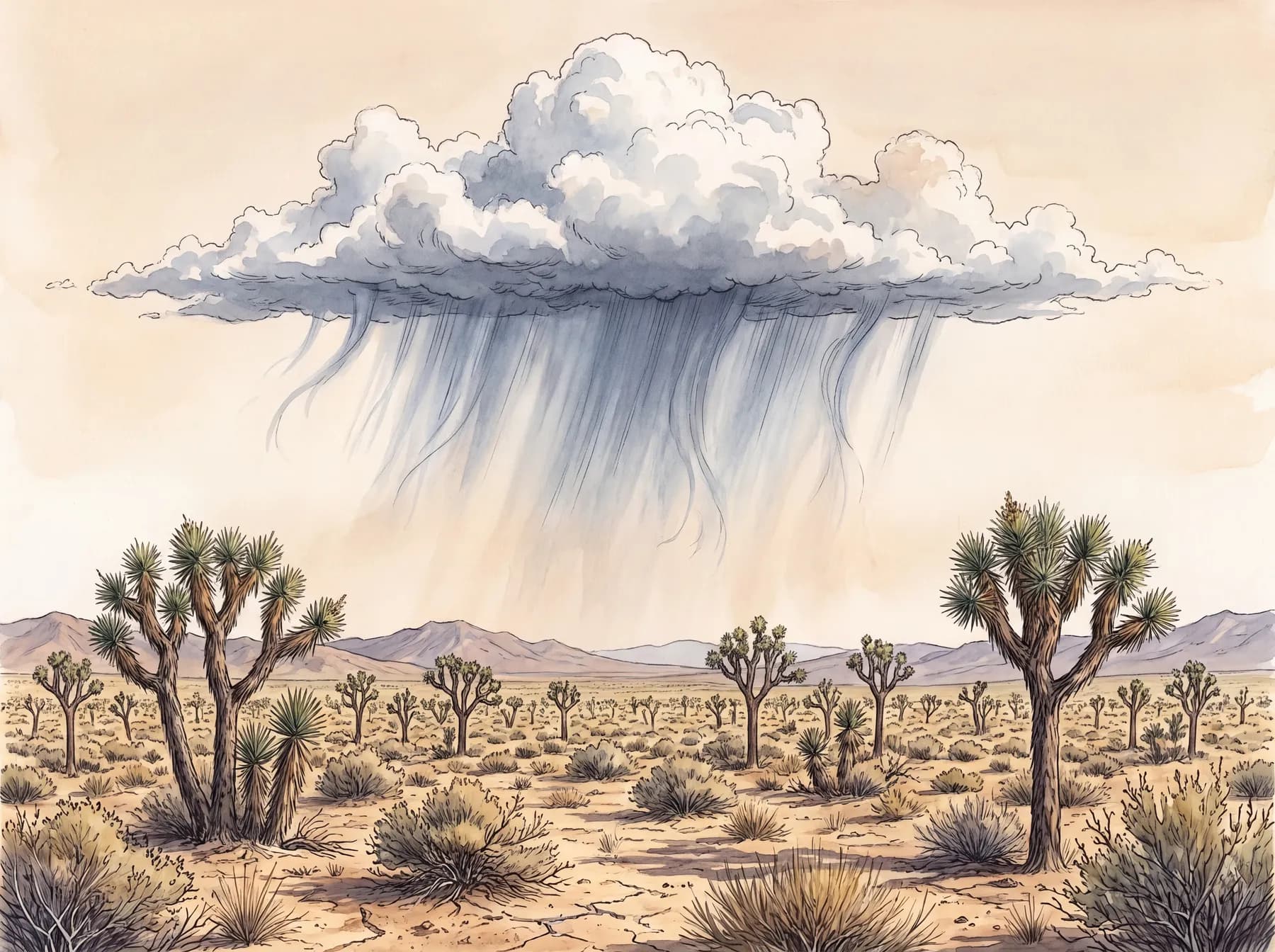
Some of the desert's rain never reaches the ground, and you can watch it fail. Virga is precipitation that falls out of a cloud and evaporates in mid-air before landing, visible as grey streaks or a ragged fringe hanging beneath a cloud base and fading out in a clear gap above the dry desert. The word is Latin for a rod or a streak, which is exactly what it looks like: rain drawn as soft vertical lines that stop partway down.
Dry air is the whole cause. The air beneath the cloud is so hot and so dry that the falling drops evaporate before they can complete the trip, and the drier the layer below, the higher up the rain quits. It is the rain shadow and the desert's aridity made visible in a single sight: a sky plainly delivering rain, and the air drinking every drop before the ground can have it. In this country that is not a rare curiosity; it is the ordinary fate of a good deal of the rain that falls.
Virga is not only a tease, though. The evaporation that kills the rain also chills the air it falls through, and chilled air is dense, so a curtain of virga can feed a sinking downdraft. That is one of the ways the desert builds the cold outflow behind a microburst and a wall of dust, and a virga-heavy cloud can also carry dry lightning, a strike with no wetting rain reaching the ground. The streaks that look like a gentle disappointment can be the first sign of gusty, dangerous air below.
So a virga cloud is worth a second look rather than a shrug. It says the air beneath it is dry and unstable, the setup that can flip into sudden downdraft wind and dry-lightning fire starts even while not a drop lands on you.
Look for soft grey streaks trailing from a cloud, thinning to nothing above the dust. That is rain the air drank going down.