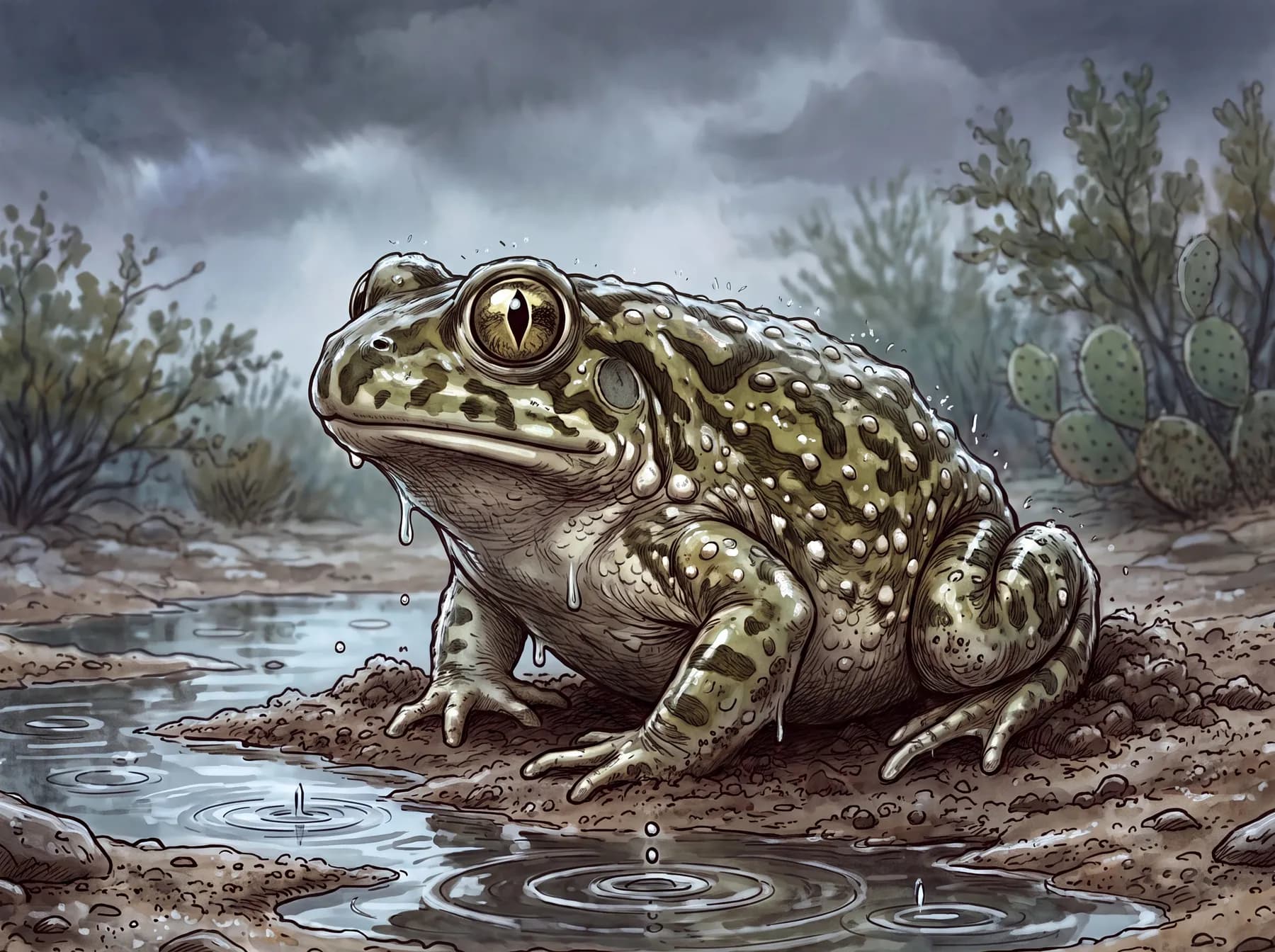
For most of the year there is no spadefoot to find here, only ground with a spadefoot in it. Couch's spadefoot spends something like 8 to 10 months dormant underground, waiting out the dry, and while it waits it does the thing that makes it worth a page: it pulls water out of soil drier than itself. Buried, it lets urea build up in its body fluids instead of flushing it away, until its insides reach an osmotic concentration of around 600 milliosmoles per liter. Water moves toward whatever is saltier, so by making itself more concentrated than the dirt around it, the toad draws moisture inward from ground that would otherwise pull the moisture out of it.
Call it a toad and you are almost right. It is a spadefoot, in a different family from the true toads, and two things on its body say so. The pupil is a vertical cat-slit where a true toad's is a horizontal bar, and on each hind foot there is a single black sickle, a hard wedge of a spade it uses to dig itself backward down into the soil. It carries no great toxic gland bulging behind the eye.
Getting under is only half the trick; getting out is timed to the sky. The spadefoot stays down until the summer monsoon, then surfaces and breeds the first night rain fills the ephemeral pools. The signal is a sound before a sight: a low, drawn-out, plaintive wah, wah, closer to a sheep's bleat than to anything you would call a croak, carrying from a pool that was dry dirt the day before.
Everything after that first night is a race against the sun drying the pool back to dust. The eggs hatch fast, in as little as about 30 hours. The tadpoles are the fastest-developing of any North American frog, able to go from egg to four-legged toad in as few as 8 days. That 8 is the floor and not the rule; the animal is plastic, stretching development toward weeks when a pool lasts and sprinting only when it must.
Up on this high-desert bench it is a northwest-fringe animal, expected where monsoon pools form but not confirmed on this ground, fossorial and easy to miss for the nearly whole year it spends out of sight. If you do handle one, its skin secretions are a mild irritant — enough to start a sneeze or water the eyes — so wash your hands and keep them off your face. This is not the Sonoran Desert toad, and none of that toad's real danger belongs here.
After a monsoon storm, walk toward a new pool in the dark: for a few nights only, the bleat is the whole animal above ground.