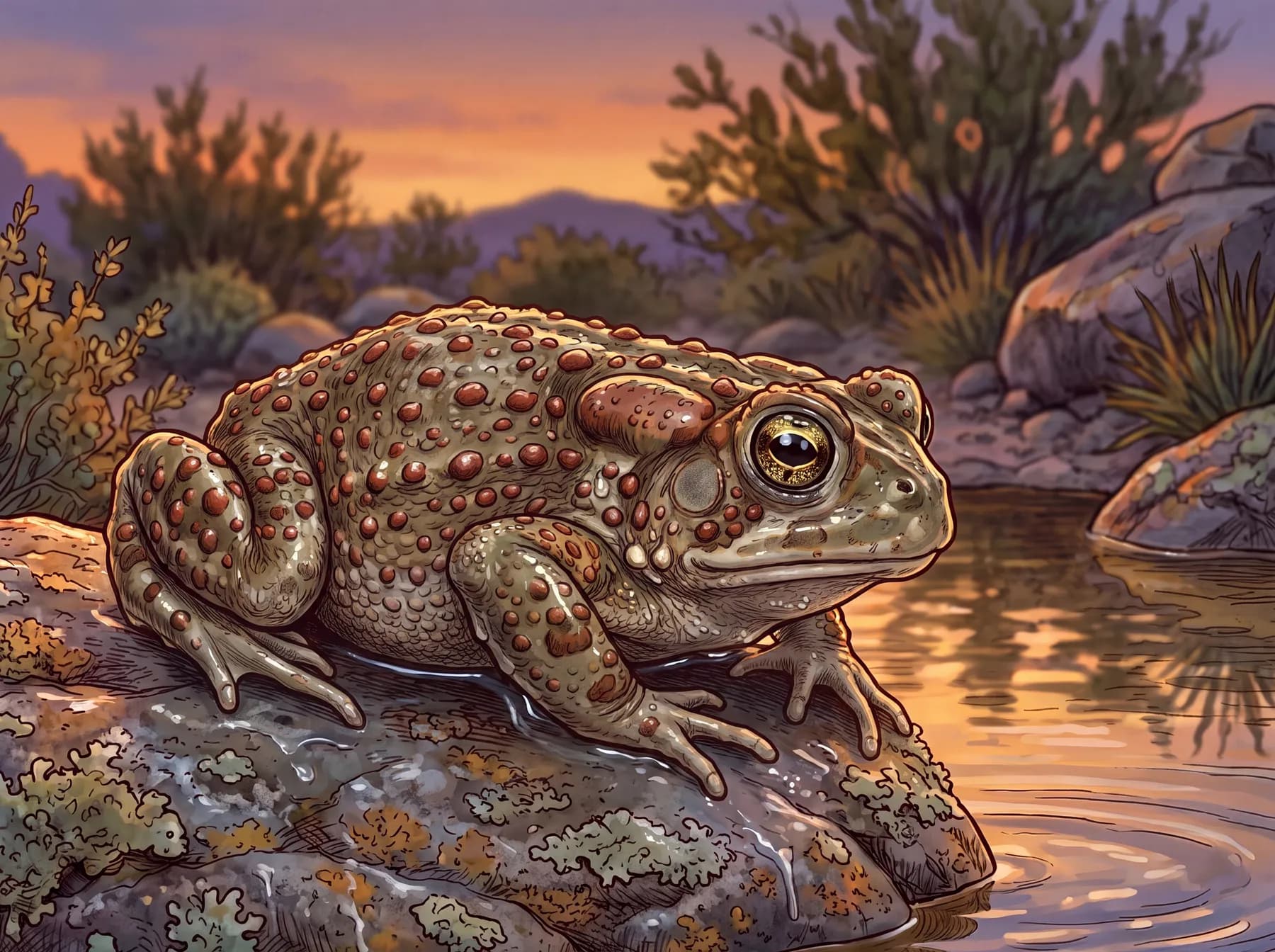
A toad here does not drink with its mouth. It drinks through its belly. On the underside, just ahead of the hind legs, is a patch of loose skin called the seat patch, and when the toad presses it against damp soil or wet rock it pulls water straight in through the skin. In bufonid toads that pelvic patch does most of the work of taking up water — researchers put it around 70 percent, far more than the mouth contributes.
That trick is what lets a toad live where there is no pond. This is dry, rocky high desert, Joshua tree and desert scrub just over 3,000 feet, and the red-spotted toad is built for it: a small, flat-bodied toad reaching about 3 inches, at home in arroyos, canyon tinajas, washes, and the occasional cattle tank, often in rocky ground. By day it wedges that flattened body into a crevice or goes underground, out of the sun, where it loses far less moisture. And it banks what it takes in. Aquaporins, the tiny channels that let water cross a cell, are concentrated in the pelvic skin and in the bladder, so the bladder stores water the animal draws down through a dry stretch.
The response is tuned finer than you might expect from a desert animal. Rather than waiting until it is dangerously dry, the toad begins pulling water through its skin after losing only about 0.6 to 3.0 percent of its body weight, a reflex run by hormones. What I should not tell you is how much it can afford to lose overall. There is a general figure for toads surviving the loss of a large share of their body water, but it has not been measured for this species, so it stays off this page.
It does not need standing water even to breed; it waits for the monsoon. When summer storms fill a tinaja or a rain pool, roughly June through September, the males call from the shallows, from open ground, from burrows and under rocks: a clear, high, musical trill lasting about 4 to 10 seconds. The eggs go into water that may not last, so the tadpoles hurry, changing from swimmer to toadlet in something like one to two months, out of the pool before it dries. For an animal this small it plays a surprisingly long game — the oldest on record reached 11.3 years, in captivity.
The red-spotted toad carries mild toxins in the glands behind its eyes, and a dog that mouths one usually gets some drooling and irritation and little else. It is easy to hang a worse reputation on it than it has earned. The genuinely dangerous toad, the Colorado River toad, lives in the Sonoran lowlands to the south and does not occur up at this elevation; its toxicity does not belong to this animal.
So the mark to learn is the gland itself. Behind each eye, look for a round parotoid gland about the size of the eye. Round and eye-sized is the tell: the region's other toads carry oval or elongated glands, and this is the cleanest way to separate them. The warts scattered over its back run reddish to orange on a pale gray or tan ground.
We have not found one here yet. After a July storm fills a rock pool, the first sign will likely be that trill.