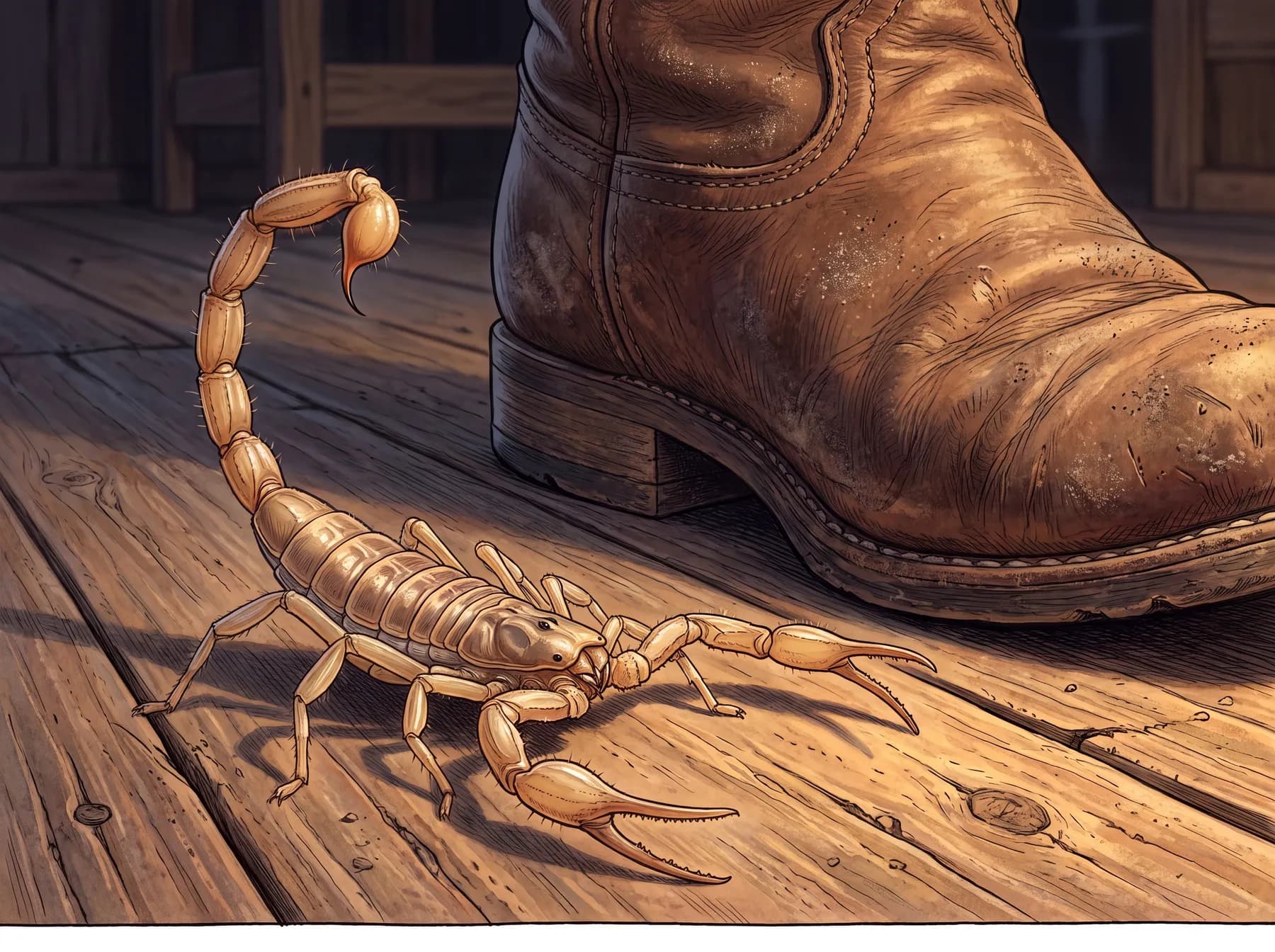
You do not find this scorpion by looking. You find it by turning off the lights.
Sweep a handheld ultraviolet torch across the ground on a summer night and a bark scorpion answers out of the dark in cold blue-green, lit up while everything around it stays black. The glow is real, and the chemistry behind it is known: compounds in the thin, transparent hyaline layer of the animal's outer cuticle, identified as a beta-carboline and a coumarin, soak up long-wave ultraviolet and throw it back as visible light in the blue-green. Every scorpion does this; a UV LED torch picks this one up at roughly six feet. What the glow is for, nobody has shown. The leading guesses have it reading its own body as a light sensor; the purpose is open while the mechanism is settled.
Worth finding, for what it is. Of the scorpions in this country, this is the only one whose sting is a genuine medical emergency, the only species that produces a real envenomation syndrome. That is a narrower claim than the one people repeat: it is not the most venomous scorpion on Earth, a different animal that lives nowhere near here. The venom is neurotoxic, and a sting brings intense pain and a pins-and-needles burn that can run 24 to 72 hours. More than 95 percent of stings stay minor. The severe cases, with agitation, roving eye movements, muscle twitching and airway secretions, fall hardest on small children and the very old, and that is the version that belongs in a hospital. If a young child, an elderly person, or anyone with severe symptoms is stung, this is the scorpion to get medical help for. An antivenom, Anascorp, was approved in 2011 and turned what had been an intensive-care illness into, for most people, an outpatient one. Two deaths are on record in Arizona since 1968.
The reason you meet it indoors rather than out on the flats is a trick none of the other local scorpions can manage: it climbs. Centruroides is the only genus in the Southwest that will go up a wall, a tree, a ceiling, and it prefers to hang inverted, clinging under things. That is how it ends up over a bed, inside hanging laundry, or in a tub, and why it turns up indoors far more than the heavy, ground-bound desert hairy scorpion. It cannot climb smooth glass. None of this makes it only a house animal; it is a desert species of washes and rock and bark that happens to favor cool, humid dark, which around a homestead means the building.
Here on the bench, the species is present in this country, not marginal; it has been recorded on the rims of the Grand Canyon and higher still. But it leans toward moist microhabitat, so it runs thicker along the drainages and around structures than out on the open blackbrush. We have not turned one up on this ground yet, though elevation and buildings put it well inside the envelope. The build is the tell. A bark scorpion is small and slender, pale yellow to tan, reaching about 2.8 inches in a female and 3.1 in a male, with a long thin tail and delicate pincers. Set it against the desert hairy scorpion, which runs past 5 inches, is heavy through the body, carries thick pincers, and does not go up the walls.
So the habits are ordinary: shake out boots before a foot goes in, do not cross a dark floor barefoot on a summer night, keep the bed off the walls, and if you want to know what shares the ground with you, get a black light.
Sweep the torch low across the ground after dark. The thing that answers in cold blue-green is the one to respect.