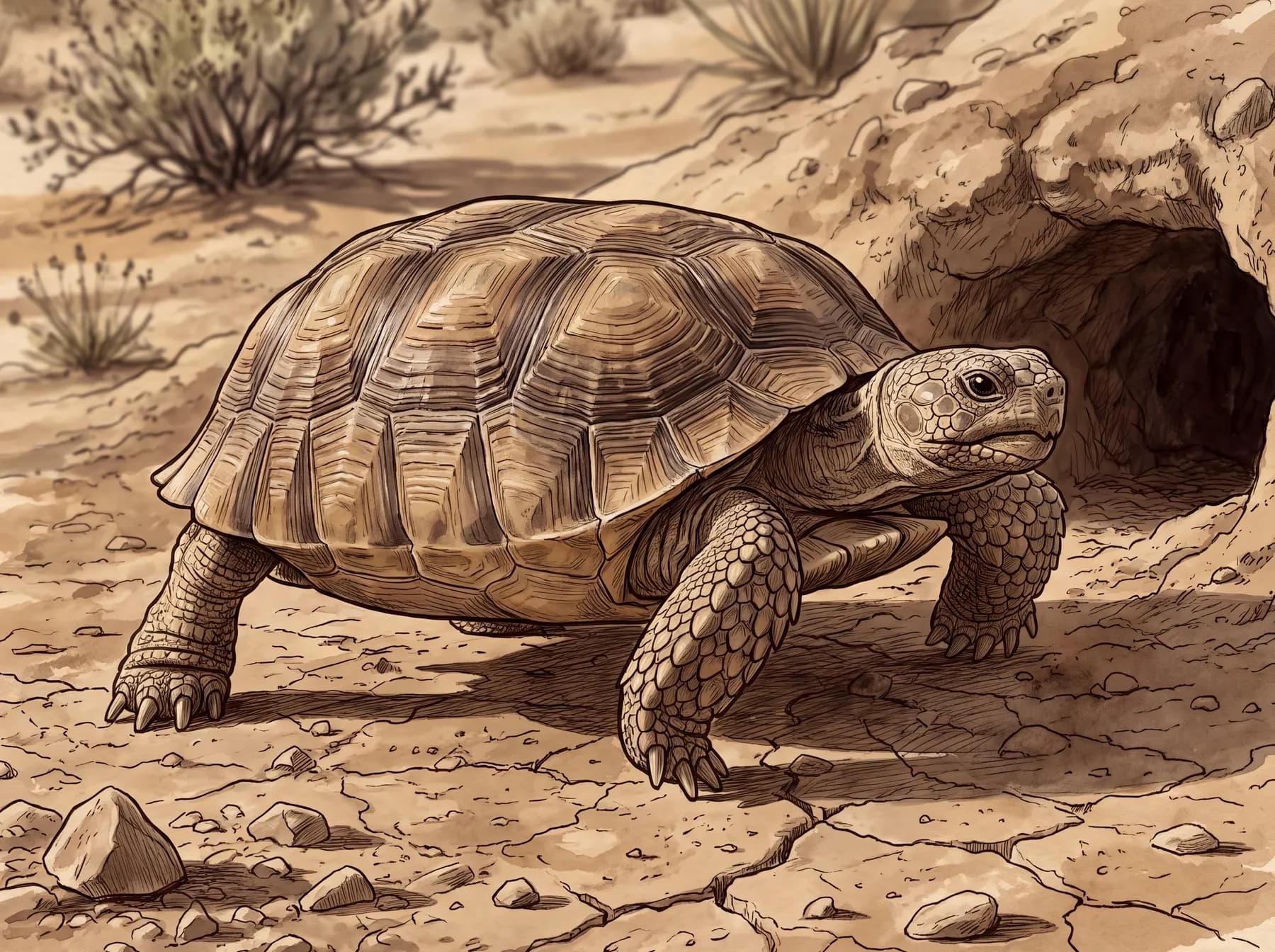
A desert tortoise carries its own water supply, and it carries it somewhere that sounds like a mistake: the bladder. Through the long dry months it stores fluid there and draws it slowly back into the body, holding its blood chemistry together against a country that offers almost nothing to drink. The canteen is internal, and that is the point of it: the water it needs is water it already carries.
But the stored water only buys time. In a Mojave drought study, tortoises lost as much as 40 percent of their body mass, their total body water dropped below 60 percent, and the salts in their blood rose to some of the highest levels recorded for any land reptile. Rather than fight those losses, the tortoise lets its internal chemistry drift, tolerating conditions it would normally work to correct. When physiologists needed a word for an animal that stops defending its own steadiness, they had to coin one: anhomeostasis. Then the rain arrives, and the tortoise drinks hard from shallow basins it digs and revisits, voids the concentrated urine it has been hoarding, and refills the bladder with fresh dilute water.
Most of that endurance happens out of sight. A desert tortoise spends more than 90 percent of its life underground, in burrows it digs with flattened, shovel-like forelimbs, and it can lie dormant below ground for as much as 9 months of the year. Winter dens run as far as 30 feet back into the bank of a dry wash, and they are not always private: researchers have counted about 3.1 tortoises in an average den and 17 in one large one. The tunnels outlast their diggers, and something like 21 other animals reuse them, packrats most often, with snakes, lizards, and rabbits among the rest. A single well-dug burrow becomes shared shelter.
There is also the question of which tortoise this is. For 150 years it counted as one species; in 2011, on genetic and behavioral evidence, biologists split it in two along the Colorado River. The animal on this bajada is the Mojave one, Gopherus agassizii, the tortoise of Joshua-tree and blackbrush country, while its Sonoran sister, G. morafkai, keeps to rockier paloverde-and-saguaro desert. You could not tell them apart by eye; the split is written in DNA, not in the shell. What makes this county unusual is that it holds the one documented place the two meet, a band of Mojave tortoises thought to have been left on the east bank when the river shifted course. That seam is narrow, the county's oddity, not a fact about any given parcel.
The tortoise buys its long life with a childhood that drags. It takes 13 to 20 years to reach breeding age, and the shell does not fully harden until about age 6; before that a hatchling can be pecked straight through. Common ravens, their numbers swollen by our landfills, open water, and power poles, have learned this. In the west Mojave, researchers found 250 young tortoise carcasses beneath a single raven nest over about 4 years, and only 2 to 5 percent of hatchlings ever reach adulthood. The Mojave population has been listed as federally threatened since 1990.
So if you find one, the rule is hands off, and not only because handling a tortoise has been illegal in Arizona since 1988. A frightened tortoise empties its bladder, the very canteen it spent the dry season filling, and one Arizona study found that tortoises which voided during handling had 5 to 13 percent lower annual survival. Lift one to admire it and you can cost it the water it was living on. We have not confirmed a tortoise on this ground yet.
So look for the burrow, not the animal: a tunnel driven into a wash bank, with most of a tortoise's life sealed somewhere inside it.