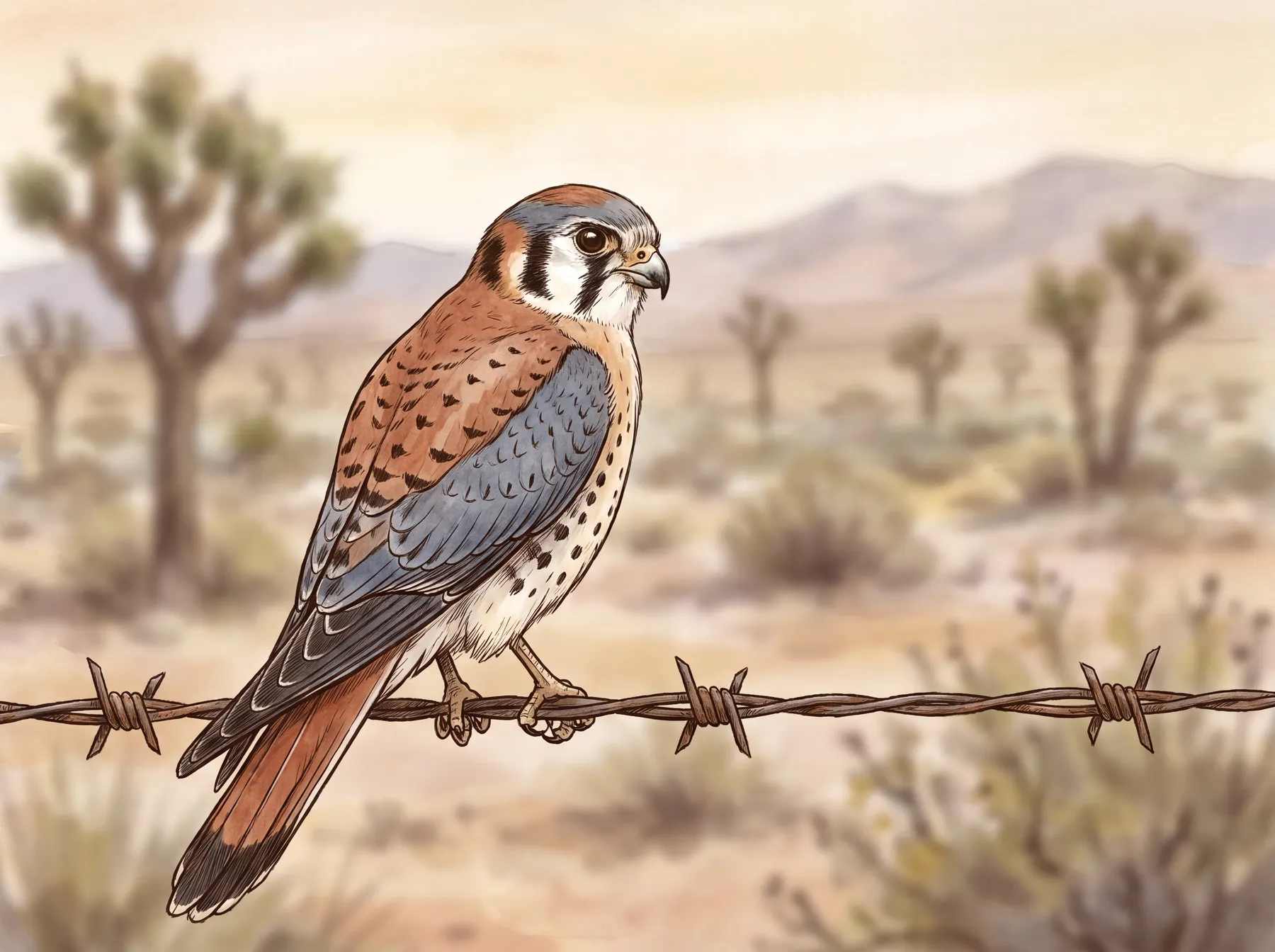
A kestrel hunting into the wind does something that looks, on film, like a glitch. The wings beat, the tail keeps fanning and trimming, the body rides every gust, and the head does not move. It hangs in one fixed spot of air as though it had been pinned there. That stillness is the reason for everything else the bird is doing. It is not laboring to stay aloft so much as laboring to keep its eyes locked on a single patch of ground.
Facing into the wind, the bird matches its own forward airspeed to the windspeed closely enough that it holds still over the desert below. In a stronger wind it stops flapping almost altogether and kites, adjusting the shape of its wings and tail by tiny amounts while the skull stays put. The head is held steady by fast reflexes and by specialized neck muscle, and the accepted reason becomes plain once you watch it: a hunting bird whose eyes are shaking is reading a shaking picture. Hold the eyes still and the ground below resolves.
That trick only earns its keep in open country. Hanging in the air is costly work, so a bird will pay for it where the ground is bare and the prey has nowhere to hide. This bajada is exactly that ground: blackbrush and Joshua-tree flats a little over 3,000 feet, low vegetation, a scatter of perches and snags, little cover. The kestrel also hunts the lazier way, watching from a wire or a post. Either way it is after a desert menu of grasshoppers, beetles, cicadas, scorpions and spiders, with lizards, mice and small birds behind them. Its old name, Sparrow Hawk, gets it wrong twice: it is a falcon, not a hawk, and it eats insects first.
When it kills more than it can use, it caches the surplus nearby, tucked into a grass clump or a fence post or a cavity, and comes back for it later, which is a real edge in a place where food arrives in pulses. It nests in cavities too, though it cannot cut its own. It takes over old woodpecker holes, rock crevices, and readily, a nest box. It is one of the very few raptors, and essentially the only falcon, you can invite onto open ground by offering it a hole to breed in.
It should be here the year round. Kestrels breeding this far south mostly stay put rather than migrate, and their numbers likely swell in winter as birds drop down from colder country. Yet the commonest falcon on the continent is quietly thinning out: down about 1.4 percent a year, a cumulative 53 percent between 1966 and 2019, with another halving projected by 2075 if the slide holds. The causes are several and unsettled, from lost nesting cavities to cleaner farmland with less prey to pollutants, which is why the decline is still under study rather than explained.
No confirmed sighting here yet. When you do find one, read the perched bird: it bobs and pumps its tail as it sits. Two black slashes run down a white face. And unusually for a bird of prey, where the sexes look alike, the male carries slate-blue wings while the female's are rusty and barred with black. On the back of its head sit two dark spots like a second face; the guess is that they discourage an attack from behind, though nobody has shown it.
On a wire, look for the tail that will not hold still, and the pair of black marks running down a white face.