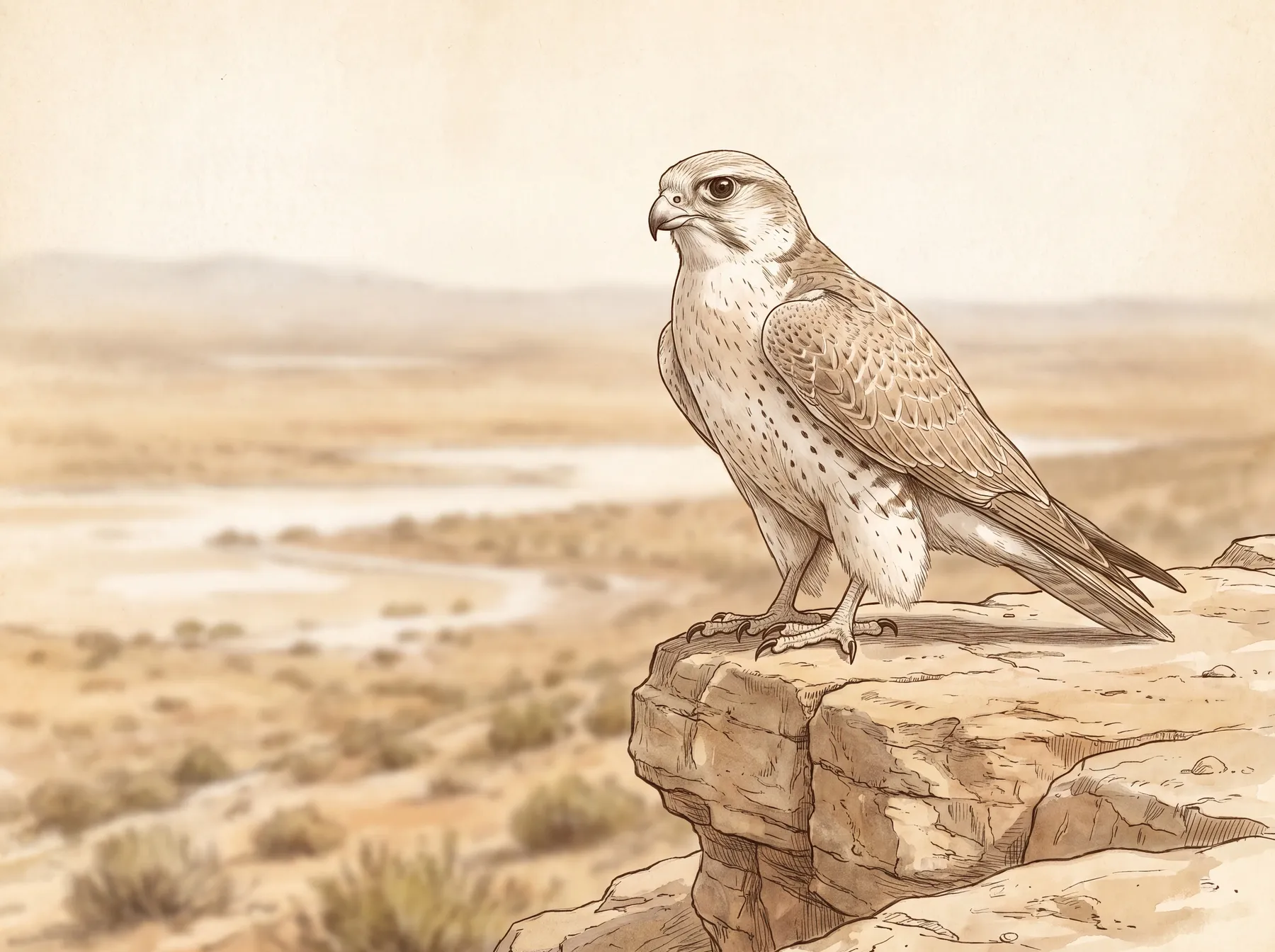
A peregrine hunts by climbing high and dropping. The prairie falcon does close to the reverse. It comes in flat, a few feet off the ground, using a low rise or a line of blackbrush as cover, and arrives inside a flock's reaction time before the birds have decided to leave. When it does use height, it stoops and then levels out near the deck, still traveling at more than 100 mph a meter or two up, sometimes gliding for over a kilometer on the way in. Cruising, when it is only crossing country and not hunting, it settles back to something nearer 45 mph.
The stranger version of the same tactic is to come in beneath a flock rather than above it, the ground hiding the approach, and then spend all that speed straight upward in a climbing strike from below. Most people picture a falcon as a thing that drops out of the sky; this one is as willing to come up from underneath a flock instead.
For a long time it was filed next to the peregrine, on the reasonable grounds that it looks like one. The genomes moved it. A draft genome published in 2018, read against both the mitochondrial tree and thousands of single-copy nuclear genes, places the prairie falcon outside the group that holds the peregrine and the larger desert falcons, on a limb of its own that branched off before the peregrine and the gyrfalcon had split from each other. It is nobody's sister species. It only wears the family resemblance.
What keeps it in open country like this is a rodent that is briefly available. Across its range the falcon's breeding runs on ground squirrels: it lays as they emerge from months underground, raises young while they are easy to catch, and then the squirrels retreat back below ground for the dry heart of summer and the diet flips to fledgling songbirds while those are leaving nests, and in winter to flocking birds like horned larks. The timing was worked out where the squirrel is a Great Basin animal; here it would be the round-tailed, antelope, and rock squirrels instead, but the pattern should carry. Unlike most falcons this one barely migrates, and many adults hold near the nesting cliff year-round. It builds nothing for them: the nest is a bare scrape in gravel on a sheltered ledge, under an overhang.
We've not caught one over this ground, though the open Joshua-tree flats and the broken cliffs that edge them are close to its ideal. It is pale and sandy above, pale below, with a narrow dark moustache thinner than the peregrine's heavy helmet. The surest mark is under the wing. Against an otherwise pale underwing, the armpits and inner linings are dark, printing as two triangular black patches where the wing meets the body. A peregrine carries no such patches.
Watch a falcon cross high and pale, then check the wingpits: two dark triangles tell you which falcon you have.