A turkey vulture can find a body it never saw. In a field trial in Panama, researchers hid some carcasses under forest cover and left others in the open, 74 in all, and the vultures located 71 of them within three days. The concealed ones took no longer to find than the exposed ones. Canopy did not hide a carcass from a bird hunting by smell.
The instrument is the nose. Set beside the black vulture it shares this range with, the turkey vulture carries olfactory bulbs about four times larger, in a brain roughly a fifth smaller, the largest smelling apparatus of any bird measured in both absolute and relative terms. The black vulture cannot match it, and is thought to solve the problem by watching instead: it tracks foraging turkey vultures and follows them down to the carcass they located first.
What the bird will not do is kill. In the same trials it passed over freshly dead animals and took them readily only once they were a day old, preferring day-old carcasses to older ones. A turkey vulture is keyed to decay, not to the living, so the shape circling over something in the wash means little for anything still breathing. Which molecule of decay it follows is still unsettled. One study measured the birds' sensitivity to the mercaptan added to natural gas and found it too dull to be a likely foraging cue.
A diet of rot needs a gut that can survive it. A survey of New World vultures found the hindgut runs on a spare, hard flora dominated by Clostridia and Fusobacteria, bacteria pathogenic to most vertebrates; the acidic gut destroys most of what the bird swallows and lets a lopsided few survive to do the work. The bird does not resist the rot so much as it has come to terms with it.
On this bajada the vulture is a summer fixture and a winter absence. Up in the high desert it is a seasonal resident that breeds through the warm months and clears south for the cold ones, the Arizona birds pulling out mostly between early September and late October. Through the desert heat it cools itself in a way that reads as crude and works: heat-stressed, it excretes onto its own bare legs, and the evaporating waste carries heat off the blood running close beneath the skin. The pale crust on the legs is the residue of that cooling.
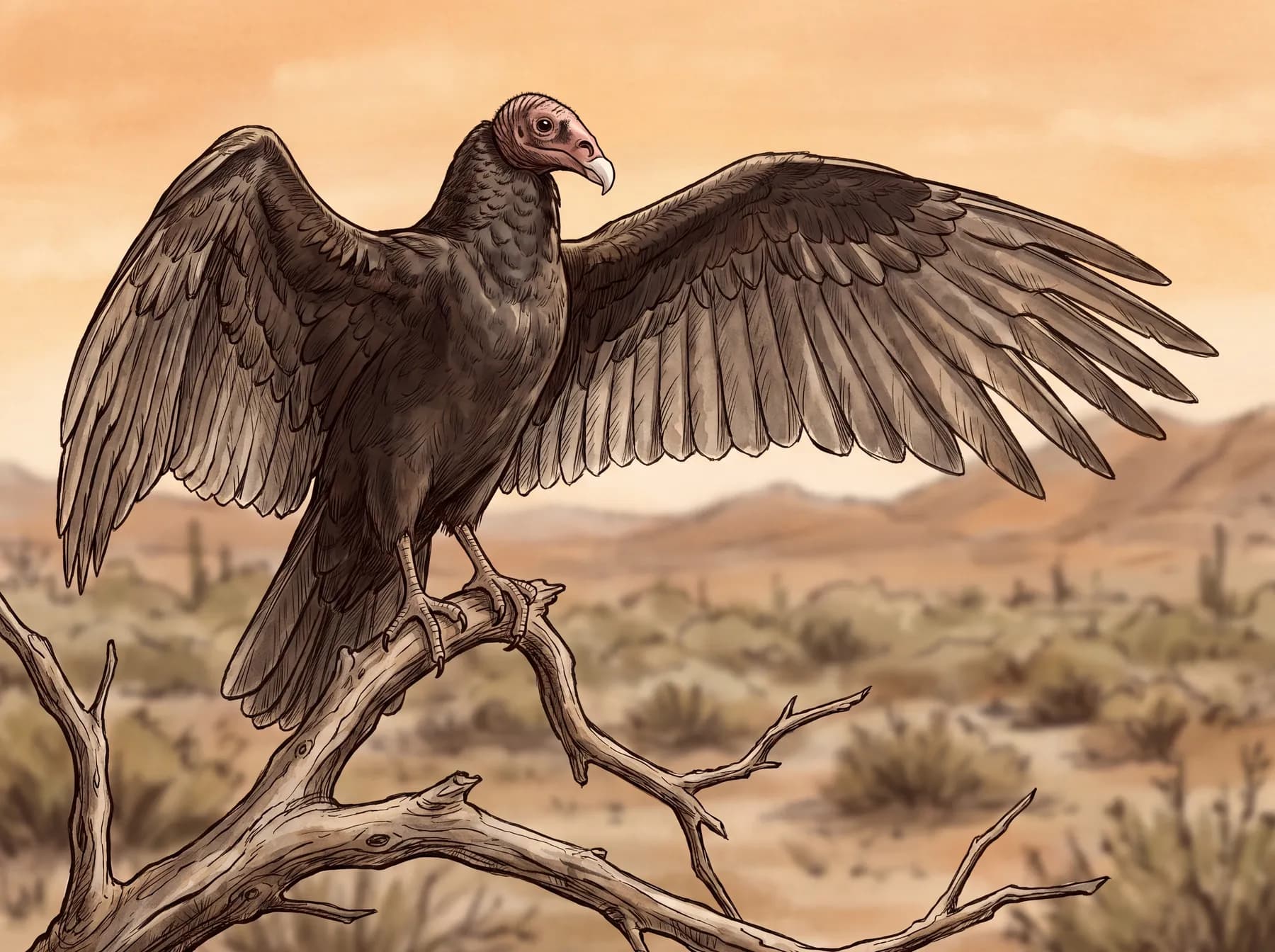
So look up in summer, and read the shape before the color. A turkey vulture soars with its wings held in a shallow V rather than flat, and it teeters as it goes, tipping side to side on almost no wingbeats, unsteady in a way no hawk or eagle is. From below, the wing you are watching is two-toned: dark linings along the leading half, silvery flight feathers behind. The bald head reads red on an adult and gray on a young bird, so an odd gray-headed vulture is not a different species, only a younger one.
No sighting of our own over this ground. The first will likely be a dark V overhead, tilting, at an angle no hawk holds.