The western diamondback is likely responsible for more snakebites than any other snake in the United States, and a study of 86 consecutive bite victims in central Arizona, where it is the snake people meet most often, found that most of them had already seen the snake before it struck.
The researchers split the bites into two kinds. A legitimate bite lands on someone struck before they knew a snake was there, or while they were backing away. Everything else they called illegitimate: the person saw it, knew what it was, and closed the distance anyway. Only 43.4 percent of the bites were legitimate; about 57 percent were not.
The pattern inside that number is the interesting part. Alcohol was involved in 56.5 percent of the illegitimate bites and 16.7 percent of the accidental ones. Nearly three-quarters of all bites, 74.4 percent, landed on a hand or arm, and only about a quarter of those were accidents, while every single bite to a foot or a leg was. Legs are bitten by chance. Arms are bitten by choice.
The danger is real, then, but not the danger people picture. Drop for drop the venom is comparatively mild, with a subcutaneous LD50 around 18.5 milligrams per kilogram, far less toxic than that of many other rattlesnakes. What the diamondback brings instead is volume: a bite usually delivers 250 to 350 milligrams and can reach 700 or 800, a large dose of a moderate toxin rather than a small dose of a fierce one. Across the country that runs to roughly 8,000 venomous snakebites a year and, with treatment, somewhere between 8 and 15 deaths.
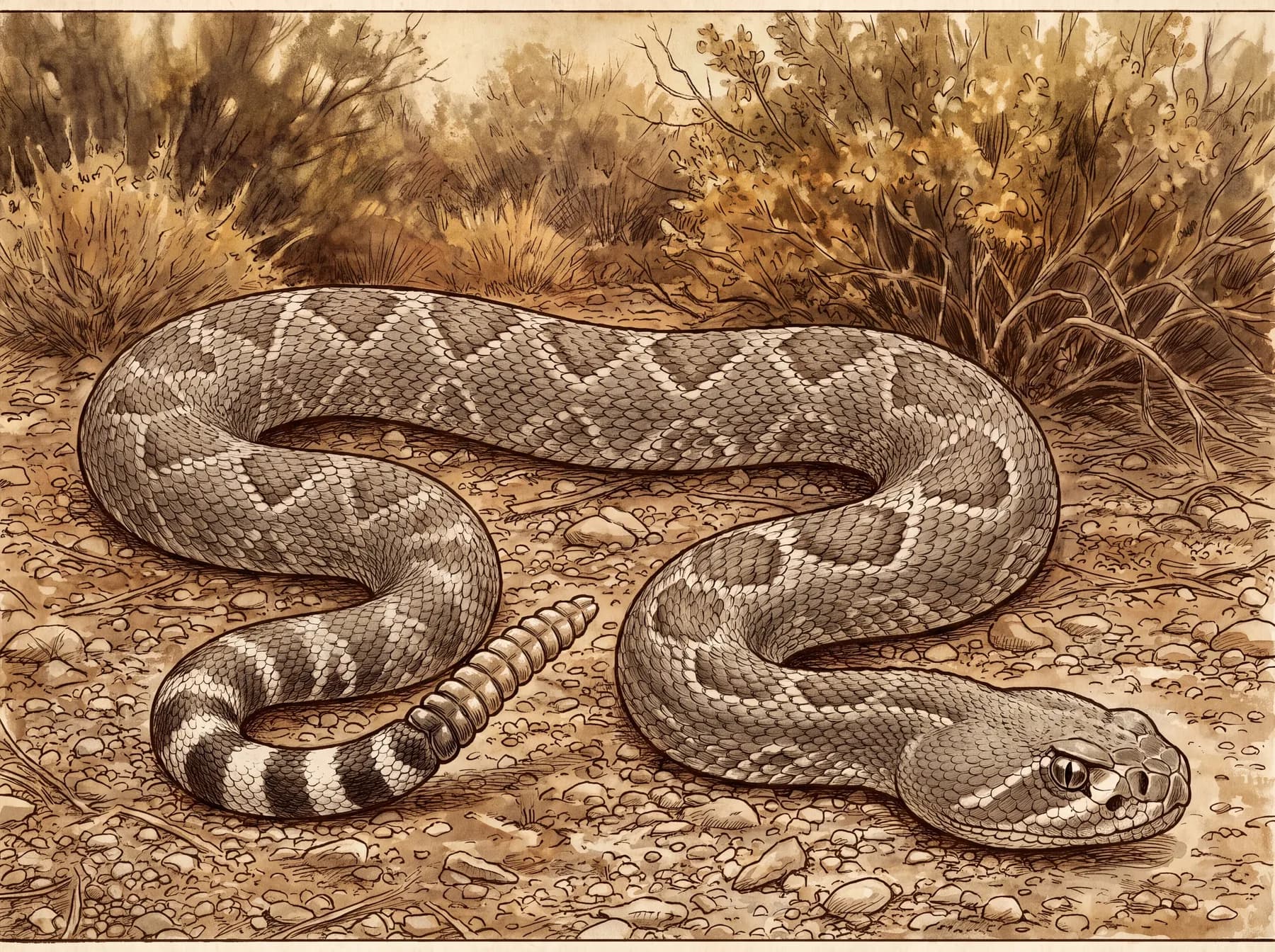
It is a large, heavy-bodied snake, chalky gray-brown, up to about five and a half feet in Arizona, and this parcel sits near the northwestern corner of its range, closer to the margin of its country than the middle. The range thins out not far north of here, though elevation is no obstacle: this ground lies well under the roughly 5,300-foot ceiling the species reaches in the state. The Mojave and speckled rattlesnakes may well be the commoner neighbours. Cornered, a diamondback often, though not always, declines to run across hot open ground; it lifts its head, rattles, and retreats slowly toward cover. Behaviour between individuals varies, and always stands its ground is folklore laid over a snake that merely often does.
The identification is not idle, because the Mojave rattlesnake carries a far more potent, neurotoxic venom and the two are easy to confuse. No single mark is reliable, so if you want to be sure, learn three together. On the diamondback the pale stripe behind the eye runs steeply back and down to touch the lip in front of the mouth; the tail wears black and white bands of roughly equal width, the coontail; and the back is heavily peppered with dark speckles. The Mojave's eye-stripe misses the lip, its white bands are wider than the black, and its back lacks that peppering.
So on the next big gray rattler, read the tail: black and white rings of equal width name the diamondback, not the Mojave.