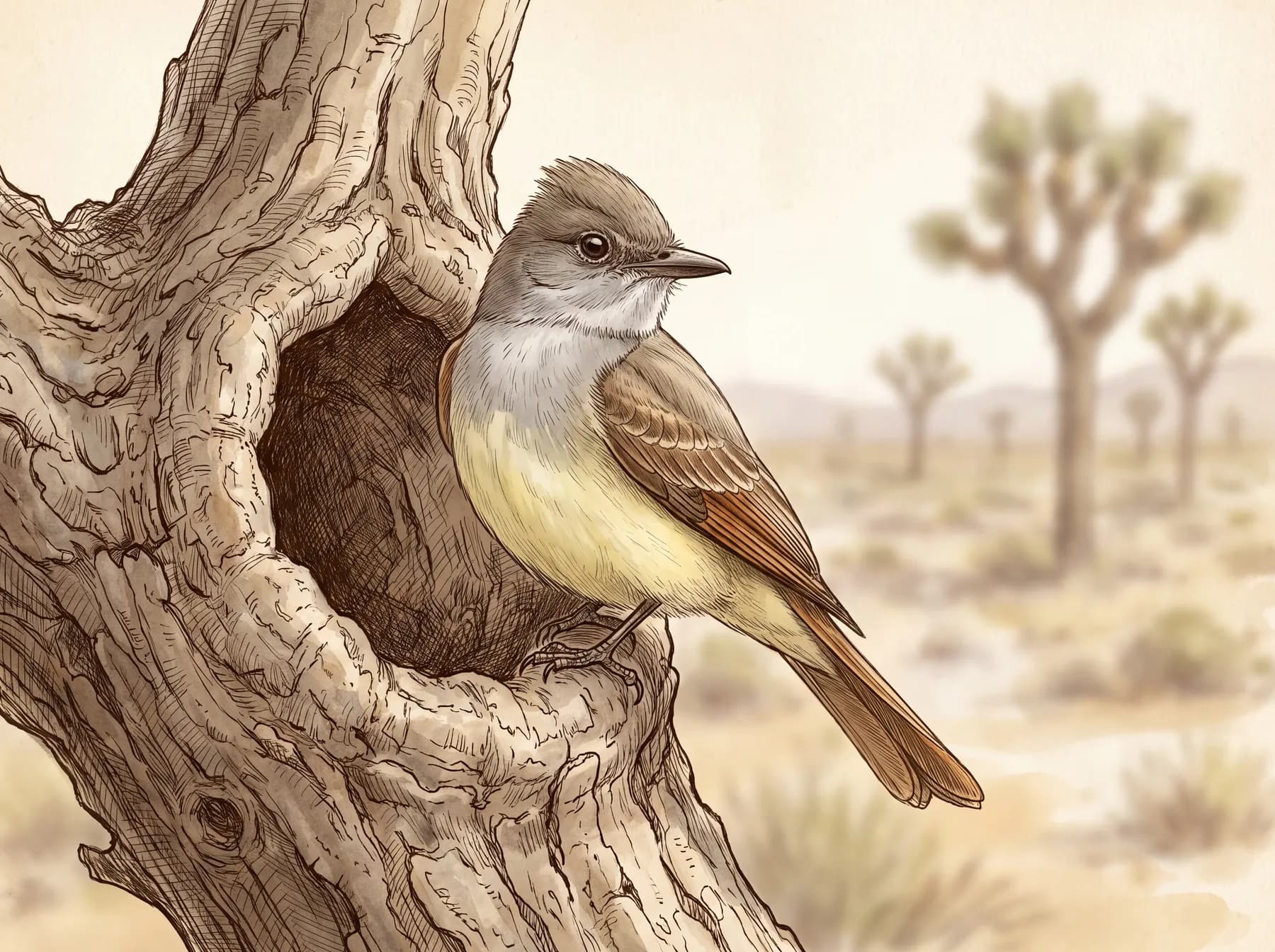
The thing worth knowing about this pale flycatcher is that it breeds in scrub too dry to keep most birds alive, and it manages by not drinking. It arrives in spring, raises a brood in the blackbrush and Joshua-tree flats, and takes its water from the insects it catches. Cornell's ornithologists put it plainly: living in a hot climate, apparently it does not drink, and gets all its water from the food it eats.
Hold that word "apparently," because it is Cornell's own, and it carries more weight than it looks. The fact is well sourced, and the authorities agree the bird does not need to drink, which is part of why it can nest in sparse desert where others cannot. But the mechanism underneath is barely studied. No one, as far as I can find, has measured how much of its water comes from prey, or tracked the water moving through it. The bird is drier than the ground it lives on, and the how of it is still an assertion more than a measurement.
What lets it breed here at all is a hole it cannot make. The ash-throated flycatcher is a secondary cavity nester, which is the polite term for a bird that moves into someone else's work. It relies on old woodpecker holes, in this country usually a ladder-backed woodpecker's, or on natural cavities in a dead Joshua-tree limb or a yucca stalk. It is spectacularly unfussy about the substitute. Nests turn up in fence posts, exhaust pipes, mailboxes, metal guy-wire frames, and once a pair of trousers left hanging on a clothesline. Put up a bluebird box and it will likely take that too. This is no grateful tenant: it will evict a Bewick's wren or a mountain bluebird from a hole, though it loses the same fight to a starling.
The name says flycatcher, and the picture that raises, of a bird snapping insects out of the air, is only half right, and the wrong half. It does sally out from a perch, but it seldom catches anything in flight. Mostly it flies to the foliage and picks prey off leaves and twigs, feeding low, gleaning more than hawking. So a flycatcher you find working this ground is not patrolling the open sky. It is hunting the brush and the dead limbs, close in, taking bugs and spiders off the surfaces where they sit. It eats small desert fruit as well, which is not what the name led me to expect.
It is here only for the warm half of the year. At this elevation, up on the high-desert bench, the breeders arrive around mid-April to May and are gone by mid-September, wintering south in Mexico; a January flycatcher here would be some other bird. Identification comes down to voice and overall paleness, because it is a plain thing, a whitish throat grading to a pale-yellow belly, with rufous worked into the tail. Watch the posture: it perches upright and pumps its head when agitated, and in real heat it holds its folded wings out from its body to shed it.
Still off our own list here. Listen in April for its call from a dead limb, then read the tail for rufous.