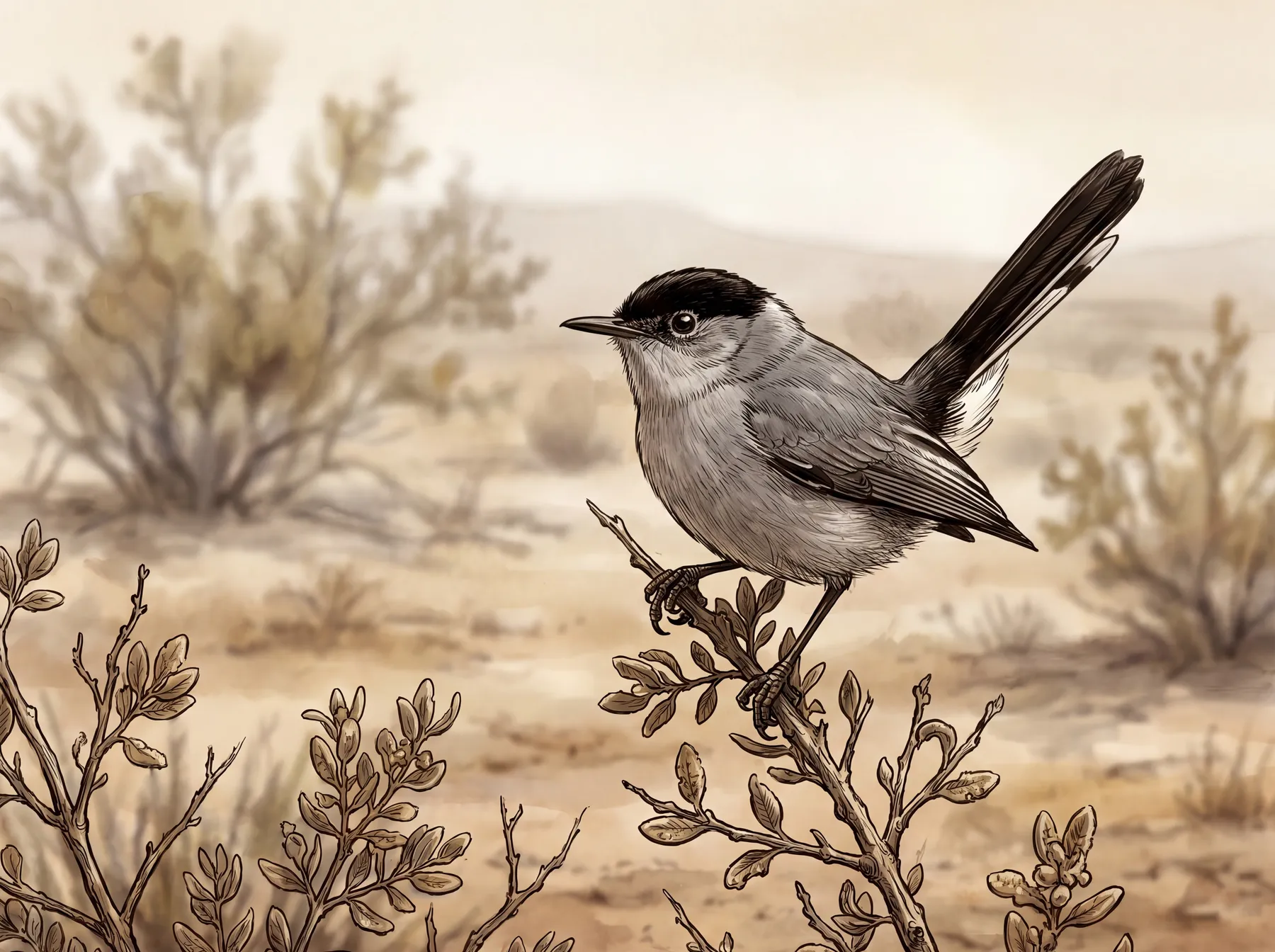
Two gnatcatchers work this scrub, and you would be hard pressed to tell them apart. Same slate-gray back, same pale underside, same long tail flicked from side to side without rest. But one of them leaves every year and the other never does. The blue-gray gnatcatcher is a migrant; researchers describe nearly all of the North American birds as migratory, here in summer or winter and then gone. The black-tailed gnatcatcher is the one that stays. On this high-desert bench it is a year-round resident, present through the July heat and the January cold, holding the same ground the whole time.
Staying costs water, and water is the thing this country does not hand out. The bird's answer is to stop needing the tap. A black-tailed gnatcatcher takes essentially all the water it needs from the insects it eats, and its nests can sit several miles from the nearest standing water. It is most common, in fact, where the annual rainfall runs under about 8 inches. The animal is not enduring the dry so much as it has quietly opted out of the problem, running its whole body on the moisture inside a beetle.
That body is small enough to make the feat stranger. At 5 to 6 grams it is among the smallest songbirds on the continent, about the weight of a nickel, and for its size it is not shy. These are high-strung, restless birds that scold and chase things many times larger, and near a nest they will dive at an intruder. A pair often works the scrub together, trading a thin run of contact calls, and the two may hold a territory year-round. It is tempting to make that a marriage. The published accounts only support a pair that may stay paired through the year, and they note the birds otherwise wander across a region, so the plain version is the better one: two birds sharing ground for a season.
Its ground here is the wash, not the open flat. The stronghold is the creosote-lined arroyo and the thornscrub down in the drainages, where it gleans arthropods off twigs and leaves: beetles, true bugs, caterpillars, ants, small grasshoppers, the odd spider or berry. Watch across the year and the hunt shifts with the season, more among the leaves in summer and fall, more on the bare twigs and branches through winter and early spring. In the worst of the heat it pulls back into shade and slows down, but it does not leave.
Telling it from its migrant twin comes down to one glance, and the glance is upward. In breeding season the male wears a black cap pulled down to the eyes, which settles it at once. But females and winter males drop the cap and go nearly identical to the blue-gray, so the dependable mark is the tail seen from below. On the black-tailed it reads mostly black with small white spots near the tip. On the blue-gray it reads mostly white. Same silhouette, opposite tail. Nobody has logged one on this bajada yet.
When one comes, it will likely show the tail first: a black underside flicking in the creosote, white spots near the tip.