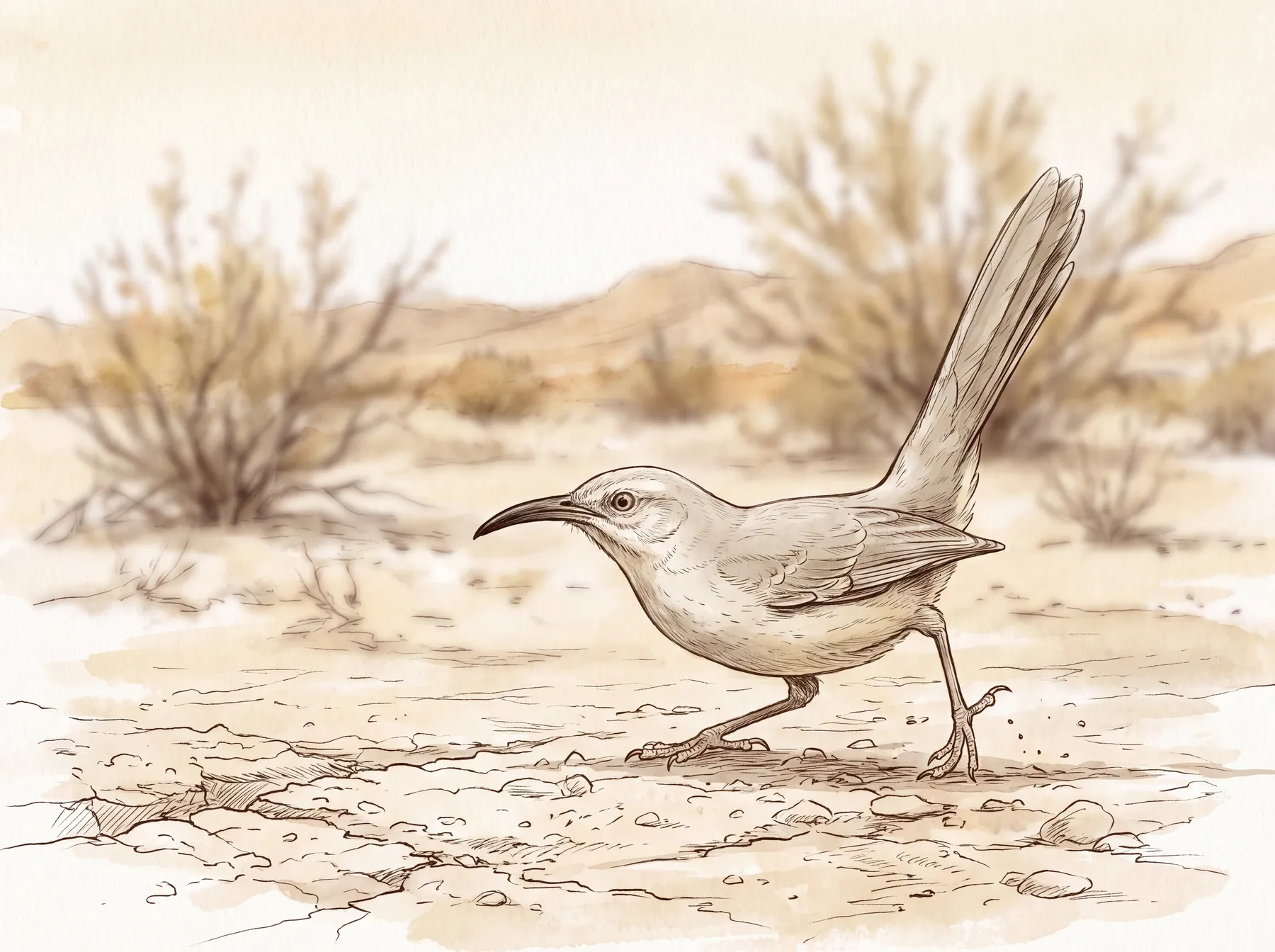
You find most birds by going where the life is: the seep, the flowering shrub, the thick cover. You find this one by going where the life is not. The LeConte's thrasher wants the barest ground the desert can offer. It settles on flat or gently sloping stretches of mostly bare, sandy soil, where the annual plants stay under a foot high and the whole stand is thin enough to walk through without brushing anything. Researchers who mapped it found that large areas of otherwise suitable desert sit empty, and concluded that the smallest patch it will accept is among the largest of any songbird, on the order of 2,500 acres of undisturbed desert. It does not tolerate emptiness. It requires it.
The bird is built to vanish into that ground. It is the palest of the eight North American thrashers, a uniform sandy gray with no streaking and no strong face pattern, colored so closely to the pale desert floor that Cornell's writers call it a ghost of a bird. It carries a reputation as one of the harder birds in North America to see on purpose. That is reputation, not a measurement: it grows out of the barrenness of the country the thrasher keeps, ground so open that for a long time few people thought to look for a bird there at all, and out of a habit of slipping off before you can resolve it.
The slipping off is literal, and it happens on foot. A LeConte's thrasher feeds almost wholly on the ground, walking and running fast over open soil, and when something presses it close it runs rather than flies, tail cocked up over its back, threading the low shrubs. It seldom flushes the way a startled bird is supposed to. Old field accounts claim it can outrun a trotting horse, which is worth keeping as color rather than as a measured speed, but the instinct behind the story is real. Given the choice between wings and legs, this bird takes the legs.
What it runs across, it also digs. Much of its food is buried, and the thrasher drives its long, downcurved bill into the sandy substrate and the litter beneath desert shrubs, probing and digging pits several inches deep for the arthropods sheltering there. That habit carries a second payoff. The bird is a true xerophile — it draws its water almost entirely from its prey, and even in the rare stretch when standing water is present it seldom drinks. The insects it digs up are the supply. Ground with almost no water becomes livable for an animal that eats its water and never has to find the puddle.
Out on the blackbrush flats the thrasher sits at the edge of its world. Its elevation band in the Arizona Mojave runs from roughly 1,800 to 3,240 feet, so this ground rides close to the ceiling, which makes the bird a local, patchy resident here rather than a common one, present where the sparsest creosote and saltbush flats open up and absent across the denser stands. Where it holds, it stays; it is sedentary and does not migrate. It breeds early, too, building nests in late December and January and laying from February into spring, running its young out ahead of the worst desert heat. None seen on this ground by us.
If one is here, you will catch a sandy blur crossing bare soil, and then only the bare soil.