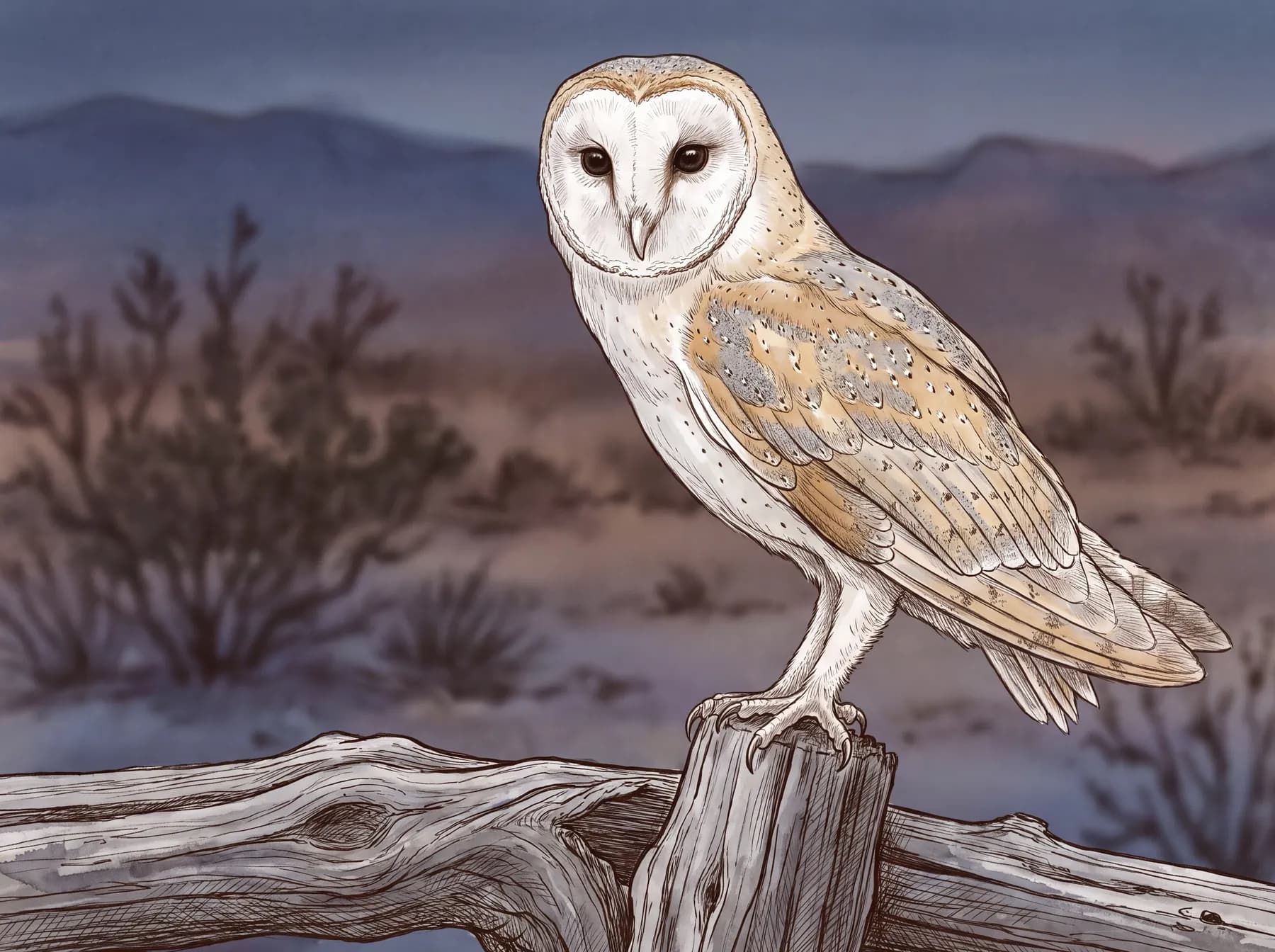
You will hear this one long before you see it, and what you hear will not be a hoot. The barn owl screams: a harsh, drawn-out, rasping shriek that carries across open ground in the dark. It does not hoot at all. The bird behind the scream is pale to the point of ghostliness, buff and gold above, white below, and in a headlamp it can look nearly white as you watch it quarter low and moth-like over the flats at dusk. The old species name, alba, meant white.
What makes it worth a page is not the scream but what the bird can do in the dark the scream comes out of. In one careful experiment, Roger Payne put a barn owl in a room with no light in it whatsoever and released a mouse. The owl caught it. To rule out heat and smell, he had the mouse tow a scrap of paper behind it, and the owl struck the trailing paper rather than the mouse, homing on the rustle and not the body. It was hunting by sound alone.
The equipment behind that catch is stranger than it looks. A barn owl's two ear openings are not level with each other, and the offset is not in the skull, which stays symmetrical, but in the soft tissue of the face. The left opening and its flap of skin sit higher than the right, and the left flap points nearly straight up while the right is angled. That vertical mismatch lets the bird place a sound up and down, not only left and right. The pale heart-shaped face helps as well: researchers have shown the ruff of stiff feathers works as a dish, gathering sound and funnelling it inward, and stripping it away in a model spoils the bird's aim. Payne measured that aim at under two degrees of error in both directions — as sharp side to side as a person, and sharper up and down.
That precision is spent almost entirely on rodents. The barn owl's diet is nearly all mice, voles, gophers, and rats. It is far too light to take a grown hen, and a chicken-keeper has little to fear from it. The numbers are the part worth carrying. In the best-measured American study, a pair brought each of its chicks around a hundred and seventy rodents before the young left the nest, and a full box of owls pulled six to nine hundred rodents off the surrounding ground in one breeding season. Counted across a full year, with the adults feeding themselves too, one family removes well more than a thousand.
So the animal earns its keep, and the thing that keeps it away is housing, not a shortage of food. Barn owls nest in cavities: hollow trees, old buildings, cliff ledges, cutbanks along an arroyo. In blackbrush and Joshua-tree country at this elevation there are no old barns and effectively no hollow trees, and the natural cavities are scarce. Where sites are short, a correctly built box on a pole has helped the birds recover. You do not attract a barn owl. You offer it a vacancy: a dry box, set high, its opening turned away from the weather, and then left alone.
None we've verified on this ground. The face is the thing to check: no other owl here wears a white heart, and the dark eyes set in it are nothing like the yellow of the rest.
Most likely it announces itself first, that tearing scream in the dark, from a bird a headlamp then finds already pale and already leaving.