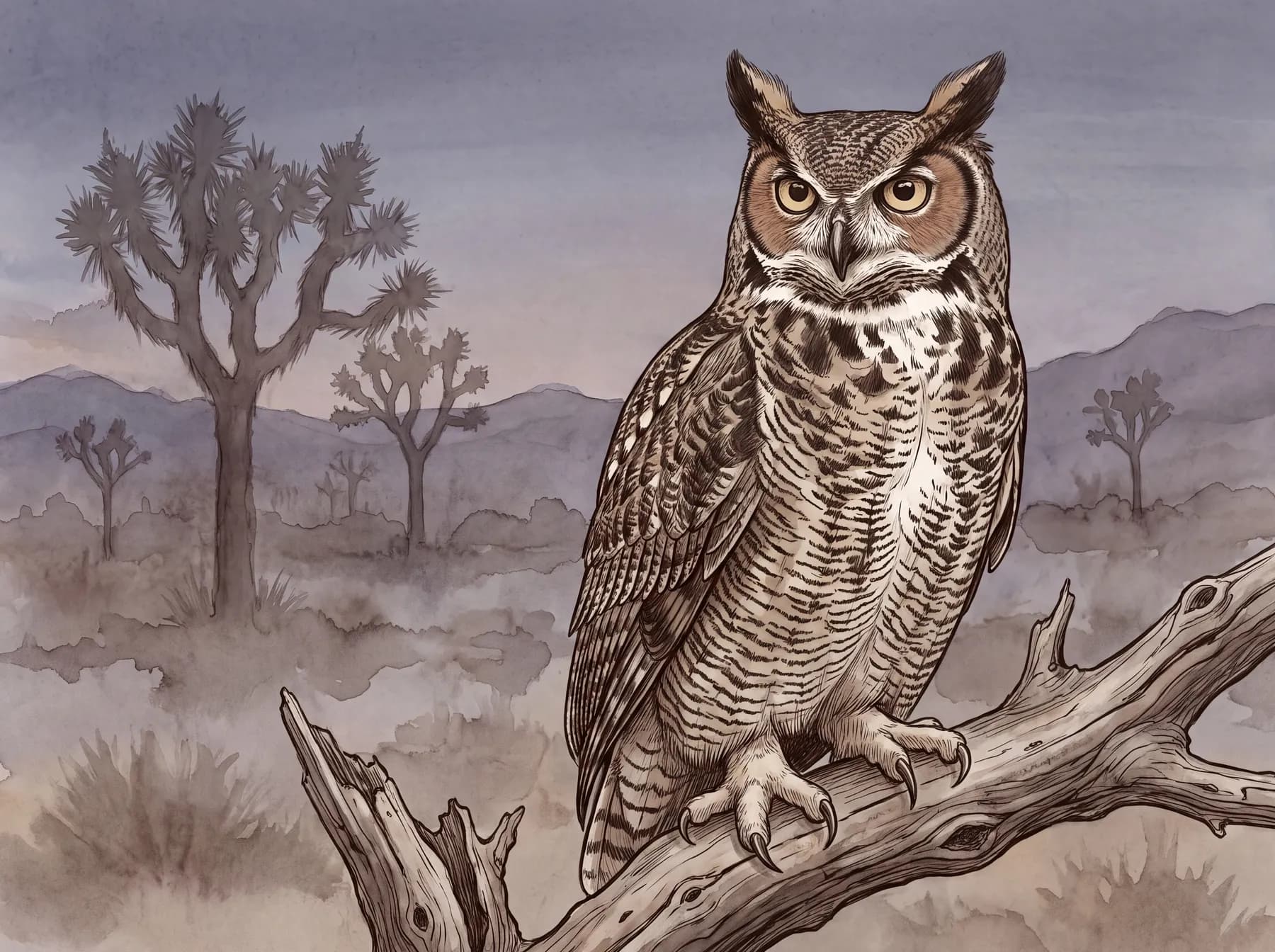
You will almost certainly hear this owl before you see it, and you may never see it at all. A great horned owl calls from cover in the dark, a run of muffled hoots carrying farther across the flats than a bird that size should manage, and the white throat it puffs out while calling is often the only pale thing showing. If one lives on this ground, the cold months are the time to listen, because midwinter is when it nests here. The range maps make it a permanent resident that does not migrate, holding the most extensive range of any American owl, as much at home in this desert as in a forest. We haven't turned one up yet.
Start with the part everyone gets wrong. The two horns are not ears and have nothing to do with hearing. They are tufts of feather, raised for display and for breaking up the bird's outline against a branch; the genus name Bubo means a horned or eagle owl. The working ears are hidden slits at the edge of the facial disk, and that dish of stiff feathers around the face does more listening than the horns ever will.
The deeper mistake is about the dark. The owl that strikes prey it cannot see, guided by sound alone under a black sky, is the barn owl, which carries one ear higher than the other to fix a sound in three dimensions. The great horned owl is a different bird, with symmetrical ears, and it hunts by sight. When one researcher tested owls finding prey in 1945, the birds worked by vision and showed no sign of using smell or heat, and below a faint threshold of light they could not locate food a foot away. It sees well in very little light. It does not see in none. Much of what everyone knows about owls is really barn-owl lore, pinned to the wrong bird.
What it does own is silence. The leading edge of each big flight feather carries a comb of stiff serrations that break up the turbulence a wing would otherwise push into sound, and soft surfaces damp what is left, so the owl reaches a rabbit without warning. The grip that lands is measured in force, not the pounds per square inch you will read online, which is folklore in the wrong unit. Live birds clenched at about 127 newtons, near 28.5 pounds of force, and a tendon lock holds the toes shut with almost no further effort.
That grip serves the broadest prey list of any North American raptor, running from prey of 0.4 grams up to 6.8 kilograms, roughly 15 pounds and about four times the owl's own weight. Rabbits and hares are the staple, but the list takes in rodents, other birds, house cats, and skunks; this is one of very few animals that regularly kills skunks. The usual explanation is that it cannot smell them, but that has never actually been tested on this bird, so it is worth holding as a story rather than a fact.
The nesting is the strangest habit. The owl builds essentially nothing, taking over an abandoned red-tailed hawk nest, a squirrel drey, or a bare cliff ledge, and it lays absurdly early: in one monitored nest the eggs arrived on the 23rd and 26th of January, the female then sitting 30 to 37 days through the coldest weeks. The standard reading is that hatching this early lands the chicks in the spring flush of rabbits and rodents, though that is the reason biologists give, not something anyone has proven.
So listen in the winter dark for the hoots, and watch for the pale sign it gives away: the white throat, puffing as it calls.