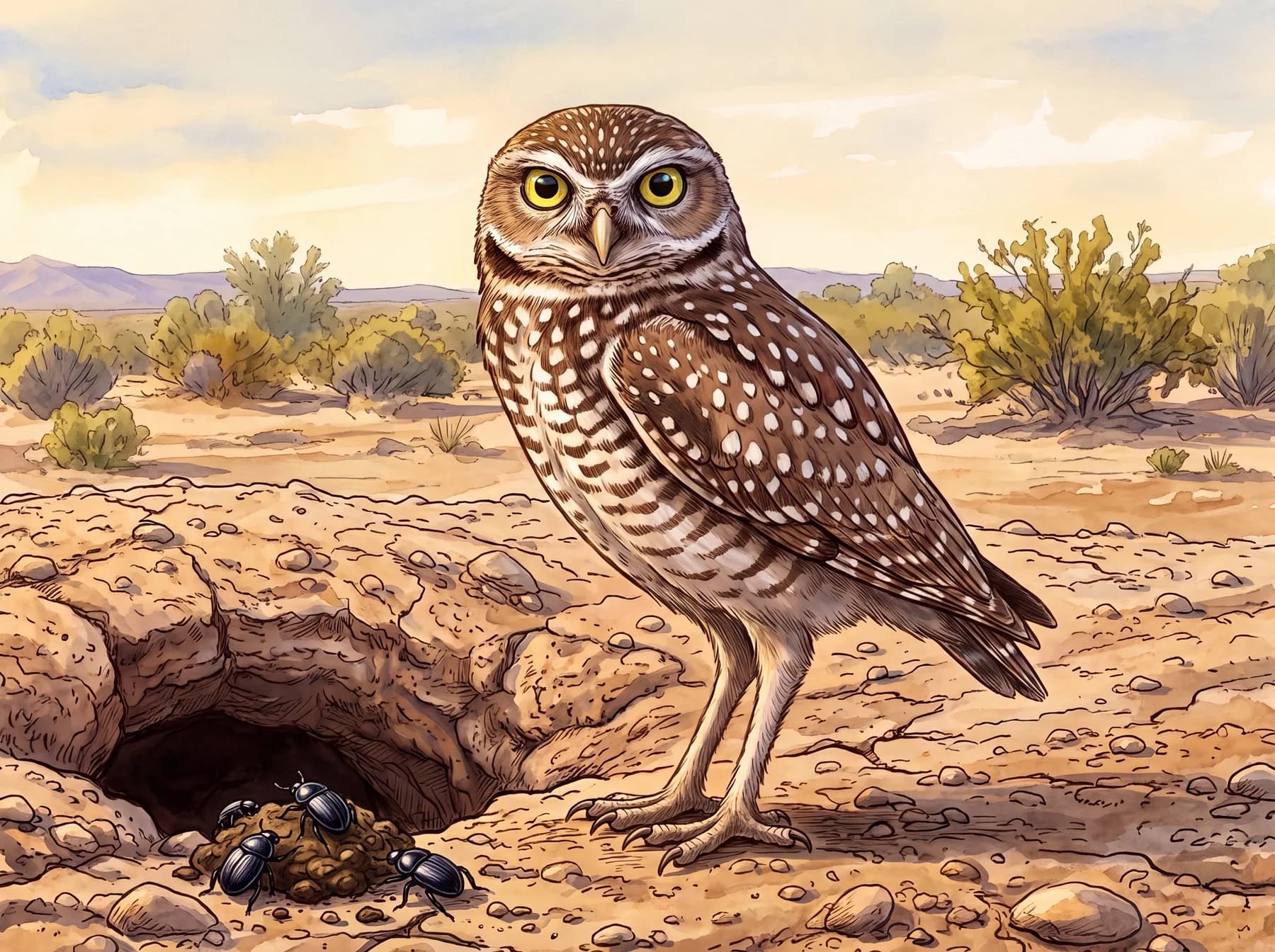
Something keeps dragging dung to the mouth of the burrow. Dried scraps of mammal droppings, gathered and spread around the entrance and worked down into the tunnel. Owls are not collectors, so the first question this bird raises is a plain one: what is the dung for?
For years the answer looked obvious. A burrow smells of owl, and a lining of dung might cover that scent from a badger or a fox working the ground by nose, or hide the eggs from something hunting by smell. It reads well. It also appears to be wrong. Researchers set out 50 artificial burrows baited with quail eggs, some lined with dung and some bare, and the dung bought the eggs no protection at all. The tidy camouflage story failed the test.
What the dung does instead is fish. Fresh droppings draw dung beetles, and dung beetles are food. One team compared owls that had dung at the burrow with owls whose dung had been cleared away, and the owls with dung ate 10 times more dung beetles and 6 times more beetle species. Take the bait away and the owl hauls in more. A second team went looking for a different answer, tested four competing ideas, and landed in the same place: the dung is there to draw prey. Whether an animal baiting a trap counts as tool use is an argument still running.
The burrow itself is borrowed. The western burrowing owl seldom digs its own; it takes over a hole left by a ground squirrel, a badger, or a kit fox, and the male remodels the inherited tunnel to fit. The Florida race digs for itself in sandy soil, so the western bird is not incapable. It simply inherits, which makes it a tenant of the diggers, and its presence a sign that the diggers are still working this ground.
Season matters as much as habitat. Southern Arizona keeps its burrowing owls through the year; the northern part of the state, where this bajada sits, thins out in winter, so the bird you might find here is a breeding-season one, present roughly mid-March through August. When it is here, it is that rare thing, an owl out in daylight. It hunts by day, peaks at dawn and dusk to skip the midday heat, and stands tall at the burrow mouth on long legs, round-headed, no ear tufts, yellow-eyed, bobbing when something worries it. Push it underground and it hisses, and the hiss runs so close to a rattlesnake's that ground squirrels raised in rattlesnake country treat it with the caution they would give a real rattle, while squirrels from country with no rattlesnakes cannot tell it means anything. None confirmed on this ground so far.
Look low and by day for a long-legged owl standing at a hole it did not dig, dung scattered at the door.