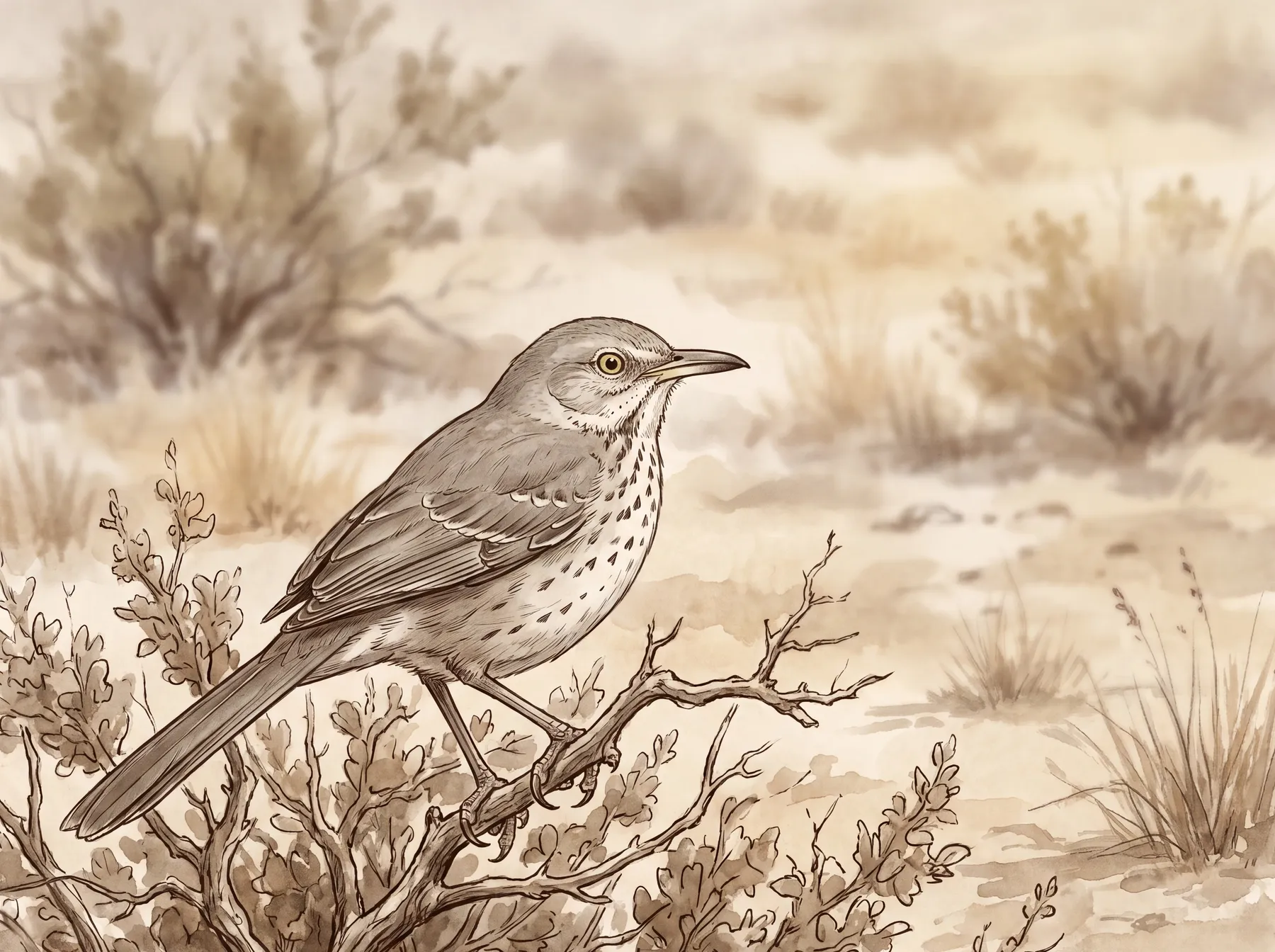
There is a plain grey-brown bird of this desert scrub whose most ordinary secret nobody has written down: how long it sits its eggs. For Bendire's thrasher, the reference accounts say the incubation period, and even which parent does the sitting, remain poorly known. That is a strange gap. Arizona holds roughly half the world's Bendire's thrashers, and still no one has reliably timed the most routine event in the bird's year. A patient watcher near a nest could add something real to the record.
When it is here, it works the ground. Bendire's thrasher forages mostly on foot, using its bill to scratch and dig shallowly in the soil for ants, termites, beetles, and grasshoppers, filling in with seeds, berries, and cactus fruit. It nests low and well defended, in a cholla, a yucca, or a mesquite. On paper the habitat here fits it well: open desertscrub grading into Joshua tree and creosote, up around 3,000 feet, is close to the center of what the bird wants.
It would be easy to file it as a resident, and wrong. This is the northern edge of the thrasher's range, and here it is a breeder rather than a year-rounder. The birds are present mostly from February into September and largely withdraw for the winter, so an empty patch of good-looking scrub in January is not evidence of absence. It may just be the wrong month to look.
The harder fact is that there are fewer of them every year. The Breeding Bird Survey has Bendire's thrasher dropping about 2.7 percent a year from 1968 to 2023, a cumulative loss near 78 percent, which makes it one of the faster-declining songbirds on the continent. Partners in Flight puts the whole world population near 83,000 birds, the low end of a spread that runs higher in other estimates, and lists it on the Red Watch List; the 2025 State of the Birds calls it a Red Alert species, one of dozens that have lost more than half their numbers in fifty years. What is missing from all of it is a clear cause. The bird even tolerates somewhat degraded shrub-grassland, so the tidy story of lost pristine habitat does not obviously apply, and the decline stays real but unexplained.
So the useful work here is recognition. The bird to rule out is the commoner Curve-billed thrasher, and if you get a clear look, three marks separate them. The Bendire's bill is shorter and nearly straight, with a pale base to the lower mandible, not the Curve-billed's long, all-dark, sickle curve. Its breast spots are small and sharp, little arrowheads, where the Curve-billed's are large and smudged. The eye tends to pale yellow rather than orange. The song parts them too: a long, low, rambling warble against the Curve-billed's sharp two-note whit-wheet.
No record of our own here. From February on, listen for that low, unbroken warble; check the short bill for its pale base.