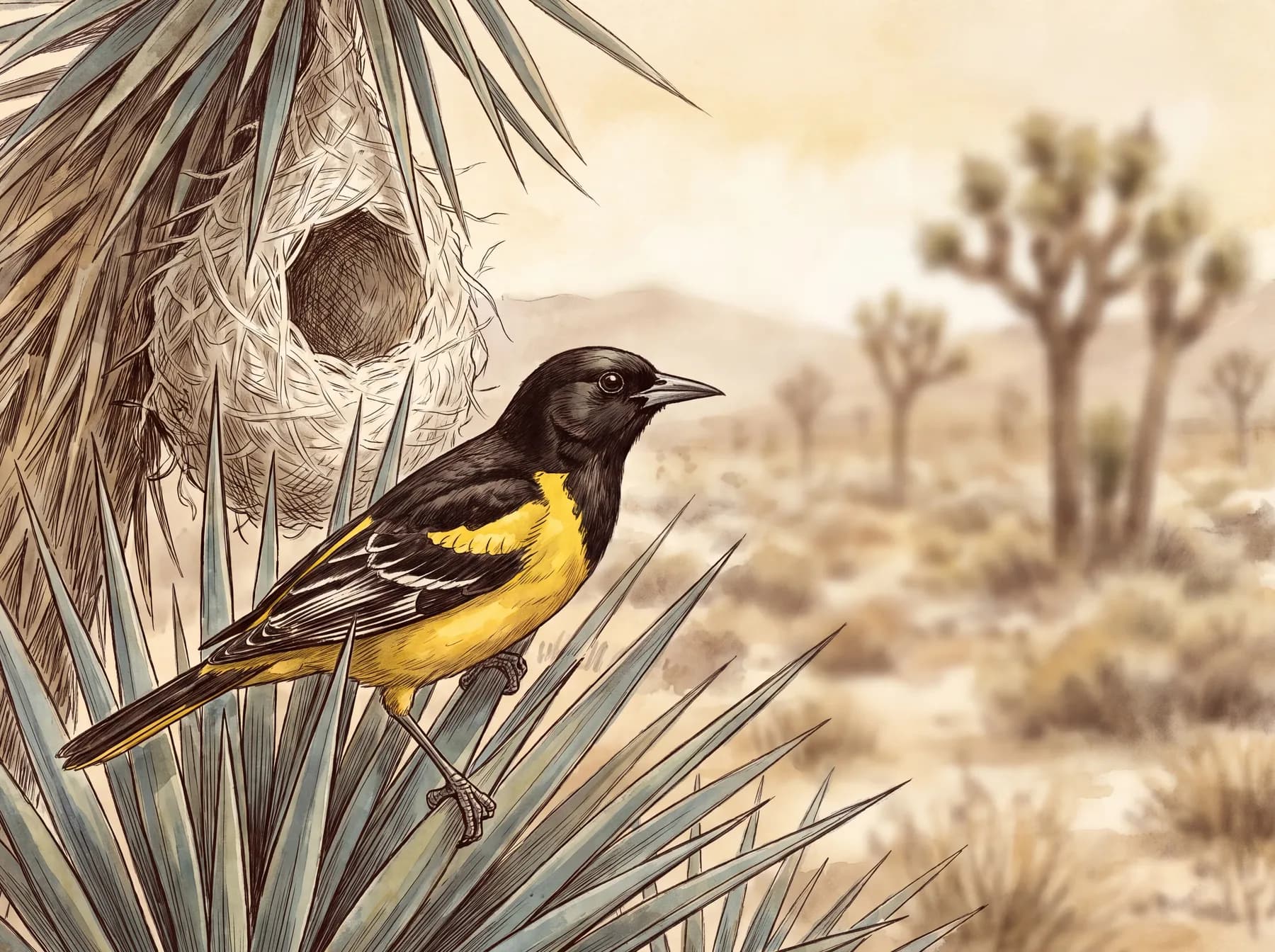
Pull apart a Scott's oriole nest and you find the plant it hangs in. The cup is woven from strips of yucca leaf, the tough fiber stripped from the dried blades, then lined with grass, hair, and seed down and slung inside a living yucca or Joshua tree. This bird does not carry in mud and a jumble of twigs. It builds its nest out of the one plant it cannot live without.
The tie is not a soft preference. Scott's oriole is bound to arboreal yuccas and Joshua-trees closely enough that it avoids open desert with no trees to nest in. Its range takes in pinyon-juniper woodland, pine-oak, and other scrublands, but the yucca runs through all of it. On this ground, in Joshua-tree and blackbrush, those trees are both the frame the nest hangs in and the raw material it is woven from.
Built into the plant, the nest nearly disappears. Cornell's ornithologists rank Scott's oriole among the most secure nesters in North America, its cup set deep in the yucca's crown of leaves and spines. A nest lowered into a rosette of stiff, sharp blades comes with its own walls. Whether the bird also picks the angle that hides it best, I have not found anyone who has measured.
It keeps to the warm months. Scott's orioles reach their breeding ground in March and April and are gone again by July or August, wintering mostly in Mexico. For half the year the yucca stands without them; the partnership is seasonal, keyed to the stretch when this desert can feed a brood. The property sits well inside the bird's elevation range, which runs from sea level to around 9,800 feet, so height is no barrier here — the yucca is what decides it.
What it takes in those months is broad: insects mostly, grasshoppers and beetles and caterpillars, with cactus fruit and berries added and nectar probed straight from the flowers. One will even come to sugar-water at a feeder.
You are more likely to hear one than to pick it out. The song is a run of rich, fluting whistles, close enough to a Western Meadowlark that a first listen can place it wrong. Both sexes sing, which is unusual among songbirds, though the female's song tends to be simpler. If a singer shows itself on an open perch, the adult male is hard to mistake: jet-black head, back, and breast against a lemon-yellow belly and rump. The female is the harder call — grayish-olive above, dull yellow below, easy to pass over as something plainer.
We've not spotted one here so far. Listen in spring for meadowlark whistles from the top of a Joshua tree.