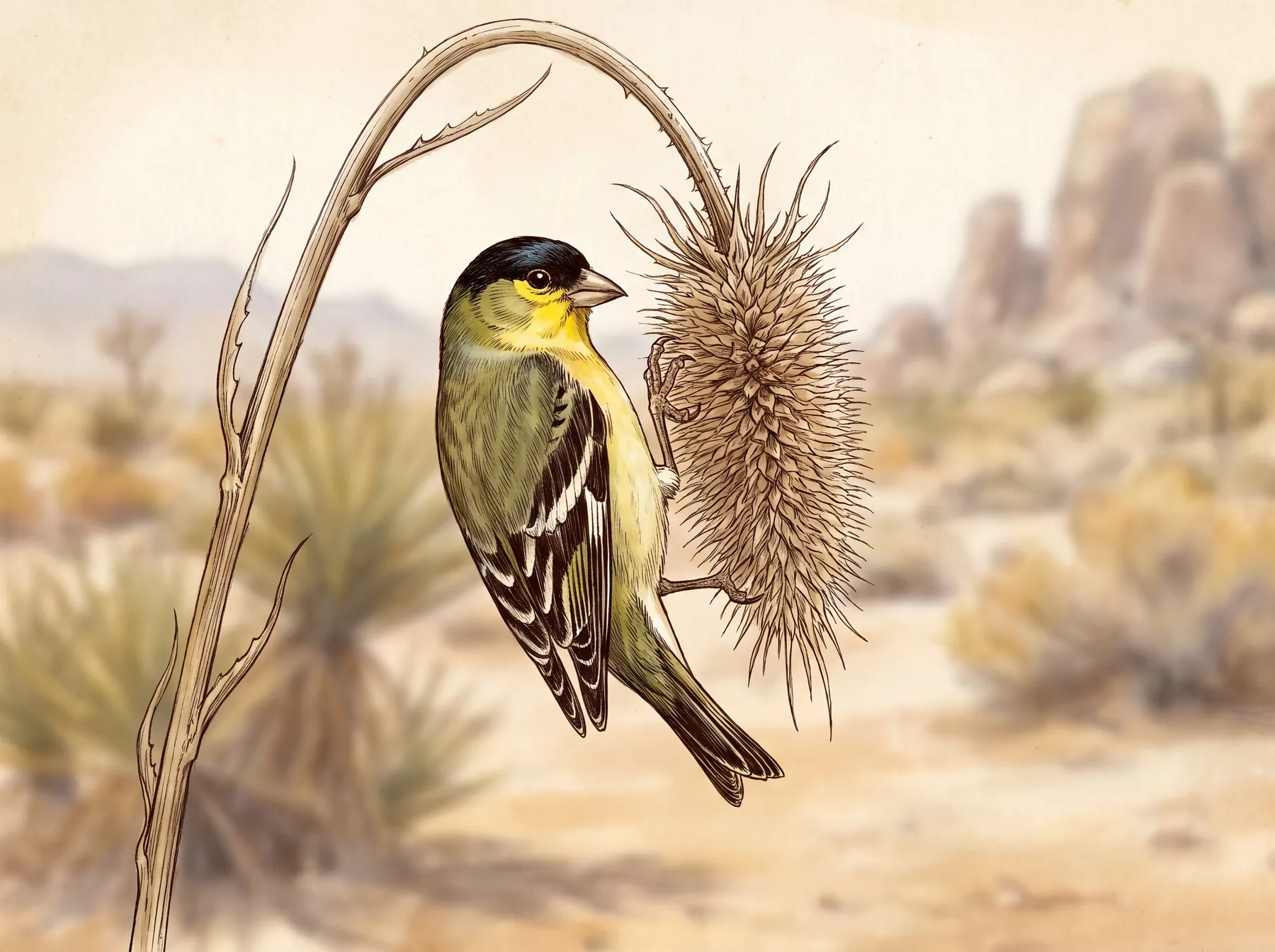
A seed is bone dry, and this finch eats almost nothing else. That is the whole problem the lesser goldfinch has to solve out here. It is a near-total seed specialist, working the sunflower family down to plants like Napa thistle and taking an insect only now and then, and dry seed carries almost no water. A bird that would go hungry on anything moister still has to drink, and drink often.
That sounds like a minor detail until you set it beside its neighbors. The desert's insect-eaters and fruit-eaters carry water in with the meal, the preformed water inside moist prey or a berry, and can go a long stretch without visiting open water. A seed-eater cannot. Researchers who study desert birds call the dry-seed diet the hardest of any for this exact reason: free water stops being a luxury and becomes a daily errand. So this is not a bird of the open blackbrush. It is a bird of water, weeds, and trees, and on this ground that means the wash, the one place up here holding both seed-bearing thickets and something to drink.
That same thirst explains where the bird has been going. Irrigation and planted trees, one ornithology account notes, let lesser goldfinches expand their range near Los Angeles; give dry country a steady drink and a hedge of weedy plants and this finch moves in behind it. It has ridden farm fields and suburban lawnscapes into places that were once too dry to hold it.
The other thing worth knowing is what comes out of the male, because his song is assembled from other birds. Males mimic their neighbors, and the impressions are local: Arizona birds have been recorded copying the Gila woodpecker, Texas birds the eastern phoebe, each finch singing back the species that happen to share its country. The song is a map of the neighborhood. Why he does it nobody has settled; the standing guess is that females are listening, and on that question "guess" is doing real work.
Watch one feed and you will see the move that fits it to a tall, thin plant. It lands high on a seed head and rides the stem down, bending the whole plant over under its own slight weight until it dangles upside down at the seeds. The nesting splits the labor cleanly. The female builds, working spiderweb and cocoons into the cup over several days while the male stays near and watches, and once she is settled on the eggs he feeds her, beak to beak.
It is easy to overlook, because it is small, the smallest goldfinch in North America at 3.5 to 4.3 inches, a notch under the American goldfinch. Our males are the green-backed form, olive above with a clean black cap; the females are plainer, but both sexes show a patch of white in the black wing.
Listen at the wash for a wheezy song wearing other birds' voices, then look for a white wing patch in a small green finch.