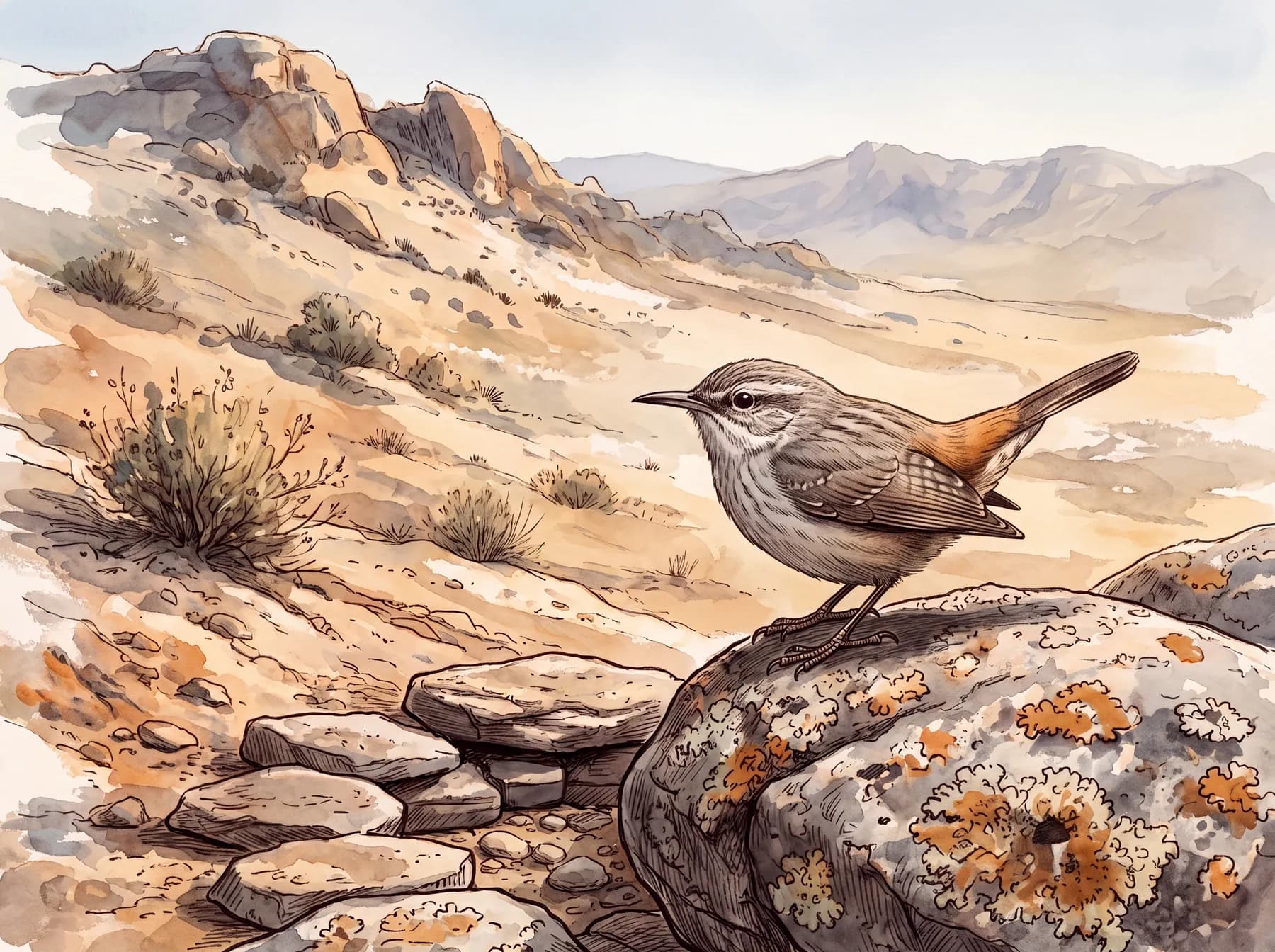
A crevice in the rock with a little pavement of flat stones laid at its mouth is the work of a bird that weighs about half an ounce. The rock wren builds it one pebble at a time, carrying each stone up in a long, slightly decurved bill and fitting it into a walkway that leads to the nest cavity. A single pavement can hold up to 1.4 kilograms of stones, roughly three pounds, hauled up by a bird you could hold in one hand without feeling much. Nothing else on this continent does it; the rock wren is the only North American bird known to make extensive use of stones in and around its nest.
Why it bothers is the honest question, and for a long time the answer was that nobody knew. The pavement is laborious, and it can give the nest's location away to a predator, so it looks like more trouble than it is worth. Researchers finally put the leading guesses to a test. They checked whether the stones warmed the cavity, whether they kept it dry, and whether they gave early warning of an approaching predator. The warmth idea failed outright: the stones changed the cavity temperature not at all. What they did do was cut water infiltration during simulated rain, and they narrowed the opening by about a third.
So the best evidence points to drainage, a doorstep that keeps the nest from flooding, though drainage is the leading explanation and not a settled one. The early-warning idea was never confirmed, and the standing verdict in the literature is still that the function is unknown. The stones do something, and dry is the part we can show.
It makes sense that water would be the thing worth managing, because the rock wren otherwise seems to want very little of it. The rock wren is not known to drink. No observation of it taking water has been reported, and even a few captive birds left water alone when it was offered; it appears to get all the moisture it needs from its food. On this bajada it works the ground for ants, grasshoppers, beetles, and spiders, probing into cracks with that thin bill, and it rests in shade through the heat of the day. It is here all year at this elevation, not passing through, though our winter may add birds down from colder, higher country.
You are likelier to hear it than to work out its masonry. A male can carry a hundred or more song types, many of them learned from his neighbors, and he sings them from the top of a prominent rock that overlooks his ground. Watch a small, pale, finely streaked wren bob steadily on its legs on an exposed stone, and you have probably found it. The canyon wren that shares these rocks is brighter, with a white throat and rusty belly, where the rock wren stays dust-colored, its tail a worn cinnamon banded with black.
Find the little paved doorstep at a crevice, and you have found the nest.