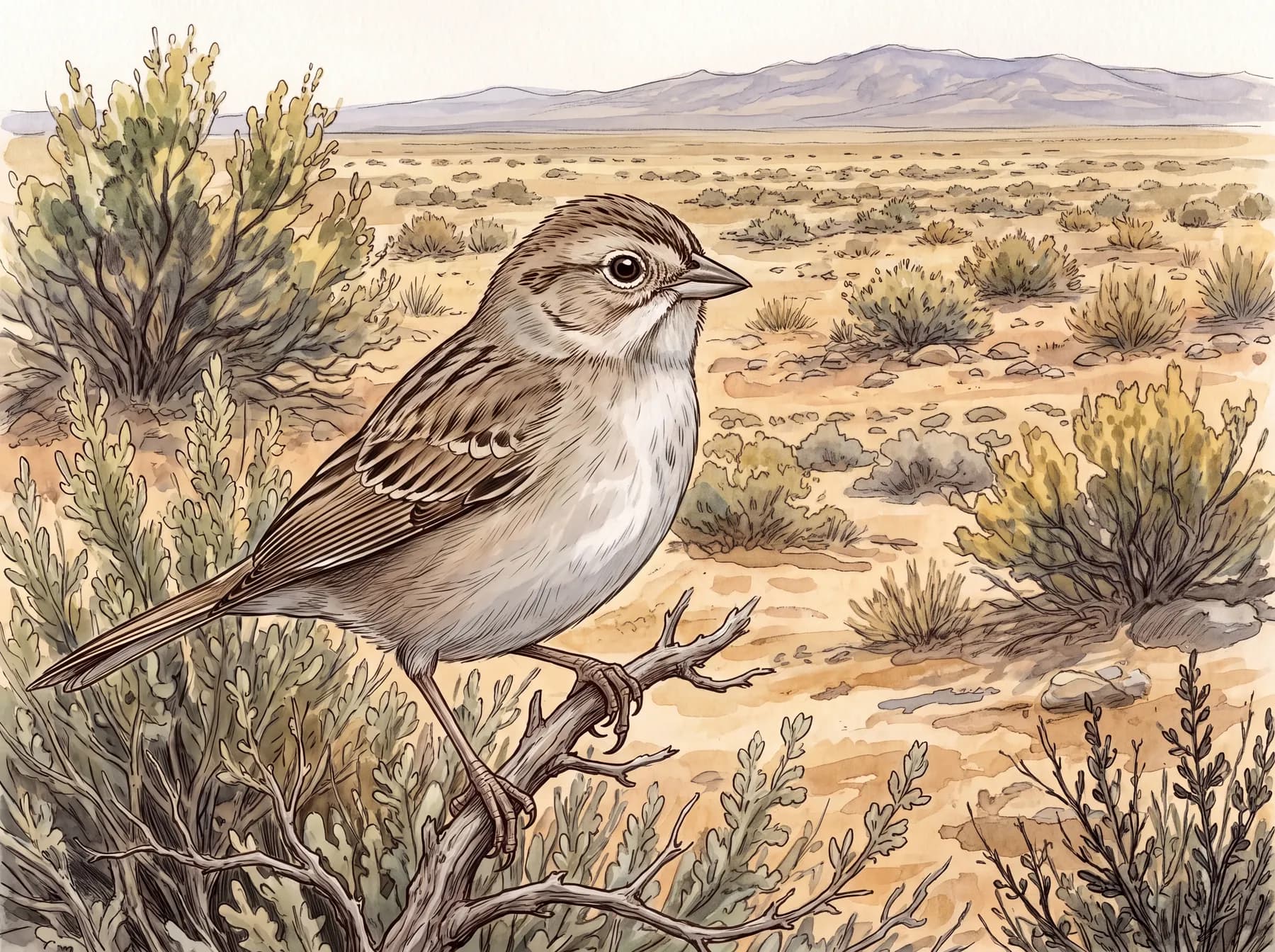
Through the cold months this is a ground-feeding bird of loose flocks, and the birds in those flocks are so plain that the field guides all but give up on them. Brewer's sparrow is the drabbest of its family: small, slim, sandy, finely streaked brown above, unmarked below, with one clean white ring around the eye and essentially nothing else to point at. Some guides call it, flatly, the sparrow with no field marks.
It belongs on this bajada in the season you would least expect a small bird to manage. Brewer's sparrow does not breed in this low Mojave country; it drops down into the desert scrub of the Southwest for the winter and is gone north again by spring, present here roughly mid-August through May. So the plain flock on the ground is a winter one, and its plainness hides the real question: how does something this small get through a desert winter, when its food has dried to seed and there is little to drink?
The answer is that it barely drinks at all. In winter the diet shifts to mostly seeds, which carry almost no water, and the bird makes up the difference by losing less. When researchers held Brewer's sparrows without drinking water, the birds lasted about three weeks, their body mass settling at roughly 75 to 85 percent of the start and then holding steady while they cut both the water they breathed off and the water they passed. Food intake and blood chemistry stayed near normal. That was a lab and not this ground, so read it as capacity rather than a daily habit; the capacity is real, and it is why a seed-eater can winter where there is no open water for weeks.
What the bird is famous for is a thing you will probably not hear here. A male runs two songs: a short one just a couple of seconds long, and a long one that can last ten or fifteen seconds and string together five to ten buzzy, trilled sections without a break. Roger Tory Peterson heard in it a Chipping Sparrow trying to sing like a canary, and it ranks among the longest and most complicated songs of any sparrow. But the long song is a breeding-ground performance, given up north in the spring sagebrush to win a mate. Down here in winter the bird is mostly silent. The elaborate song rides along inside the plain body, saved for another country.
That other country is the point of the plainness, too. Brewer's sparrow is a sagebrush specialist, by some counts the single most abundant bird of Great Basin sagebrush in summer, and its breeding numbers have fallen hard as that shrub-steppe is broken up by farming, grazing, fire, and invasive grass. None of that loss happens on this bajada, which only borrows the bird for the cold half of the year before it returns north to breed in what sagebrush is left.
We've yet to log one here, and in winter you would not have the song to go on, so the ring is the mark. On a small streaked sparrow with a blank face and no rufous cap, that complete clean white eye-ring is the whole call.
Look for it low, in a winter flock working the bare ground, plain to the point of anonymous but for the one white ring.