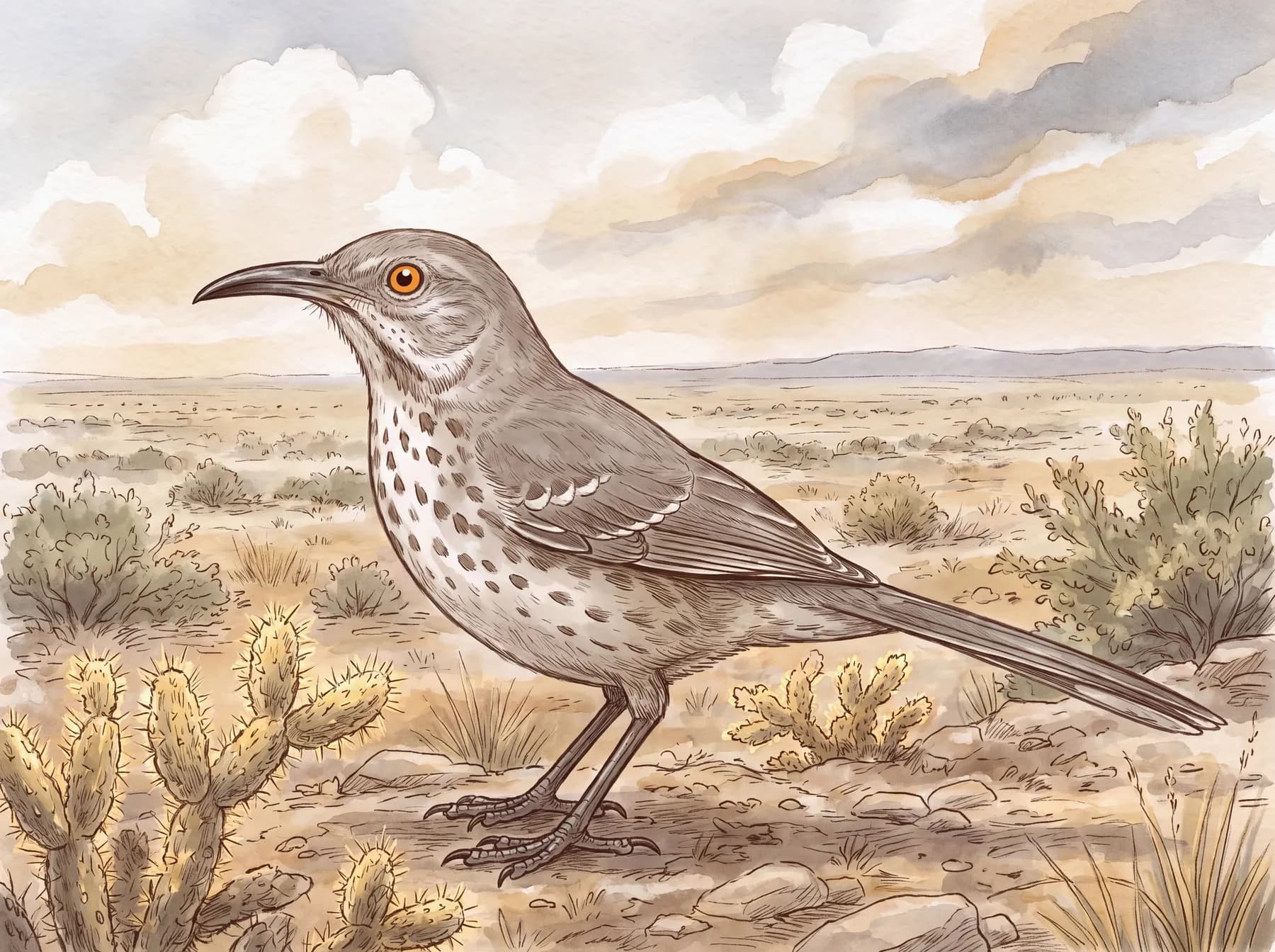
Bendire's thrasher entry in this guide ends by telling you which bird to rule out. This is that bird, and it is here, which the range maps did not expect.
The curve-billed thrasher is a Sonoran and Chihuahuan animal. In Arizona the published account puts it through the lowland deserts of the southern and central parts of the state, around Tucson and Phoenix, and describes it as highly localized, mostly confined to desert country rather than higher ground or riparian woodland. This parcel is none of that. It is Mojave, in the northwest corner of the state, on a Joshua tree and blackbrush bajada.
Height is not the problem, and being exact about that matters, because the easy assumption is wrong. The species is recorded from near sea level up to about 1,890 meters, roughly 6,200 feet. At about 3,050 feet, this ground sits comfortably inside its altitude tolerance. What does not fit is the desert itself: the wrong one, well away from where the books put the bird.
So this entry is a record rather than a description. One bird, seen, in August. That is all it claims, and that is enough to be worth writing down.
What to look for, if it comes back. The bill is the name and the tool. It is long and clearly bowed, and the bird uses it on foot, probing soil and working under leaf litter for whatever is beneath. The eye is a startling orange in a grey-brown bird. The breast carries big, soft-edged, roundish spots, less like markings than like something spilled.
The confusion is with Bendire's, and the marks run the other way from that entry. Where Bendire's shows a short, nearly straight bill with a pale grey base to the lower mandible, this one carries a longer bill, decurved along its whole length, dark throughout. Where Bendire's has a yellow iris and small sharp triangles down the breast, this bird has orange and smudges. Six to eleven millimeters of bill separate them, which sounds like nothing until you have both in your head and the difference becomes obvious.
You will almost certainly hear it before you see it. The call is an abrupt, brash whit-wheet, loud enough to arrive ahead of the bird, and once learned it is not mistakable for anything else in this scrub.
Where it belongs, it nests in cholla, and conspicuously so, building out in the open and letting the spines do the defending. There is no cholla nest to report here and no reason to imply one. A bird passing through, or wandering, or quietly extending its range northwest, is a different claim from a bird breeding, and only the first has any evidence behind it.
Which makes the useful thing simple. If you get another look, note the month, and note whether there is a second bird. One is a record. A pair, in spring, in a cholla, would be something else entirely.