How many quail cross this bajada next spring was mostly settled the winter before, by rain. Gambel's quail are a boom-and-bust breeder, and biologists describe a reproductive output that swings sharply from year to year, tied closely to how much rain falls in winter and spring, with dry years yielding few young birds. A wet winter and a pair will breed hard, laying a clutch of 10 to 12 eggs and sitting on them for 21 to 23 days. A dry winter and they barely bother.
When the eggs do hatch, the chicks are running almost at once. They are precocial, able to feed themselves from the first day and off the nest soon after, with nothing carried to them. In a country where a nest is a fixed target, the sooner the whole family is mobile, the better. Those families are what a covey is built from, though the larger groups that gather in fall and winter can pool more than one.
So the green plainly matters, and biologists have been asking why since the 1960s. The oldest answer is a nutritional one. Green forbs, brought up by winter rain, supply carotene and vitamin A, and that surplus is thought to stimulate the gonadal development that carries a bird into breeding condition. Without the green, the switch never flips. It is a sensible idea with a long record behind it, and it is still, honestly, a hypothesis.
A stranger idea gets repeated more often, and it deserves a careful hearing rather than a retelling. In dry years, desert annuals stunted by drought produce phytoestrogens (chiefly formononetin and genistein), compounds that mimic the hormones a bird uses to begin breeding, and researchers found these correlate with suppressed reproduction and all but vanish in the wet years when the forbs grow well. The story is usually told as plants actively switching the birds off. Two things get left out. The bird in that study was the California quail, not this one, and the result was a correlation, never shown to cause anything and never repeated. It is the more colorful account, not the better proven one, and the experiment has never been run on Gambel's quail at all.
Water is the other thing people assume it must have, and the evidence there is contested. This is a bird with little if any strict need for free water, taking its moisture from succulent plants, insects, and cactus fruit, though when that green food dries out in a hot summer, a standing dish counts for more. What it needs without argument is cover. A quail caught on open ground is prey, and its reply to danger is not the air but the ground. It runs. Gambel's is a permanent resident rather than a migrant, so any covey here would be one that lives here the year round, and none has shown on this bajada for us yet.
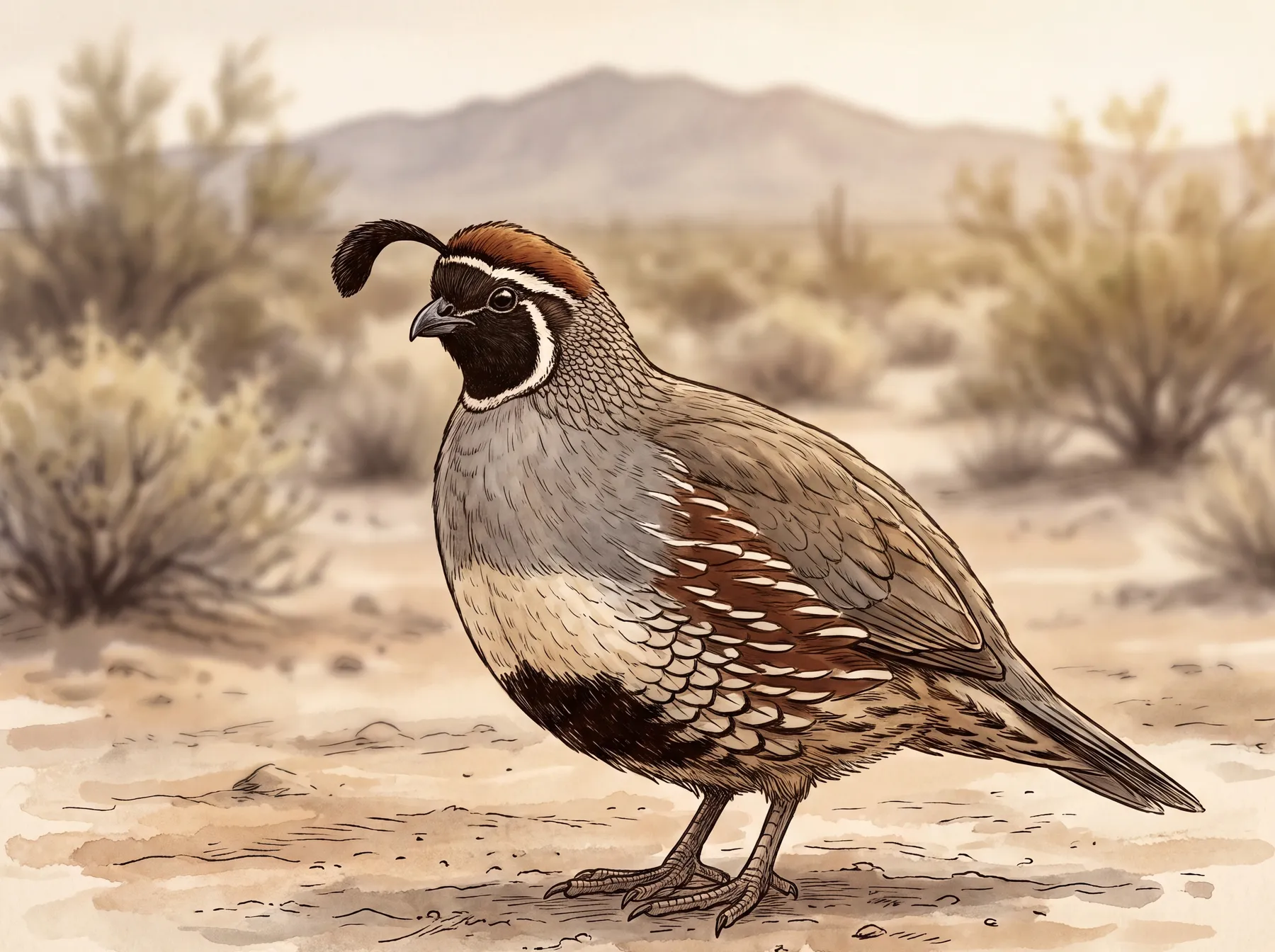
When you do find one, read the head first. Both sexes carry a forward-curving black plume, a small cluster of feathers that looks like a single teardrop drooping over the bill, thicker and darker on the male, fainter on the female. Then watch what the covey does with its feet.
A covey pours into the blackbrush in a single line, each black plume tipping forward, and the open ground goes quiet behind it.