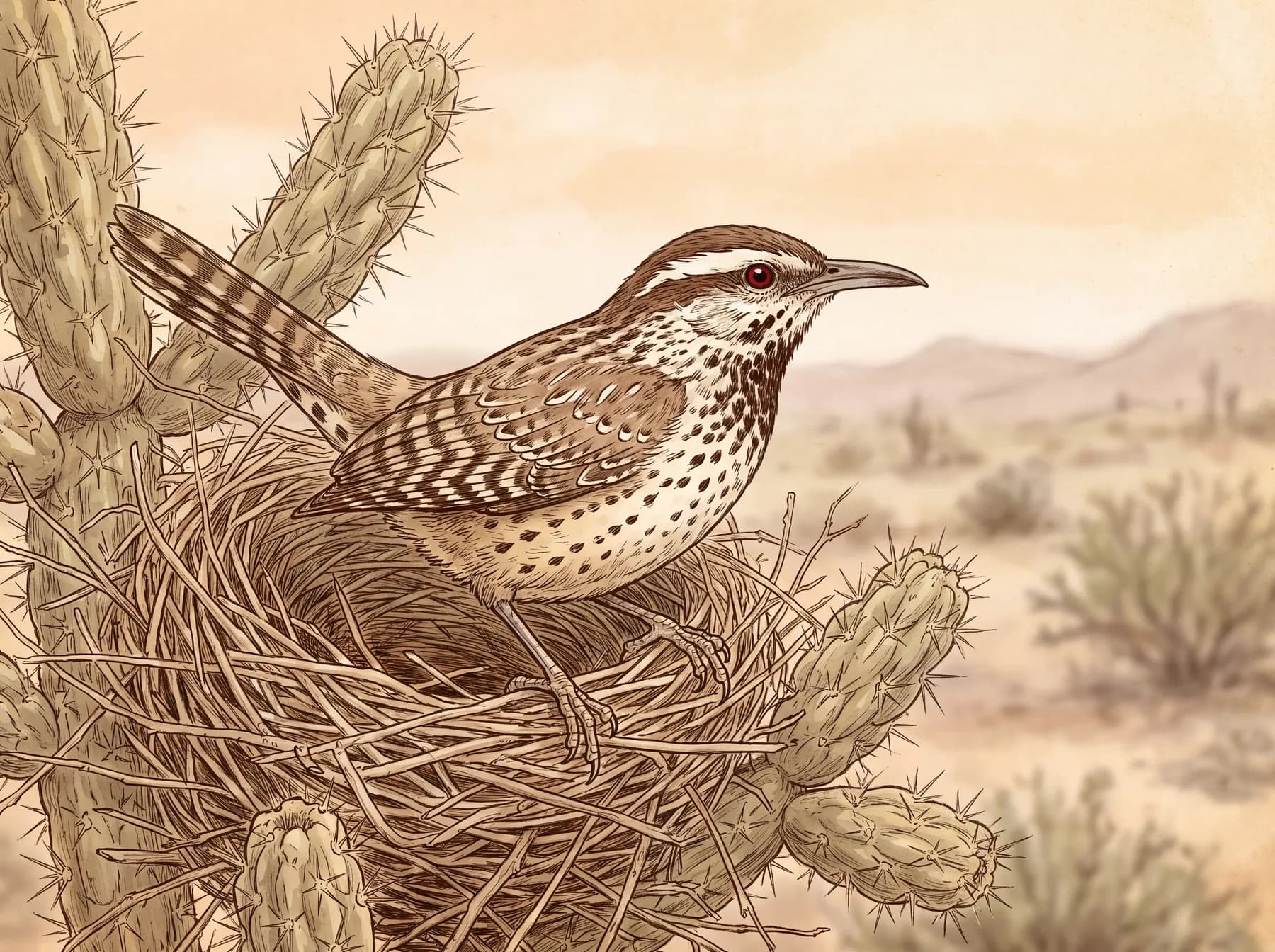
Find a cholla with several football-shaped bundles of grass wedged among the spines, and only one of them will ever hold eggs. The rest are something else. You will be told they are decoys, built to trick a snake or a hawk into spending a strike on an empty room. It is a tidy story, and the literature does not back it.
When researchers went looking for what the spare nests actually do, the honest answer came back vague. The predator-decoy idea is the one people repeat and the one the evidence supports least. What the extra nests demonstrably are is bedrooms and future nurseries: the cactus wren roosts in them at night and reuses them for later broods across the season.
That points at what makes the bird worth a page. Unlike most birds, it uses its nest year-round rather than only for breeding. It sleeps indoors every night of its life, in a woven house it keeps in repair through the seasons. The house is built to be hard to enter: a domed thing about the size of a rugby ball, roughly seven inches across and a foot long, some six ounces of grass set three to ten feet up among the cholla spines, with a narrow tunnel for a door. The entrance is small enough to keep most predators out, too tight in places for a flying bird to pass cleanly, so the wren lands on a doorstep perch and works its way in.
The building happens fast and early. A nest goes up in one to six days, but most of the work is done in the first three hours of each morning, before the heat turns the day hostile. And the pair does not stop at one. While the female incubates the first clutch, about sixteen days on the eggs, the male is already raising the next nests, the roosts and the winter quarters, working ahead of the season while she sits.
It affords all this with a body tuned to the dry. A cactus wren rarely drinks standing water and takes most of its moisture from what it eats: insects and spiders, and a good deal of fruit, since up to a fifth of the diet is cactus fruit and berries. In a hard enough drought some pairs skip breeding altogether rather than spend water they do not have. It does not migrate. The bird in the cholla in January is the same bird in July, holding the same ground out in the Joshua-tree and blackbrush. One we haven't pinned down on this bajada, though the cholla and the elevation make it a bird to expect.
Listen for it before you see it: a harsh, dry cha-cha-cha, the largest wren in the country sounding like an engine that will not catch.