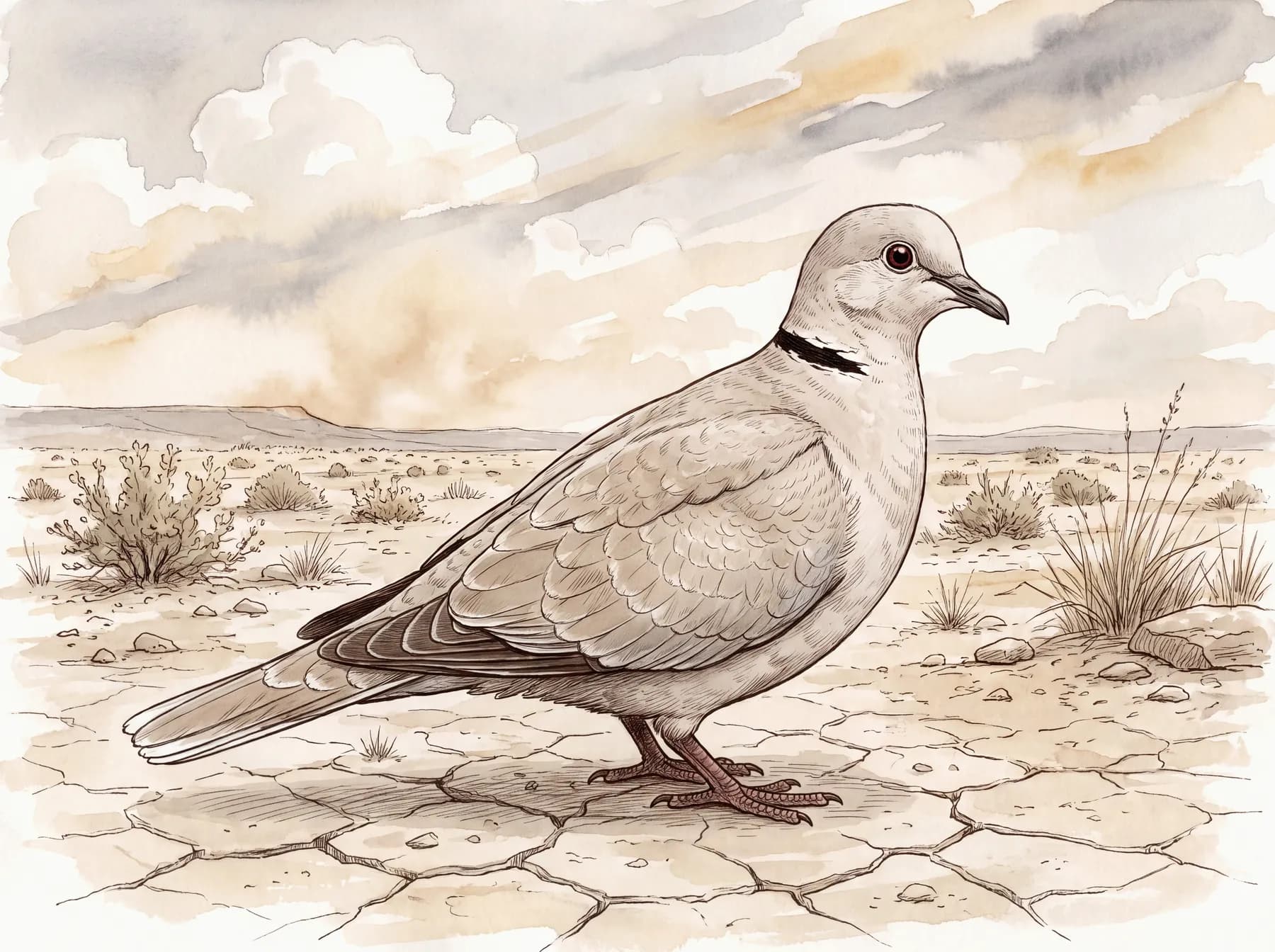
Every other bird in this guide is here for reasons that predate us. This one is on the parcel because somebody broke into a pet shop in the Bahamas in 1974.
Around fifty doves got loose in that burglary, or were let go by the owner afterward, and the birds crossed to the Florida mainland. From the 1980s they went west and north, growing at something on the order of thirteen percent a year, and reached the Pacific Northwest by 2000. Inside a single human lifetime the species went from an accident on an island to a common bird across most of a continent. It is now abundant enough that its arrival somewhere is no longer news, including here.
Two cautions about that number. Thirteen percent a year is the North American expansion as a whole, not a rate anybody measured on this ground or in this state, and it should not be read that way. And the dove tends to attract one of two stories, either a charming immigrant or an ecological catastrophe, when the honest position is duller. It arrived by accident, it spread fast, and clear evidence that it displaces native doves is not there.
What it did follow is us. The spread tracks towns, farms, grain and feeders rather than wild country, which makes this the one bird in the guide that is here because of people rather than in spite of them. On a lived-on parcel, that is not a small distinction.
There are already two doves in this guide, so the marks that matter are the ones that separate three birds and not one.
The collar is the name and the giveaway: a narrow black half-ring across the back of the neck, which neither of the others has. The tail settles it at distance, squared off at the end with white in the corners, against the mourning dove's long taper to a point. The build is heavier and the color paler and greyer than a mourning dove, closer to sand than to warm brown.
The voice is the last one and probably the most useful, because a dove calling is a dove you have not yet found. The advertising call is three notes, koo-KOO-kook, delivered from a high perch and repeated as many as a dozen times running. It is flatter and more insistent than the mourning dove's soft falling coo, which is the sound people mistake for an owl.
Seen here, confirmed. Which for this species means only that the wave that started with a broken window finally reached this bajada, along with the power line it likes to sit on.