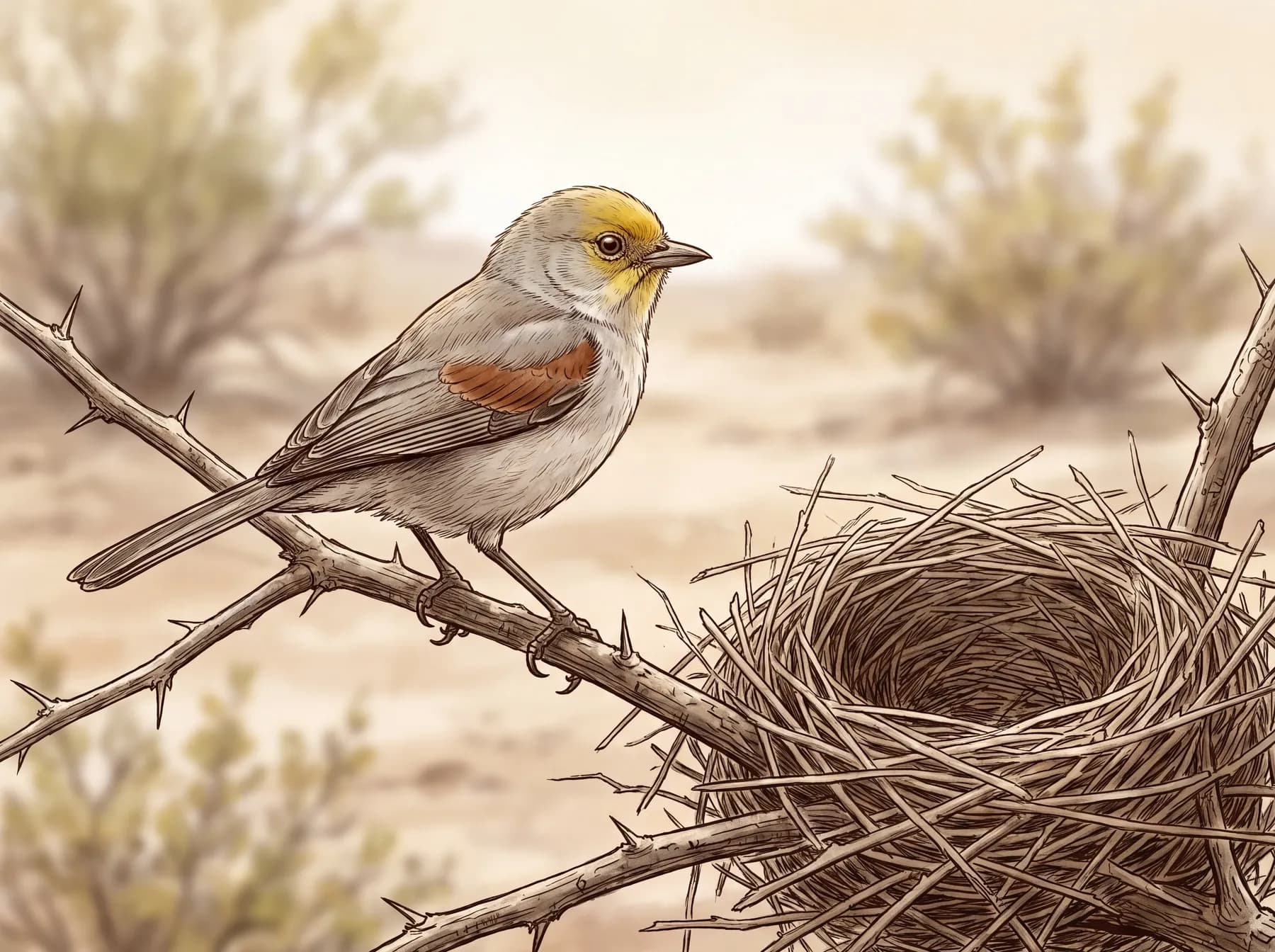
Walk a thorny wash on this bajada and you may pass several enclosed balls of twig wedged into the spiniest shrubs, each about the size of a fist. They look like the work of a colony. They are mostly the work of one bird, a gray scrap of a thing weighing about seven grams, which builds more houses than it can sleep in at once.
The verdin is the only North American member of an Old World family, the penduline tits, and it stands alone in its own genus on this continent; its nearest relatives are the Remiz tits of Eurasia and the Anthoscopus tits of Africa. It builds year-round. The big nests, up to ten inches across, are for breeding. The ones that matter in winter are smaller and thicker-walled, and a single bird keeps several going, some to raise young in, others only to sleep in.
The reason a bird this small bothers with all that construction is that it cannot fix the real problem, which is its own size. At roughly eleven centimeters and seven grams it is among the smallest songbirds on the continent, and small means a great deal of surface wrapped around very little body. That cuts both ways here. On a long winter night it loses heat it can barely spare; near the summer's worst, close to fifty degrees Celsius, it can shed water to the dry air faster than five percent of its body mass an hour. Cold and drought lean on the same tiny animal from opposite seasons, and it cannot grow its way out of either, so it works on the house instead.
The winter roost is where that work pays. Researchers measuring free-living verdins through cold desert nights found the insulated nest can cut the energy a bird spends staying warm by as much as half, and that a sheltered bird loses roughly a third less weight overnight than an exposed one its size should. It spends much of every day, and all of every night, inside. The walls do the work its body cannot.
Water is the other squeeze, and the verdin mostly steps around it by not drinking. It takes its moisture from what it eats, mainly insects and spiders, with some nectar, fruit, and seeds, and its measured water turnover in the field runs only three to four milliliters a day. Nectar is the exception. Its bill isn't built to enter a narrow desert flower the honest way, so it often bites through the base of the bloom — chuparosa, ocotillo, agave — and drinks from the side, taking the sugar and skipping the pollination the flower was paying for.
This is a low-desert bird near the upper edge of its range in this country. It is most at home lower down, in mesquite and paloverde thornscrub, and up on this bench it holds on mainly where the thorny washes give it the dense cover it needs. Up close, the adult is the tell: a plain gray body, a sharp pointed bill, and a small bright yellow head, with a chestnut shoulder patch that usually stays hidden. A young bird shows neither the yellow nor the chestnut, only a pale base to the bill.
Or read the shrub instead of the bird. A fist of twigs in the spiniest thing around is its signature.