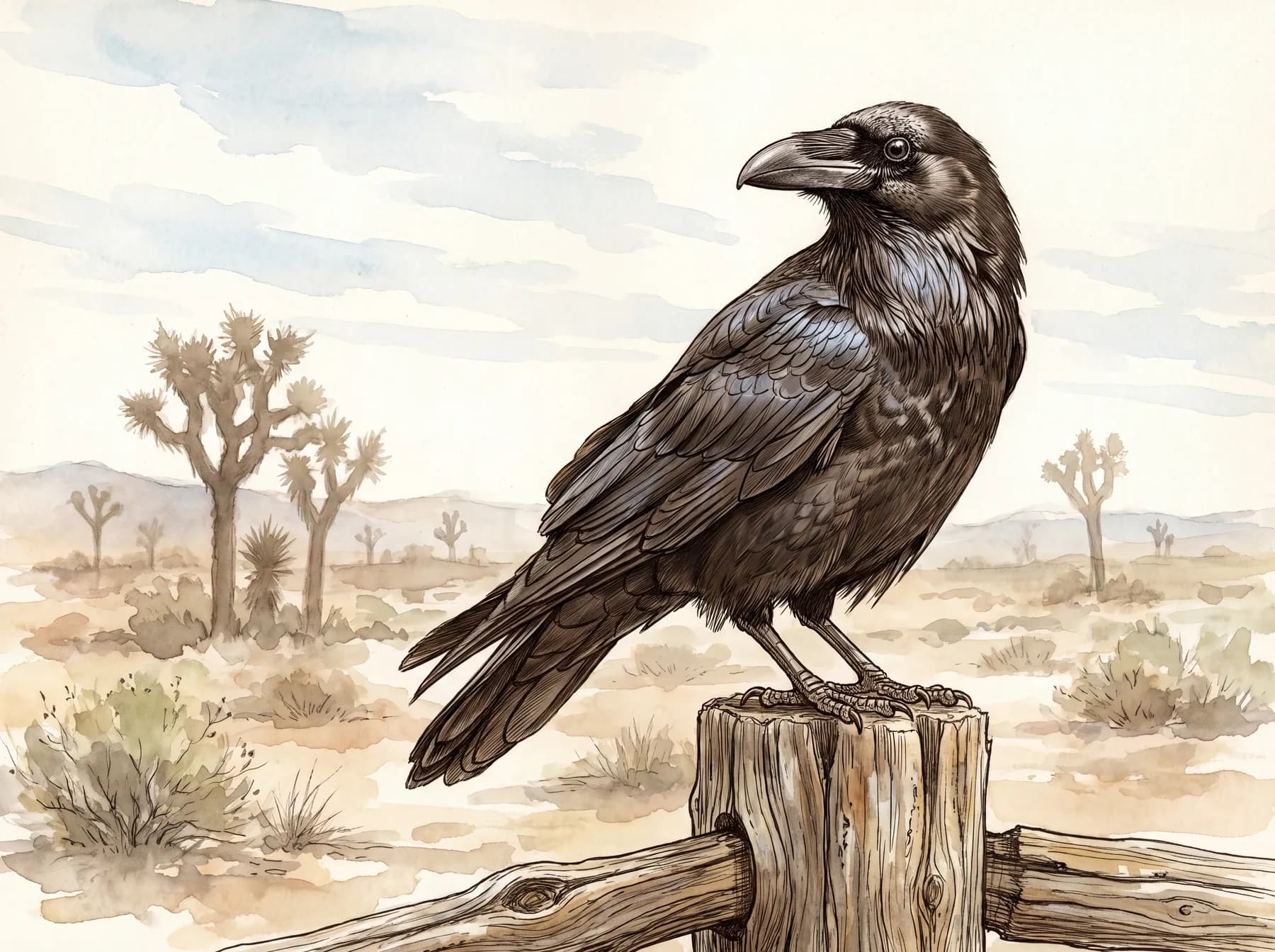
You will likely hear it before you place it: a low, guttural croak that carries, on a still day, more than a mile. The sound is the bird's whole name. Corvus corax traces to the Greek korax, a word built to imitate the croak, so the raven is named, in the oldest way, for the noise it makes. But the voice is the least surprising part of the animal. The croak is only the doorway to the mind behind it, one of the more capable in this desert.
When researchers counted the neurons packed into bird brains, the raven's forebrain came in at roughly 1.2 billion, more than a capuchin monkey carries in the same part of its brain, and at a density no mammal reaches. That hardware shows up in what the bird can do. In one experiment, ravens that had learned from the inside how a peephole worked grew careful about hiding their food when they heard a rival and the peephole stood open, but stayed relaxed when it was shut. They were guarding against a watcher they could not see. In another, offered a tool that would open a baited box only later, they held onto it for as long as 17 hours and turned down an easy snack to keep it.
The memory runs personal, too. Ravens that traded with one person who dealt fairly and another who took the treat and gave nothing back later chose the fair one, and the memory of that single exchange still held a month later, when 7 of 9 picked the honest trader. Two famous results are worth keeping apart here. The experiment where a bird remembers a dangerous human face for years and passes the grudge to its flock was done on crows, not ravens. The raven's proven grudge is the quieter one, about who trades fairly.
For a long time the raven was assumed to trail wolves to their kills, an easy story of a scavenger following the hunter. Tracked properly, it mostly does not. GPS tags on 69 ravens and 20 wolves in Yellowstone, followed for about 2.5 years, found the ravens rarely shadowed the wolves at all. Some birds instead seemed to hold a map of where carcasses recur and fly straight to them, as far as 155 km in a single day. The raven was not following the hunter. It was forecasting him.
Out here that intelligence collides with a problem of our making. There are far more ravens in the Mojave than there once were, and the reason is us: landfills, open water, and power poles to nest on have pushed the local population up more than 700% over about 40 years. That subsidized crowd leans hard on the young desert tortoise, whose shell stays soft for years. At some sites where hatchlings were raised and released, ravens have taken up to about 72% of them. The biologists who study it stress that this is a subsidized boom, not the desert balancing itself, and the pressure it puts on the young tortoise is something people created.
If you want to separate it from a crow, the tail settles most of it. A raven spreads a wedge, a blunt diamond, where a crow's tail opens square. It is a big bird, 58 to 69 cm long with a wingspan of 120 to 150 cm, half again larger than a crow, carrying a heavy bill and shaggy throat feathers, and it soars on long steady wings where a crow flaps quick and choppy. The likelier confusion on this bajada is the smaller Chihuahuan raven, but the wedge tail, the soaring, and that mile-carrying croak still name it. We've not marked one on this ground yet.
Watch for the silhouette: long wings, a wedge of tail, one heavy bird soaring where the crows flap, and listen down-canyon for the croak.