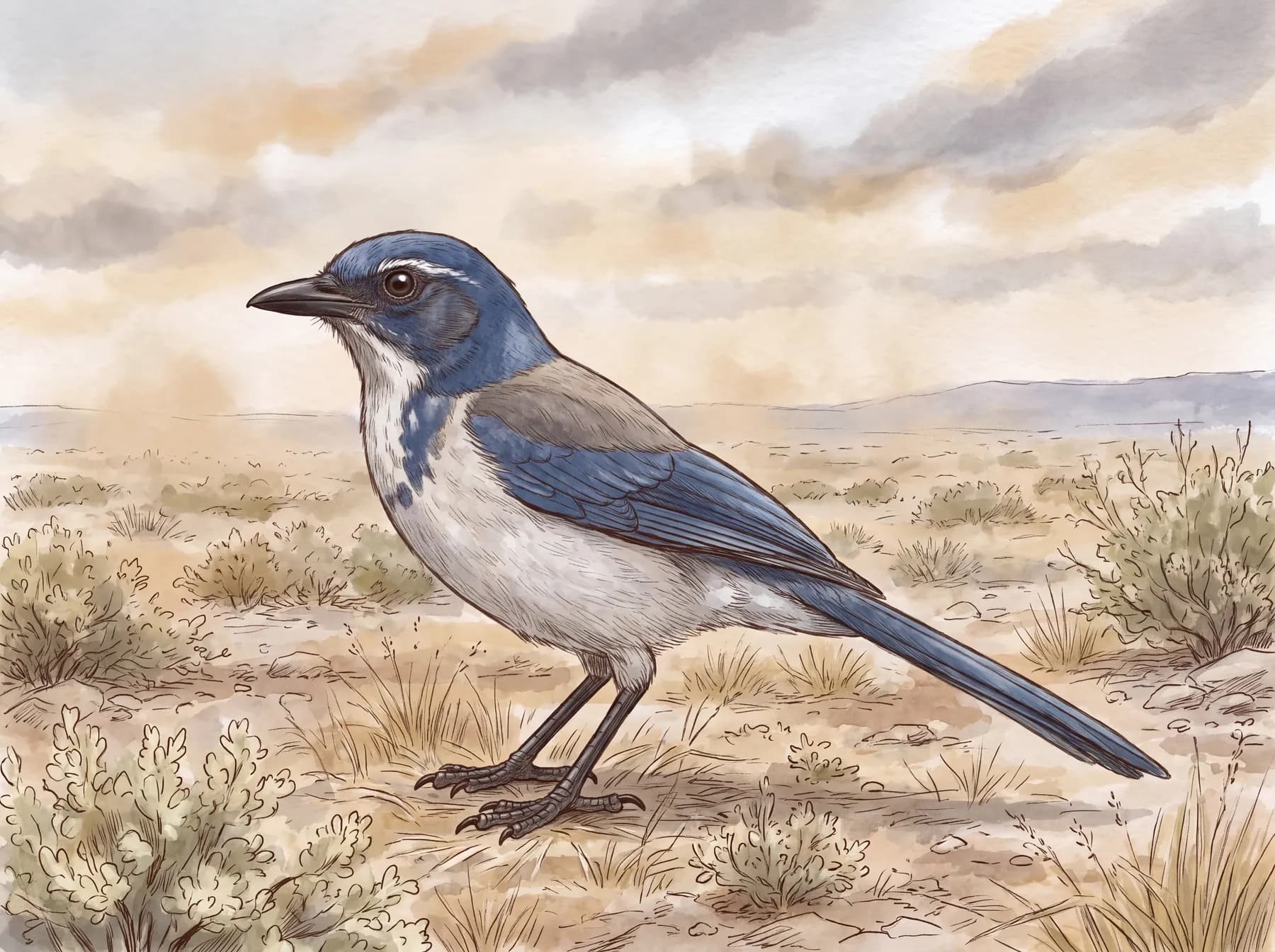
Nothing else in this guide is blue. That makes the identification question trivial and the interesting question something else entirely: what a pinyon-juniper bird was doing on a creosote bajada in August.
Woodhouse's scrub-jay belongs to the woodland. It is the interior bird of the pinyon and juniper country, oak scrub, canyon rims and the upper edge of the desert, and the published band for it runs roughly 4,000 to 7,000 feet. This ground sits at about 3,050. The bird was below its book, standing on the wrong plant community.
That is worth stating carefully, because the guide already carries a second bird in a similar position and the two cases are not the same. The curve-billed thrasher here is in the wrong desert at a perfectly ordinary height. This jay is in roughly the right country at the wrong height. Being outside a range map is not one condition. It is several, and they mean different things.
The likeliest explanation is movement rather than accident. Woodhouse's scrub-jay does not migrate. But birds without a territory, the ones that have not paired and settled, gather into flocks outside the breeding season and travel away from breeding habitat together, and a young jay drifting downhill onto open scrub is a coherent version of what was seen. That is a reading, not a documented pattern for this elevation, and it should be held loosely until a second sighting either supports it or does not.
Look for a long-tailed blue bird with no crest. The head, wings and tail are blue, the back carries a grey-brown patch between the shoulders, the underparts are pale, and a soft, blurry blue-grey band runs partway across the chest and does not close. It was called the Western scrub-jay until recently, when the coastal and interior birds were separated. The coastal one is now California scrub-jay. This is the other one.
Its real work is somewhere else. A scrub-jay caches food, scattering it across the territory in a great many separate hiding places and coming back for it later. The part that matters is what happens to the ones it does not come back for. A buried seed that is never retrieved is a planted seed, and over enough birds and enough years that is a woodland slowly moving itself around by being forgotten. The jays are not gardening. The junipers simply exploit their imperfect memory.
None of which happens here. There is no pinyon or juniper woodland on this ground for a jay to keep, and a bird on this bajada is not caching anything into a future stand of trees.
So the note to make is date and direction. If jays turn up in the cold months and are gone by spring, that is the downslope story showing itself. If one appears again in June, the map wants revising.