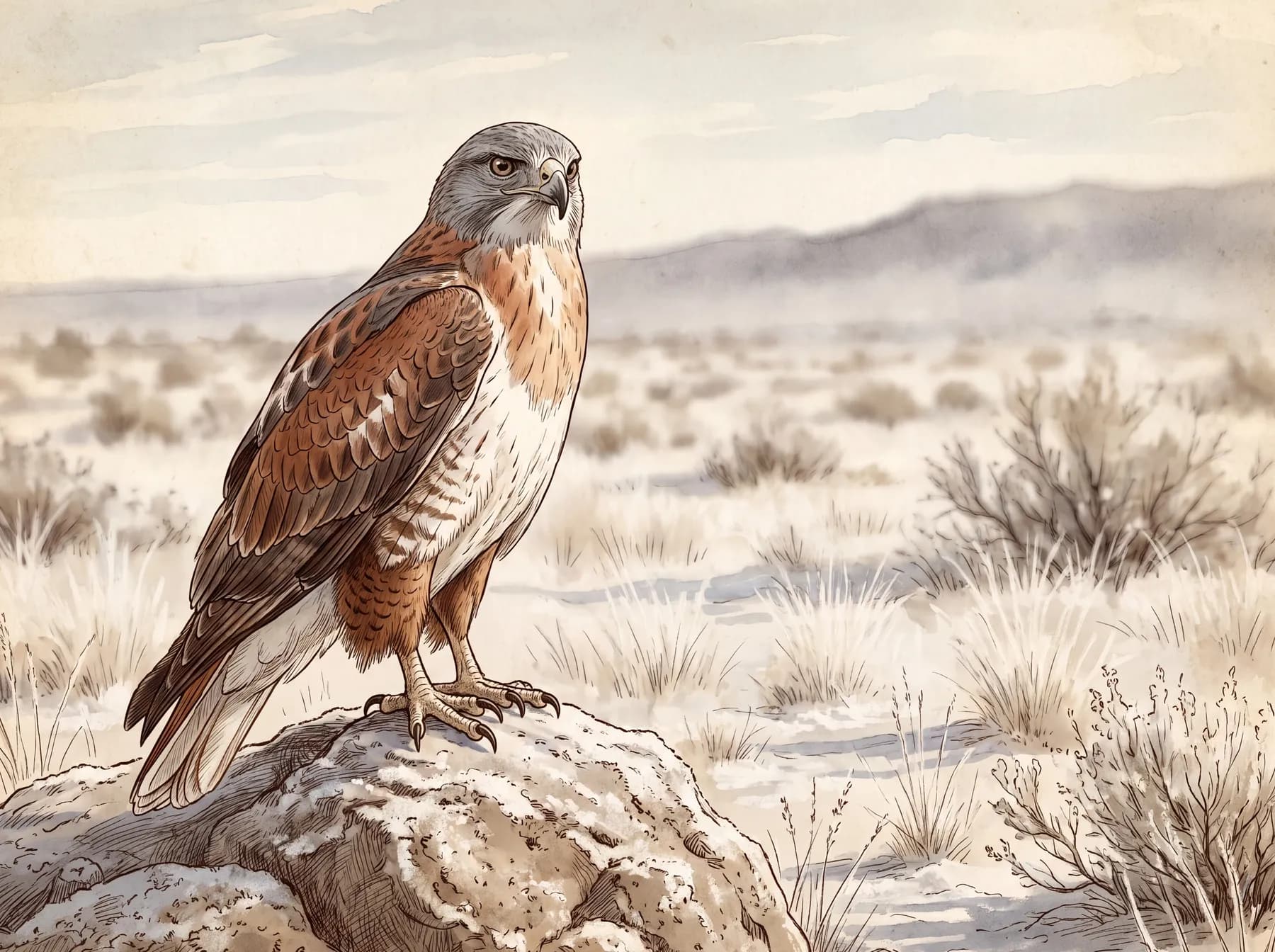
The largest hawk on the continent shows up on this ground only in the cold months, and it never stays to nest. Ferruginous hawks come down around October and are gone again by early March. That is worth sitting with, because everything about the bird argues for a resident. It has a wingspan close to a metre and a half, near-white underparts, and rust worked across the back and shoulders. It is the largest buteo in North America, one of the broad-winged soaring hawks, and at up to 4.5 pounds it outweighs the red-tailed hawk you see here all year. And still it is only a winter guest.
The reason is elevation and habitat, not temperature. It is tempting to assume the hawk drops in because the desert has finally cooled to something it can stand. The plainer answer is the true one. Ferruginous hawks breed north of here and higher up, in Arizona roughly between 4,700 and 6,400 feet, in high grassland and sagebrush country. This ground sits in the blackbrush and Joshua tree, well below that band and in the wrong plant community for nesting. So the bird that breeds in the cool high country moves down to lower, warmer ground for the winter, and this bajada is the lower, warmer ground. What looks like a hardy cold-weather specialist is really a bird coming downhill to wait out the season.
On its breeding grounds it hunts open country by sitting and waiting, taking a high perch or soaring low over the ground and then dropping onto jackrabbits, ground squirrels, and prairie dogs. That last prey points to something the bird carries with it. Before the bison were killed off the plains, ferruginous hawks often built their nests partly from bison bones and wool, worked in among the sticks. Their numbers still rise and fall with rodent colonies, and the loss of prairie-dog towns is part of why the breeding range in Arizona has shrunk. The hawk on this desert in January is, in a real sense, a visitor from a country that mostly does not exist anymore. None of that history happens on these flats. It explains where the bird comes from, not what it does here.
One piece of that build shows up close. The ferruginous hawk's legs are feathered the whole way down to the toes, like a golden eagle's, an open-country trait for the cold. Only three diurnal raptors in North America wear those full trousers: this hawk, the rough-legged hawk, and the golden eagle. On a big pale hawk perched on a post against a winter sky, the feathered legs are one of the surer marks.
None has crossed over this ground for us yet; the season and the open flats make it a bird to expect. In the air the mark is easy to catch. Those dark rufous legs, held back beneath the tail, close into a shallow V against the near-white belly. A large, pale hawk showing a rusty V overhead in December is very likely this one and not the red-tail working the same fence line.
Look up in the cold months for a near-white hawk too big for the red-tail, dragging a rusty V beneath it.