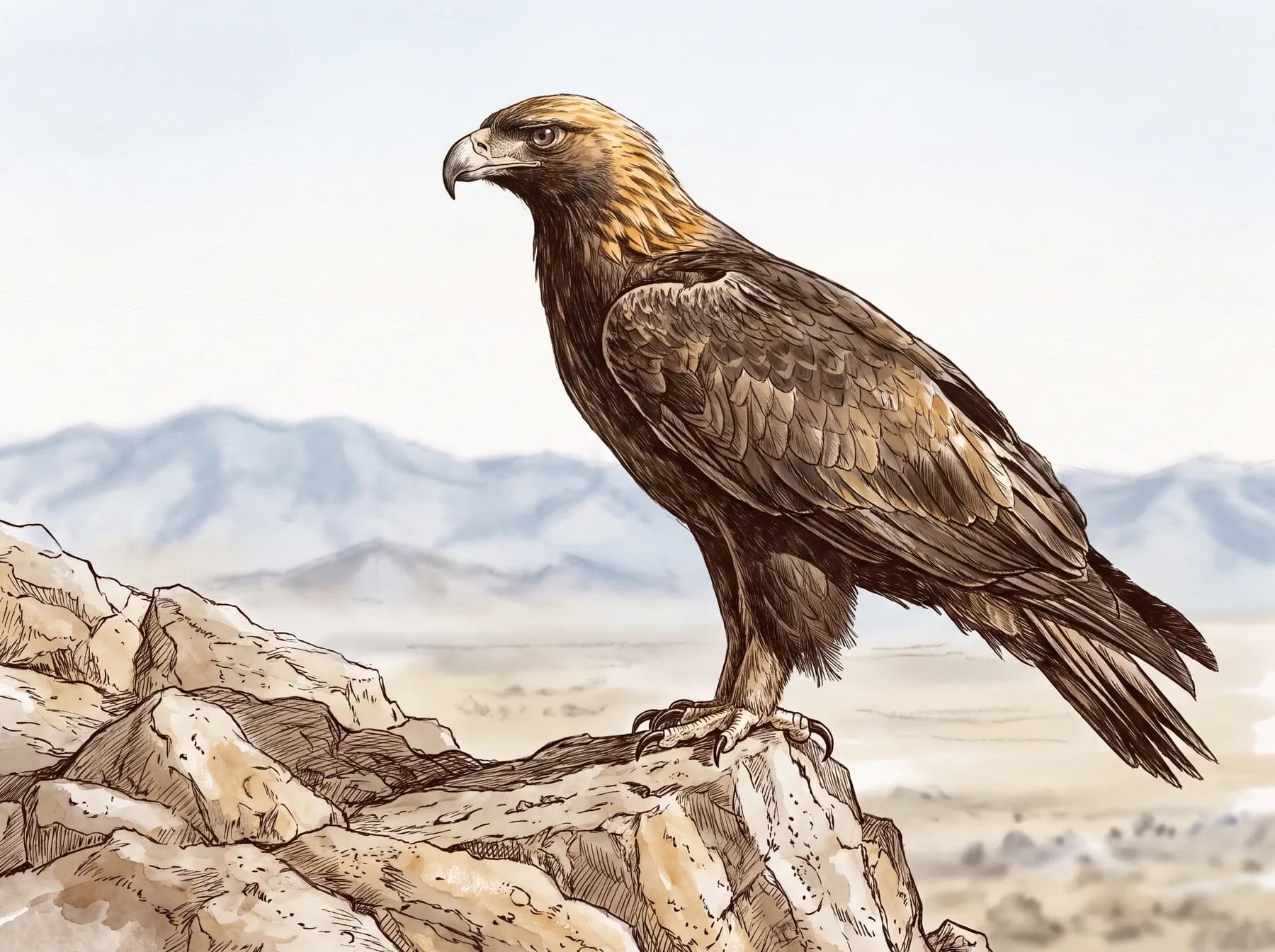
The one thing everybody knows about an eagle is the eyes, and most of what everybody knows is too generous. The reputation runs to many times a human's resolution, and some texts put it as high as ten times sharper than a person. When someone finally measured an eagle's eye, the figure came back at twice.
Two things temper even that. The eagle actually tested was not this one but a close relative, the wedge-tailed eagle, and no one has measured a golden eagle's eyesight directly, so twice is an inference across the family rather than a reading of this bird. The researcher who reviewed the result wrote that the eye out-performs a human's by a factor of two at best, and that the textbook figure of up to ten times overstates it. Twice sounds like a letdown until you ask what twice buys.
What it buys is the open ground in daylight. An eagle's sharpness is best in bright light and falls to about a third of its peak by sunset, so the bird is made for the glare of the afternoon, reading the desert floor for anything that moves. Here what moves is mostly one animal. In the Mojave, black-tailed jackrabbits come to about half of what golden eagles carry to the nest.
A desert this dry does not grow jackrabbits thickly, and that scarcity sets the scale of the bird. A single pair holds a fixed territory and returns to the same cliff nest for years, yet still has to range across an enormous amount of country to find enough hares, and researchers tie the outsized home ranges of Mojave eagles to exactly that poverty of prey. In the worst heat some of these desert birds move uphill to cooler, better-fed mountains and come back. The eagle is easily large enough to take a fox or a bobcat, but on this ground the staple is the hare.
One more inherited number is worth distrusting: the dive. You will read that a stooping golden eagle reaches some famous top speed, and if you hunt for the measurement behind it, there is none, because no instrument has ever been put on a wild eagle's stoop. The peregrine falcon's 242 miles an hour is real, clocked on a trained bird in a rigged dive. The eagle's figure is only ever a guess.
We have not seen one over this bajada yet. It is a big bird, six and a half feet across the wings and seven in a big female, and the one it is easiest to confuse with is a young bald eagle, which shows blotchy white through the wing and bare lower legs.
So check the legs on the next big eagle: feathered to the toes, the gold that names it worn at the nape.