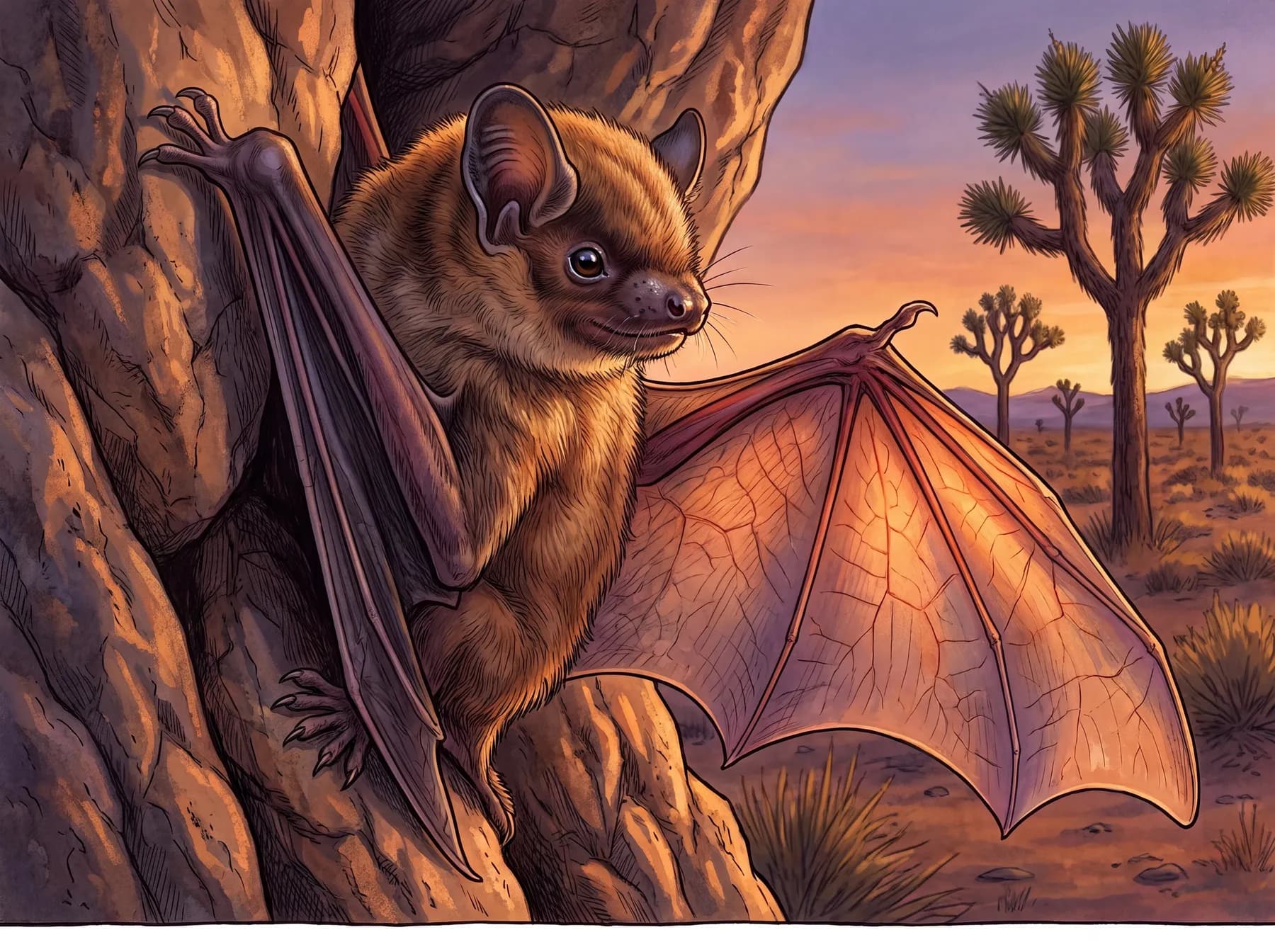
You will probably never know this bat when you meet it. Long after full dark, a small scrap of flight works low over a wash and close to the brush, slow and fluttery and erratic, never a fast straight line. That loose, moth-like flutter over cover is one of the few honest field marks the California myotis offers. Almost everything else about it resists a clean call.
It is one of the smallest bats here, though not the smallest; the canyon bat edges under it. The trouble is the company it keeps. On the wing it is very nearly impossible to separate from the other small Myotis bats, and especially from the western small-footed myotis, which shares its size, its coloring, and much of its ground. Even in the hand the marks are fine: dull, non-glossy brownish fur, short rounded dark ears, a forehead that rises steeply and abruptly from the muzzle, and feet that are notably small. Those small feet are the tell, but reading them means holding the animal, which almost never happens.
What it lacks in legibility it makes up in likelihood. It is one of the most common bats in desert scrub, and desert scrub like this is squarely the ground where it has been recorded in Mohave County. By day it roosts deep in the narrow dark the desert hands out for free: a rock crevice, the space under a slab of loose stone, the gap behind a curl of bark. It comes out to hunt well after dark, later than most people would keep watching.
None we've confirmed on this ground. With a bat this common and this hard to name, that is a detection problem, not an absence. The likeliest first proof is not a clean sighting but a flutter caught on a camera near the wash, or a detector's recording of its calls — and even then the honest result may get only as far as a small Myotis, with the last step of the naming left open.
So the useful move is to aim lower, at the group rather than the exact species. Watch the washes and the brush edges well after dark. Look for the smallest, slowest, most erratic flutterer working low over the ground, and be willing to call it a small Myotis, and most likely this one.
Late, low, and fluttering over the wash, too small to name.