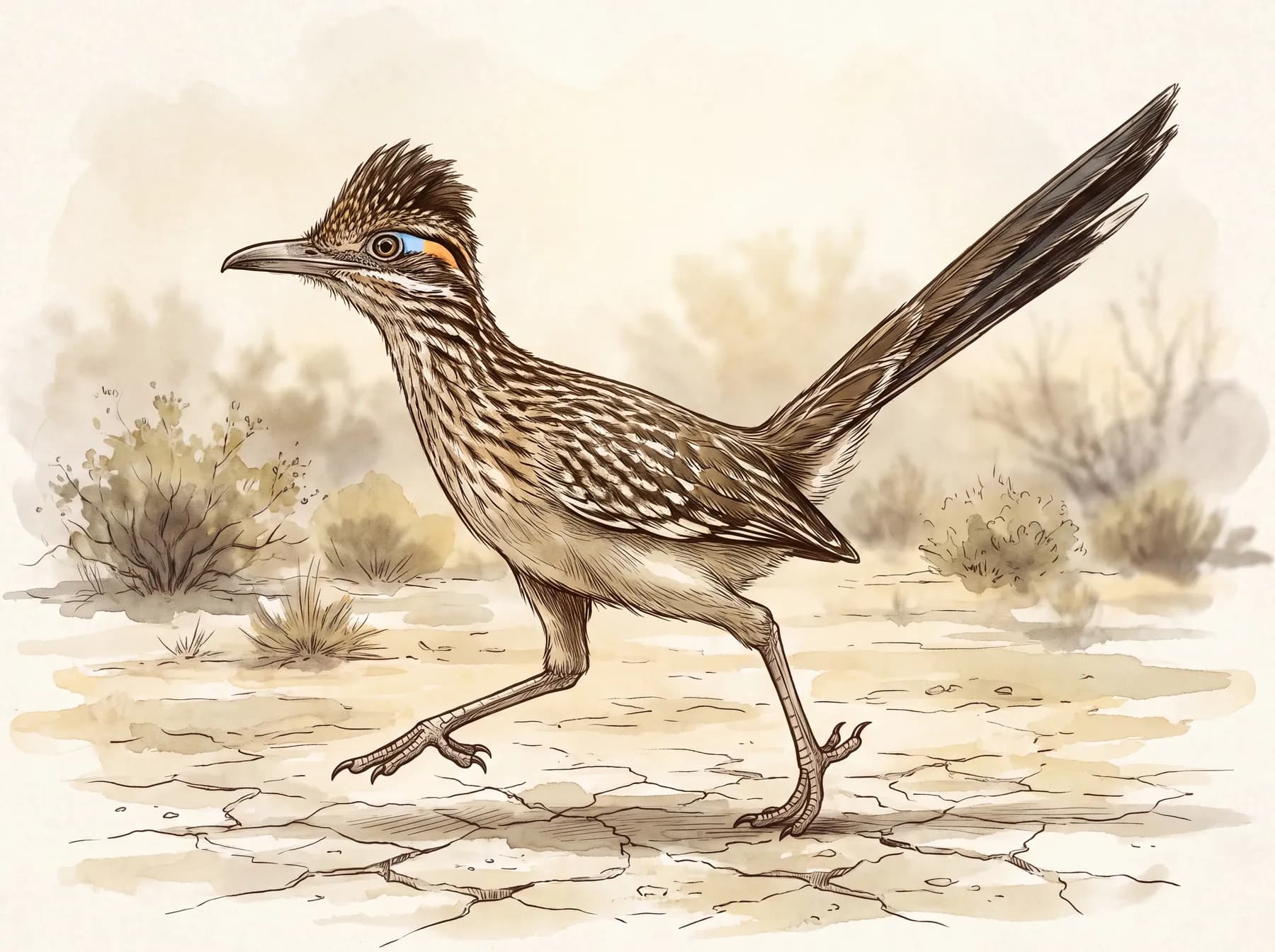
Most birds spend the desert night burning fuel to stay warm. The roadrunner does something closer to the opposite. On a cold night it lets its body temperature fall on purpose, a controlled hypothermia, and rides the shortage out at lower cost. Then at dawn it turns its back to the sun, raises the feathers between its shoulders, and reheats. Under that ridge of feathers lies a patch of bare black skin, and researchers who measured the trick found that sunning this way saved a bird roughly 550 calories an hour, enough to hold its resting metabolism steady while the air sat as cold as 9 degrees Celsius. The back is, in plain terms, a solar panel it unfolds at sunrise.
It can afford that partly because it has quit the expensive habit of flight. The roadrunner is a cuckoo, family Cuculidae, kin to the brood parasites that lay their eggs in other birds' nests, though this one builds and tends its own. It is made for the ground: long-legged, long-tailed, heavily streaked brown and white, with a shaggy crest and a bare patch of red and blue skin behind the eye. It still flies, but rarely and weakly, in short low glides, as though it treats the option as a last resort rather than a way to get anywhere. In this Joshua-tree and blackbrush country it is a permanent resident, here year round, not a bird passing through.
Staying is the hard part in a place this dry, and it keeps its water by two economies most birds lack. It runs a salt gland near the eye that sheds concentrated salt at something like six times what a kidney can reach, so it can dump salt without spending much water to do it. And it reabsorbs water from its own waste, pulling moisture back through the gut before the droppings leave. Between the two, it holds onto water a kidney alone would lose.
For food it runs down almost anything it can catch and beat: lizards, snakes, mice, young ground squirrels, small birds, and the armored things most animals leave alone — scorpions and tarantulas. Larger or dangerous prey it kills by battering against the ground or a rock. The one story everyone knows about it is mostly wrong. It carries a reputation as a rattlesnake-killer, sometimes said to hunt in pairs, one bird distracting while another strikes. Audubon says flatly that the prowess has been much exaggerated. It does eat snakes; the coordinated tag-team is folklore, not something anyone has shown.
It is fast on foot, though not as fast as the legend. The authoritative figure is about 15 miles an hour, with reports up to around 20; the higher numbers repeated everywhere are newspaper arithmetic, and against a coyote it loses. You may not have to chase it in any case. Unlike most desert birds, a roadrunner may walk toward you rather than away, closing the distance instead of keeping it. Not one we've met on our own ground.
Read the ground for its track: two toes forward, two back, printing an X that hides which way the bird was going.