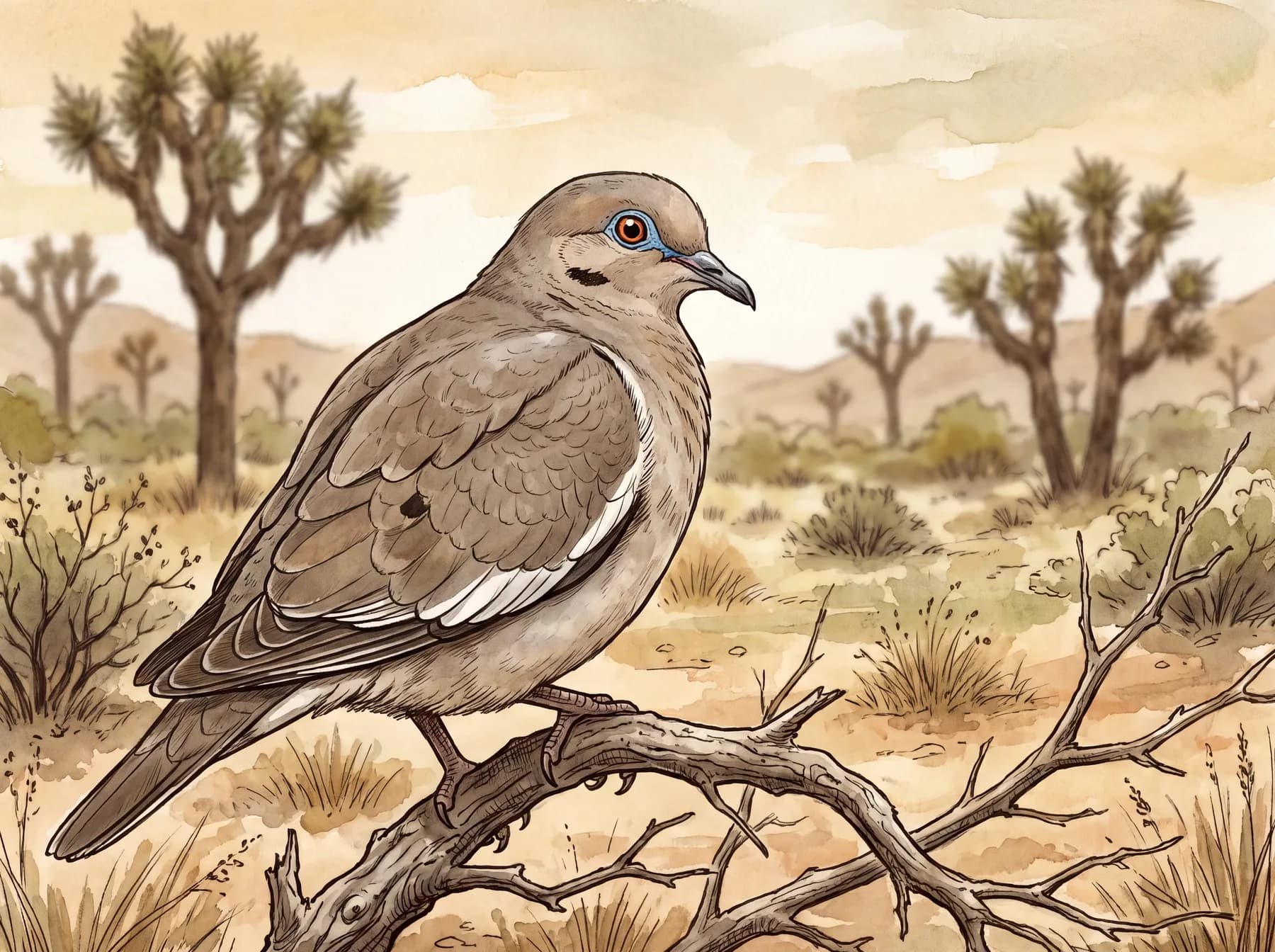
In the country where this dove is famous, it is very nearly made of one cactus. Where saguaro grows, crop and isotope studies by Wolf and Martinez del Rio found its fruit makes up about 50% of the white-winged dove's summer diet, and at the height of fruiting the cactus supplies more than 90% of the carbon in the bird's body. The dove drinks the flowers' nectar on the morning shift after the bats leave, carries the pollen as it goes, then eats the ripe fruit and moves the seed. Its breeding is even scheduled so the young are hungriest just as the fruit ripens.
None of that happens here. Saguaro is a Sonoran plant that gives out around 4,000 feet and never reaches the Mojave, so there is none on this bajada and none up the slope. That whole economy belongs to southern and central Arizona and the low ground along the lower Colorado River. Out on the blackbrush and Joshua-tree flats, the bird's famous story has been left in another desert, and the local one has to be built from what is actually here.
What is here is seed. Away from the cactus the white-winged dove is a plain seed-eater: mesquite and native seeds in wild desert, and around towns the developing seeds of Bermuda grass and other lawn and field plants. That is what one would be doing at this elevation, working seed heads and, in the heat, coming in to water and feeders. It is also near the edge of where it belongs. This is a Sonoran bird only recently and still uncommonly pushing north into the Mojave, mostly around lower, warmer ground than this. Up on this bench it is likelier a summer wanderer than a settled nester, and we would not assume it breeds here.
If it comes at all, it comes as a summer voice. The white-winged dove is not a resident. It arrives from Mexico in the second half of April, would breed between the middle of May and the middle of August, and is gone south again by about the middle of September, wintering in Mexico and the tropics beyond. The window to find one here is narrow and warm, a few months with an empty page on either side.
Learn the sound before that window opens. The call is a rolling, hooting who-cooks-for-you, and the odd part is real: who cooks for you is also the standard mnemonic for the barred owl, so you can hear your first white-winged dove and file it under owl. When you get eyes on it, one mark ends the argument with the mourning dove it otherwise resembles. Look for a narrow white stripe laid along the folded wing at rest; note also the orange-red eye in bare blue skin and the short rounded tail, where a mourning dove's tail is long and pointed.
In flight the stripe opens into a bold white crescent across the wing. No other dove here carries that bar.