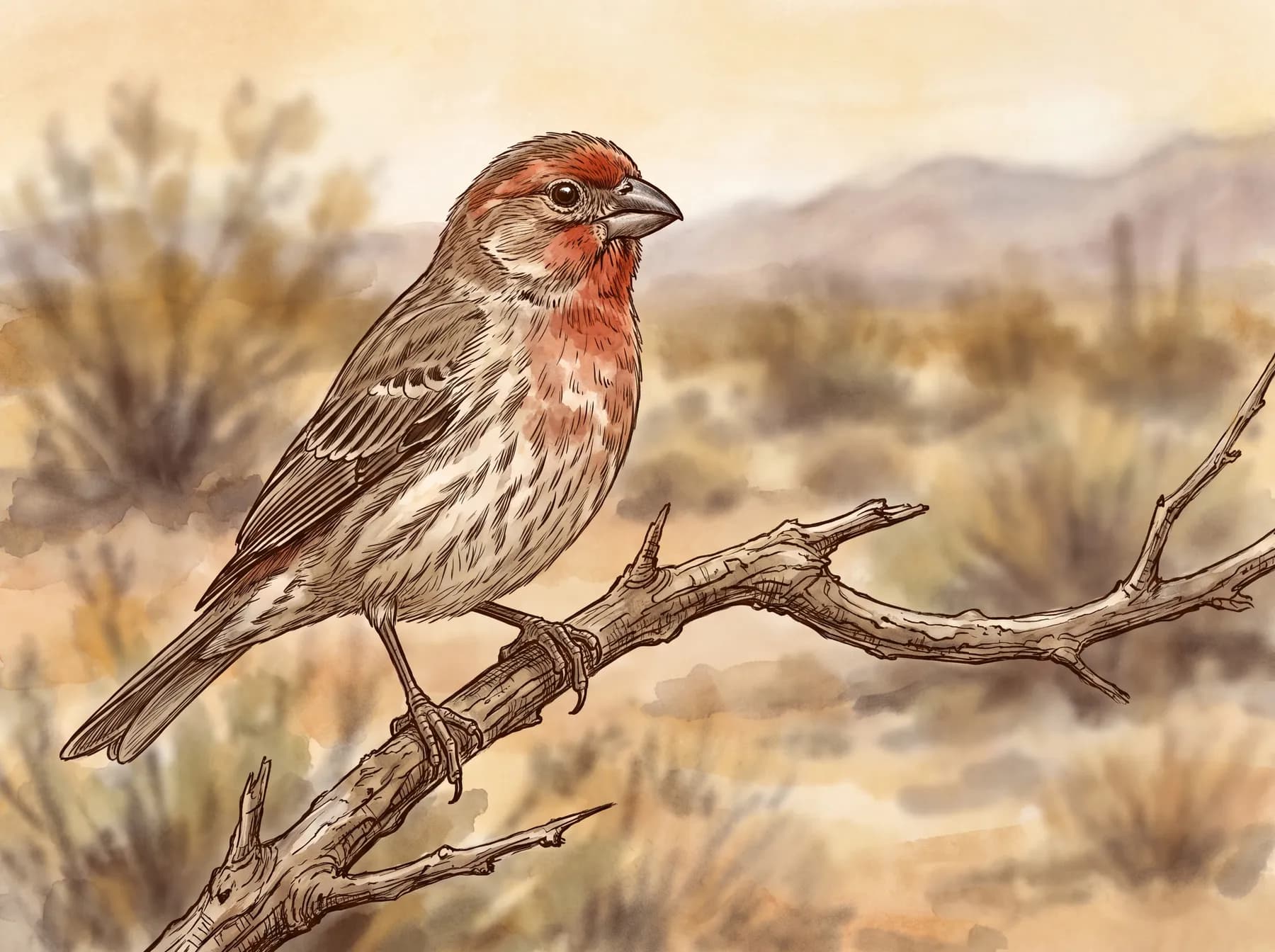
The red on a male house finch is not a fixed marking. It is food. Feed a molting male a diet stripped of the right pigment and he grows in pale yellow; give him one carotenoid and he comes out orange, another and he comes out bright red. The bird cannot manufacture the color at all. Every scarlet feather is pigment he ate while that feather was growing, which makes the red less a costume than a readout of how well he was feeding. He wears his harvest.
The females read it. In the study that founded this whole line of work, researchers brightened some males by hand and left others alone, and the brightened ones paired faster and more often. Among the untouched birds, the redder males proved the more attentive fathers and the likelier to last the winter. Given a choice, a female takes the reddest male available. The color is not a preference she happens to hold; it is the nearest thing she has to a record of his quality.
There is a catch worth holding onto. House finches grow a full set of feathers once a year, in the late-summer molt, a timing Cornell's ornithologists describe. Between molts the color is locked for the next year. A brilliant male in spring is not reporting how he is feeding now; he is wearing last autumn's foraging, a receipt from a season already closed. Why the receipt stays honest — why a poorly fed male cannot just grow in red and cheat — is still argued over. The current suspicion runs somewhere unexpected: the red pigments gather in the liver's mitochondria during the molt, and researchers have found feather redness tracking how well those mitochondria perform. If that holds, the color reports on the bird's cells and not only his dinner. It is a suspicion, not a settled fact.
None of this is a desert novelty borrowed from greener country. The house finch is a true native of the arid West, and out in the Joshua trees and blackbrush it is a permanent resident, not a seasonal guest. That matters, because the bird carries a famous origin story that runs backward here. Every house finch east of the Great Plains descends from cage birds: captured near Santa Barbara in 1939, sold illegally as "Hollywood finches," released on Long Island when the trade grew risky, and nesting wild by the early 1940s. The eastern population came out of the West. The birds on this bajada are the original wild stock, and nothing followed the settlers to reach them, because they were already here.
A few practical things follow from this. Because the red is dietary, it makes a poor field mark; some males wear orange or yellow instead, and the plain grayish-brown bird with blurry streaks and no red, the one you might overlook, is simply the female. The finch is a near-strict vegetarian, with seeds, buds, and fruit making up 97 percent of its year-round diet, and it feeds even its nestlings almost entirely on regurgitated seed. That dry diet leaves it thirsty; on a hot day a single bird can drink more than its own bodyweight in fluids, which is why it comes readily to water and feeders. The feeder is where the one real caution lives. A bacterial eye disease first seen at feeders near Washington in January 1994 spreads where birds crowd, and Cornell followed it through a survey that ran from 1994 to 2008. The answer is not to take it down but to keep it clean: scrub it with a 10 percent bleach solution, 1 part bleach to 9 parts water, and space feeders so the birds are not packed together.
Watch the birdbath on a hot afternoon. The first bird down, drinking more than it weighs, is very likely this one.