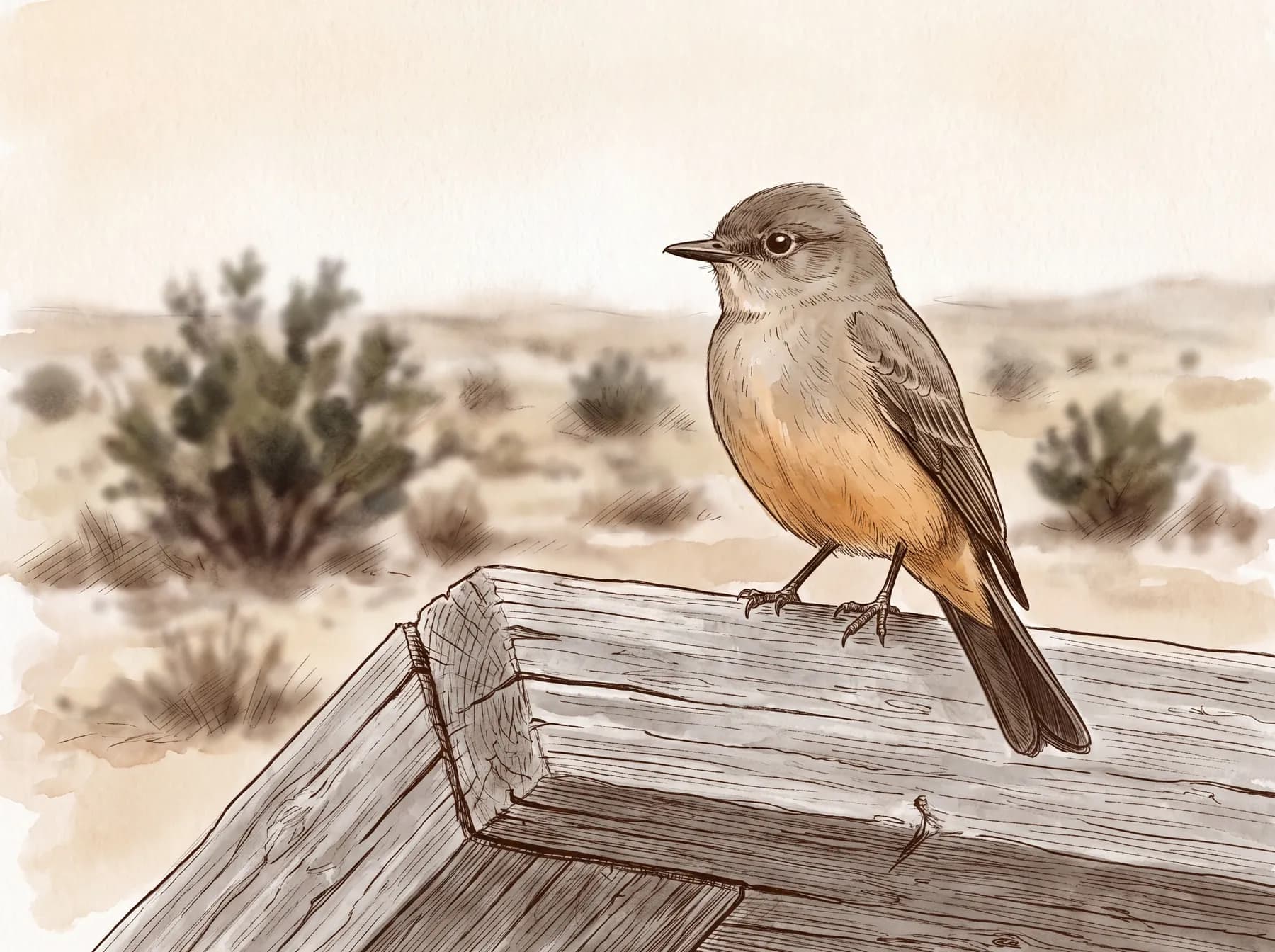
The other two phoebes are tied to water; Say's phoebe left all of that behind. It lives in very dry country, far from water, and the careful sources say it has no special attachment to the vicinity of water at all. On this bajada of blackbrush and Joshua tree, that difference is the whole reason it can be here while its cousins cannot.
On ground this arid, it makes a living the way its family does, only without the stream. It hunts by perch-and-sally, dropping from a low perch to snatch an insect in midair or to pounce on one crossing open ground, and it will hover low over the flat before falling on something below. The diet is almost entirely insects: beetles, grasshoppers, crickets, flies, and bees. Nothing on that menu needs a pond nearby.
What it needs instead has nothing to do with water. Say's phoebe nests on a sheltered ledge: a pocket in a cliff face, a cut in a dirt bank, the beam under a bridge, the inside of a well or a mine shaft, the eave of a building. Researchers who have looked at what these sites share put it plainly: the most important feature is shelter from above. By that measure a porch is a cliff. The bird will even move into another species' abandoned nest, a swallow's old nest, rather than start from nothing.
The courtship is a tour of exactly these spots. The male escorts the female from one possible site to the next, fluttering his wings and chattering at each until she settles on one to build in. The pair is loyal to the place if not provably to each other. One or both birds often return to the same territory year after year, sometimes reusing last season's nest, though whether it is with the same mate nobody has established.
That indifference to everything but a ledge is why the bird ranges as far as it does. Say's phoebe breeds farther north than any other North American flycatcher, holding one of the broadest latitudinal ranges in the family, from central Mexico up into arctic tundra, apparently limited mainly by where it can find somewhere to nest. It may, reportedly, follow the Trans-Alaska Pipeline farther north still and nest on the pipe itself, though that one is offered as a possibility rather than a settled fact.
Here in the high desert it should be a year-round resident rather than a summer bird that clears out for winter, allowing for some seasonal shuffling that is normal for the species. None on our list here yet. When you look, it is a soft dusty gray, plain across the head and back, 6.7 to 7.5 inches long, and the tell is the belly: a warm apricot-buff wash beneath a blackish tail. It does pump that tail, though less insistently than its streamside cousins do.
Look on the porch beams and along the bank of the wash for a gray bird with a sunburnt belly, sitting where the shelter is.