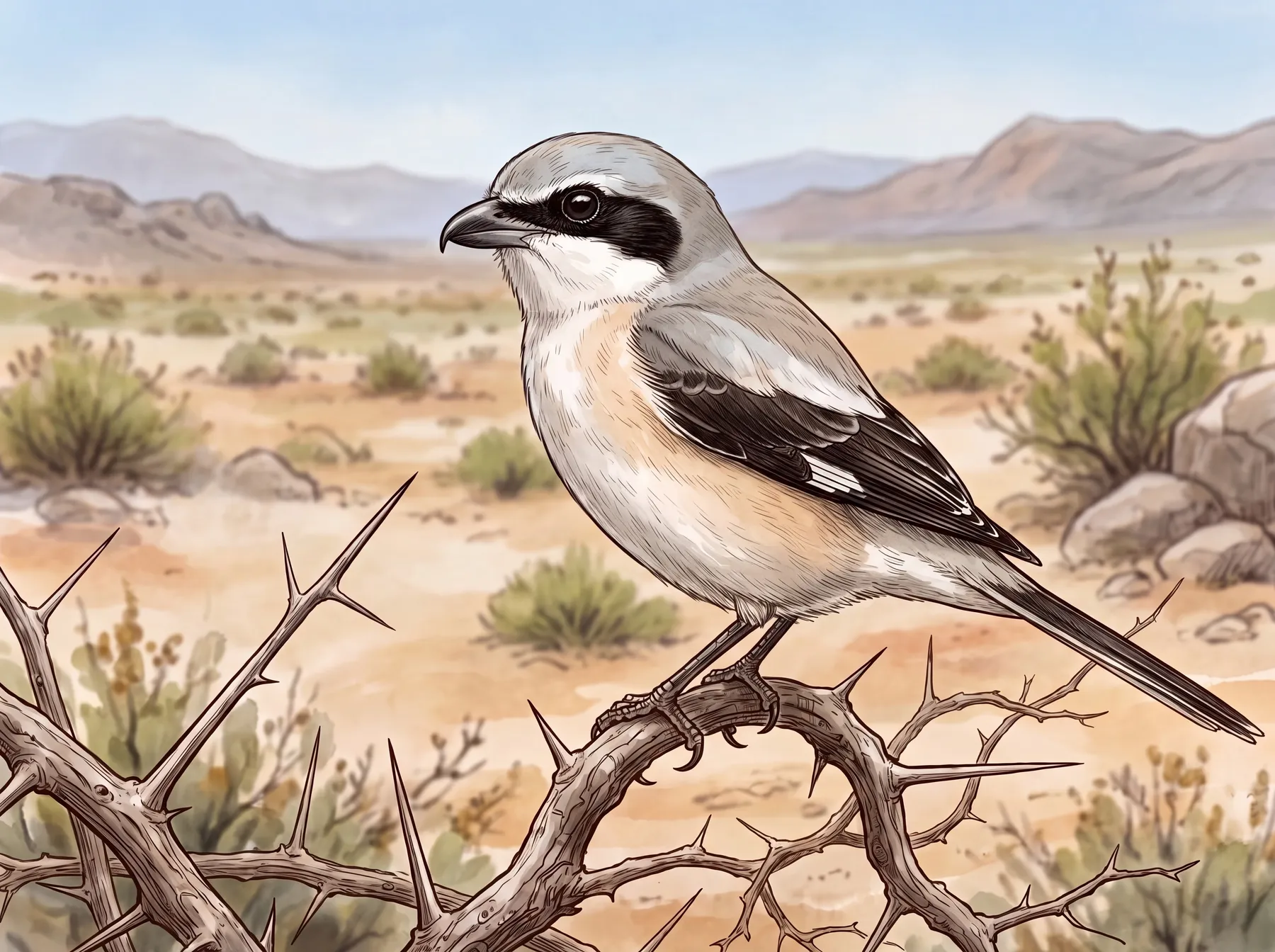
Find a grasshopper skewered on a blackbrush thorn, or a small lizard wedged onto a barb of fence wire, and you might assume something with talons put it there. Nothing here with talons did. The author is a gray, robin-sized songbird with a black mask and a hooked bill, a bird that has taken up a hawk's trade without a hawk's body. The whole interest of the loggerhead shrike is how it makes up the difference.
Start with the feet, because they are the problem the rest of the bird solves. A shrike's feet are an ordinary songbird's, made for perching and too weak to pin a carcass down and hold it while the bird tears off meat. A hawk clamps its kill in its talons and works at it; a shrike cannot. So it borrows a thorn. Impaling the body on a spine or a barbed-wire point does what a talon would: it anchors prey too large to hold, and it banks the surplus for lean days, which matters most in winter and to a male feeding a nest. The thorn is the talon it was never issued.
The kill works the same way, physics standing in for a grip. Clamping down with its bill, the shrike rolls its own head fast along its long axis, a whiplash twist that researchers using high-speed video measured at up to seventeen times a second, and slower than that on average, nearer eleven. That spin throws the prey's body around its own neck at roughly six times the force of gravity, inside the 2 to 12 g the same study records for a person in a low-speed rear-end car crash, hard enough to break the neck. Then the bill finishes the work. On its upper edge sits a tomial tooth, the same notch a falcon carries, and it severs the spinal cord.
The larder holds a stranger trick. Some shrikes impale toxic grasshoppers they cannot eat fresh and leave them a day or two; as the insect ages its defenses break down, and the bird returns to a meal that would have poisoned it on the day of the kill. That was worked out in Florida on one toxic species, so read it as something the bird knows, not a scene on this fence line. Stranger yet, a shrike impales its own nestlings' fecal sacs, where every other songbird carries them off and drops them clear. Nobody has established why.
It belongs on this bajada in both halves of the year. Here on the blackbrush bench, the loggerhead shrike is a year-round resident and breeder, and the local count swells in the cold months as northern birds move south. The open ground with scattered high perches is textbook shrike country: it watches from a height and drops onto beetles, lizards, mice, and other birds. At 8.3 to 9.4 inches it is robin-scale, not sparrow-scale, gray above and white below, its oversized blocky head the source of the name loggerhead.
Watch the high bare perches: a masked gray bird flashing a white wing patch as it drops is a hawk's work on a songbird's feet.