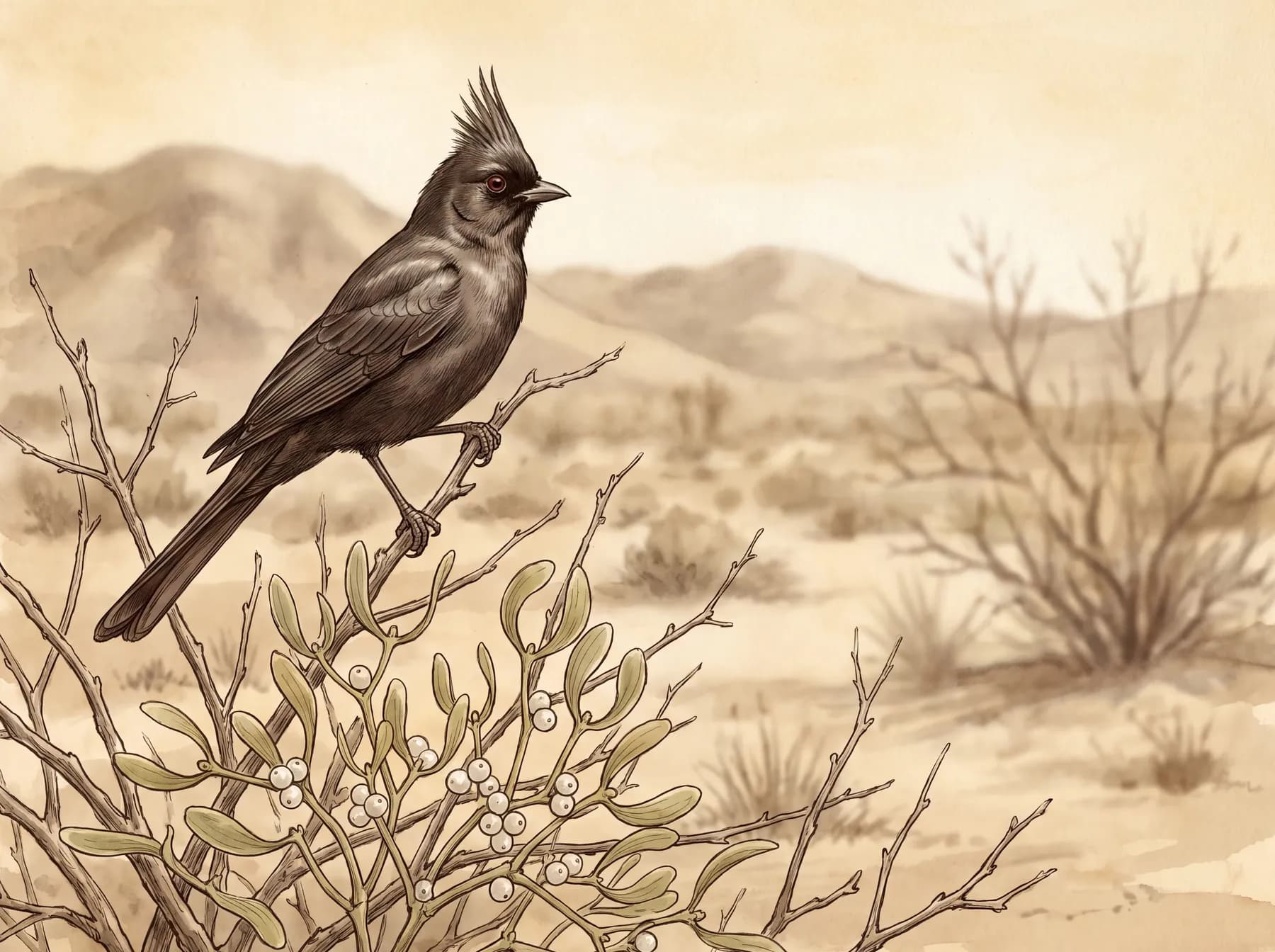
For half the year, this bird eats almost one thing. Of 46 Phainopeplas collected across the cold months, from the end of October into February, every one held desert mistletoe berries in its gut and nothing else — not mostly mistletoe, only mistletoe. It belongs to a bird you might otherwise pass over: a slim, crested, long-tailed thing sitting on the highest twig of a mesquite, guarding the clump of parasite growing in it.
The berry is a problem most birds would solve by grinding. A Phainopepla does the opposite. Its gizzard is small, roughly 1.5 percent of its body mass, thin-walled and weak where a seed-eater's is a muscular mill, and it takes the berries one at a time. Each berry, 3 to 5 millimeters across, gets squeezed so the seed and its slick pulp are pressed out of the skin and passed into the gut, while the emptied skin is held back. After a dozen to two dozen berries the bird voids the collected skins in a single wad, then goes back to swallowing. The whole passage, berry to droppings, runs 12 to 45 minutes, and a bird can move about 1,100 berries through itself in a day.
The same leaky gut plants the bird's food. The seed leaves still wrapped in viscin, a pulp sticky enough that the dropping does not fall clear but catches on the branch where it lands. There it germinates, sinks into the host, and grows into the next mistletoe. So the Phainopepla is the plant's main disperser, dropping seeds mostly onto the catclaw and mesquite down in the washes where the mistletoe already lives. It eats the parasite and, in the same motion, plants more of it.
None of this lasts the year, which is the odd part. The Phainopepla is here in the cool, wet months, keyed to when the mistletoe fruits, and it thins out as the desert heats through summer. When the berries run out and the bird turns to insects and other fruit, the gizzard it barely used all winter grows back: by August it runs about 2.2 times its December mass. Where the birds go is a real, century-old puzzle. Tracking has followed some desert breeders roughly 232 kilometers to cooler coastal woodland, with no genetic split between the two groups, though the researchers are careful to say the movement alone does not prove they nest a second time there. The tracking data cannot yet close it.
You will probably see the male first, sitting up high and glossy black, though folded at rest he looks plain black; the white patch in his wing shows only when he flies. The female is soft gray and easier to miss, except for the eye. Both sexes carry a startling red eye, and on the gray female it is the mark that catches you. One more oddity is filed where you will almost never meet it: seized by a hand or a hawk, a Phainopepla pours out loud imitations of other birds, and the borrowed alarm calls in a mob. No confirmation of our own to date here.
Look for a slim black bird on the highest twig, near mistletoe, showing white only when it drops into flight.