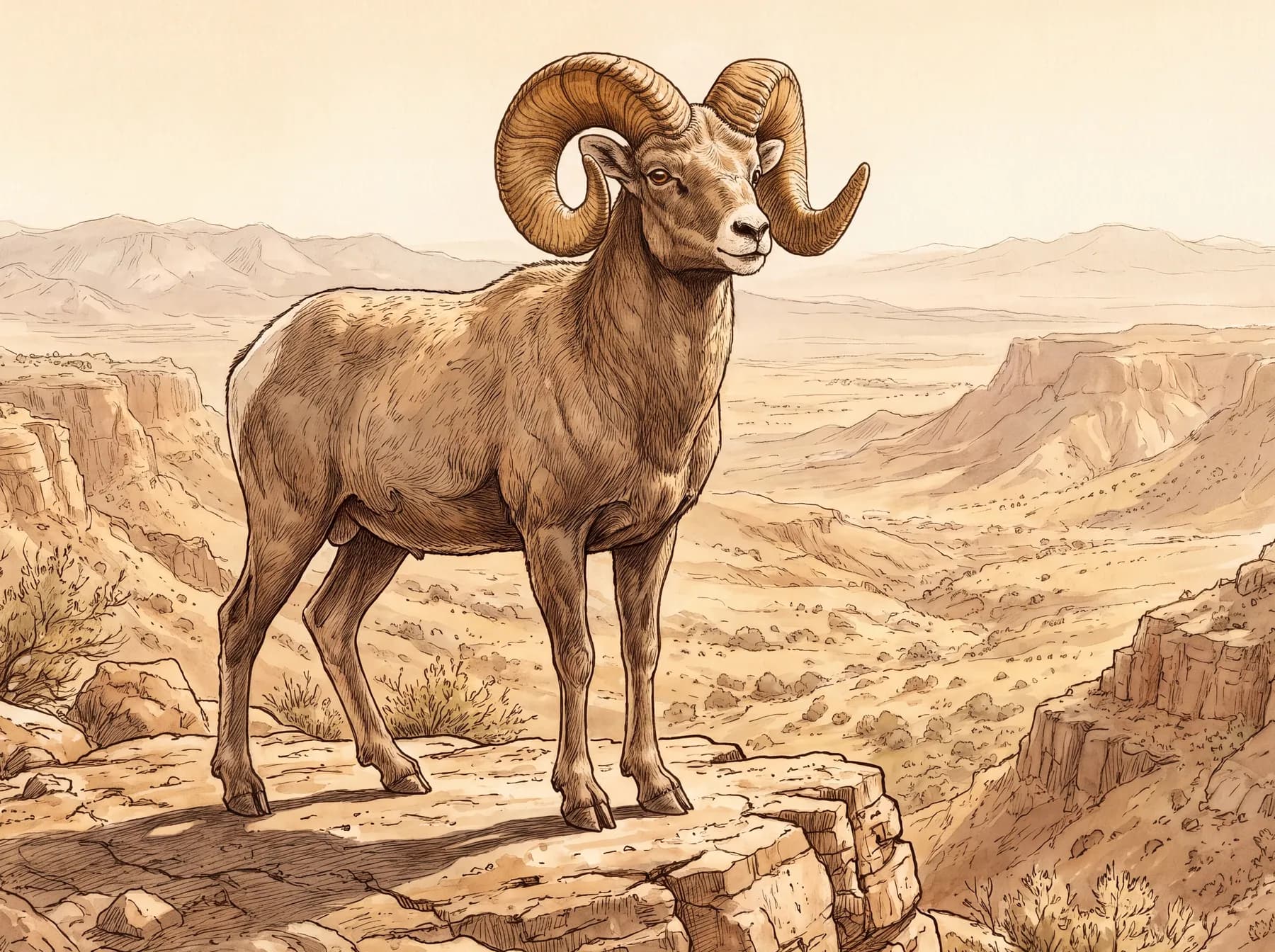
You will not find a bighorn in the yard, and that is the first honest thing to say about it. The animal belongs to the rock: the steep, broken slopes and cliffs of the ranges that stand above this bajada, not the open Joshua-tree and blackbrush flats below. Desert bighorn are escape-terrain animals. They hold to ground too sheer for most things to follow, and forage only a short way out from that cover, so the flats are a margin they cross, not a place they live. For a homestead at the base of the ranges, the plain verdict is that the sheep are up on the surrounding slopes, low in number and shy, not walking through the blackbrush.
What lets it own that ground is mostly underfoot. A bighorn's hoof is cloven, a hard sharp outer rim around a soft, concave center that grips rock like a suction cup. On that footing a sheep can stand on a ledge about 2 inches wide and leap gaps of up to 20 feet from one rock to the next. A ram is compact and heavily built, 115 to 280 pounds, made for balance on stone rather than speed on the flat, where it would lose. Its defense is not to outrun the mountain lion, its main predator, but to climb into terrain the lion will not follow. The steep, waterless country that makes life hard for everything else is the country it owns.
Water is the other reason it can live up there. For much of the cooler year a desert bighorn goes long stretches without drinking, pulling most of its water from the plants it eats and from rain caught in rock pools, and in the mildest seasons it can go weeks, even close to two months, without visiting open water. Its body is built for the shortfall: it can lose nearly a third of its weight to dehydration and recover, then drink back more than a fifth of its weight in a single visit. But that is a cool-season trick. In summer heat the sheep depend on free water and visit springs regularly, which is the correction to the tidy story that a desert bighorn never needs to drink.
This is core country for the animal. The desert bighorn of northwestern Arizona are Nelson's subspecies, and Mohave County sits well inside their established range. They are also a comeback. Arizona's desert bighorn fell to roughly 1,000 by the middle of the last century, and the state now holds over 5,600, rebuilt across decades by moving sheep into empty ranges, about 1,400 of them since 1955, and by building water catchments where the dry ground offered none.
We have not confirmed a bighorn from this ground, and you should not expect one to appear. But there is a real shot at glassing one. Work the high rocky slopes with binoculars on a clear, cool morning, when the sheep are up and moving before they bed on a vantage ledge through the midday heat. Read the horns to tell them apart: a ram carries a heavy curl that can top 30 pounds after eight years of growth, while a ewe wears a short, thin, only slightly curved horn that never closes the loop.
Watch the skyline of rock, not the flats. A shape that resolves into a curl of horn is the one you earned.